The The Role of Employee Experience in Moderating the Effects of Work Climate and Psychological Safety on Turnover Intention among Coffee Shop Employees in Sleman Regency
##plugins.themes.academic_pro.article.sidebar##
Downloads
##plugins.themes.academic_pro.article.main##
Abstract
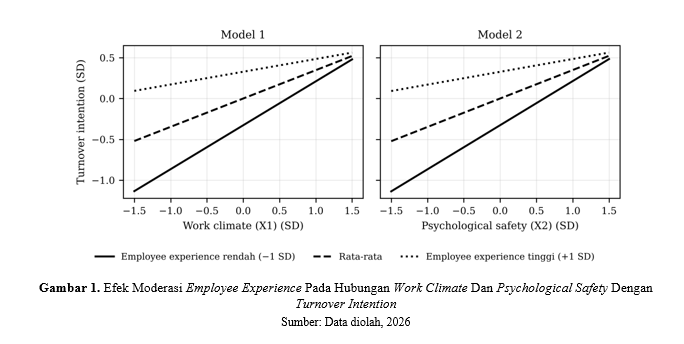
Tingginya turnover intention pada industri coffee shop dapat meningkatkan biaya rekrutmen dan menurunkan kualitas layanan. Penelitian ini bertujuan menganalisis pengaruh work climate dan psychological safety terhadap turnover intention, serta peran moderasi employee experience pada karyawan coffee shop di Kabupaten Sleman. Penelitian menggunakan pendekatan kuantitatif dengan melibatkan 140 responden yang dipilih melalui purposive sampling. Data dikumpulkan menggunakan kuesioner dan dianalisis dengan Partial Least Squares Structural Equation Modeling (PLS-SEM). Karena ditemukan masalah validitas diskriminan dan multikolinearitas antara work climate dan psychological safety, pengujian dilakukan menggunakan model terpisah dengan pendekatan two-stage untuk mengestimasi efek moderasi. Hasil penelitian menunjukkan bahwa kedua variabel berpengaruh signifikan positif terhadap turnover intention, berlawanan dengan hipotesis. Employee experience berpengaruh langsung terhadap turnover intention dan memperlemah pengaruh kedua variabel tersebut. Temuan ini menegaskan pentingnya pengembangan karier, peningkatan keterampilan, dan pemberian penghargaan untuk mempertahankan karyawan berpengalaman. Hasil penelitian perlu diinterpretasikan secara hati-hati karena keterbatasan sampel dan penggunaan data persepsi responden.
##plugins.themes.academic_pro.article.details##

This work is licensed under a Creative Commons Attribution-NonCommercial 4.0 International License.
LPPM Politeknik Piksi Ganesha Indonesia
References
Chao, H., Fanbo, M., & Patwary, A. K. (2024). Examining organizational commitment to environmental performances among hotel employees: The role of ethical leadership, psychological ownership and psychological empowerment. Sage Open, 14(2). https://doi.org/10.1177/21582440241255226
Clarke, E., & Näswall, K. (2026). Safe to stay: The role of leader behaviors and psychological safety in employee retention in high-demand workplaces. German Journal of Human Resource Management. https://doi.org/10.1177/23970022251337643
Cohen, J. (1988). Statistical power analysis for the behavioral sciences (2nd ed.). Lawrence Erlbaum Associates.
Cropanzano, R., Anthony, E. L., Daniels, S. R., & Hall, A. V. (2017). Social exchange theory: A critical review with theoretical remedies. Academy of Management Annals, 11(1), 479–516. https://doi.org/10.5465/annals.2015.0099
Edmondson, A. C., & Bransby, D. P. (2023). Psychological safety comes of age: Observed themes in an established literature. Annual Review of Organizational Psychology and Organizational Behavior, 10, 55–78.
Fornell, C., & Larcker, D. F. (1981). Evaluating structural equation models with unobservable variables and measurement error. Journal of Marketing Research, 18(1), 39–50. https://doi.org/10.1177/002224378101800104
Frazier, M. L., Fainshmidt, S., Klinger, R. L., Pezeshkan, A., & Vracheva, V. (2017). Psychological safety: A meta-analytic review and extension. Personnel Psychology, 70(1), 113–165. https://doi.org/10.1111/peps.12183
Hadi, S., & Nurdiyansyah, F. (2025). Strategi Pengembangan Sumber Daya Manusia Untuk Meningkatkan Kualitas Layanan di Loji Breakfast Banyuwangi. Jurnal Penelitian Ilmiah Multidisipliner, 2(04), 2026-2038. https://ojs.ruangpublikasi.com/index.php/jpim/article/view/1542
Hair, J. F., Risher, J. J., Sarstedt, M., & Ringle, C. M. (2019). When to use and how to report the results of PLS-SEM. European Business Review, 31(1), 2–24. https://doi.org/10.1108/EBR-11-2018-0203
Hair Jr, J. F., Matthews, L. M., Matthews, R. L., & Sarstedt, M. (2017). PLS-SEM or CB-SEM: Updated guidelines on which method to use. International Journal of Multivariate Data Analysis, 1(2), 107–123.
Harianjogja.com (2026) Usaha Kafe di Sleman Tercatat 205 pada 2026, Tertinggi dalam Enam Tahun https://jogjapolitan.harianjogja.com/r-1274971/usaha-kafe-di-sleman-tercatat-205-pada-2026-tertinggi-dalam-enam-tahun
Henseler, J., & Chin, W. W. (2010). A comparison of approaches for the analysis of interaction effects between latent variables using partial least squares path modeling. Structural Equation Modeling, 17(1), 82–109. https://doi.org/10.1080/10705510903439003
Henseler, J., Ringle, C. M., & Sarstedt, M. (2015). A new criterion for assessing discriminant validity in variance-based structural equation modeling. Journal of the Academy of Marketing Science, 43(1), 115–135. https://doi.org/10.1007/s11747-014-0403-8
Hom, P. W., Lee, T. W., Shaw, J. D., & Hausknecht, J. P. (2017). One hundred years of employee turnover theory and research. Journal of Applied Psychology, 102(3), 530–545. https://doi.org/10.1037/apl0000103
Ibrahim, A., Sopiawadi, M., G, E. A., Abdullah, I. M., H, M. R. S., & Julliana, W. (2026). Formulasi strategi bisnis UMKM kopi Qyanda Subang. Jurnal Penelitian Nusantara, 2(1), 259–271. https://doi.org/10.59435/menulis.v2i1.950
Itam, U., & Ghosh, N. (2020). Employee experience management: A new paradigm shift in HR thinking. International Journal of Human Capital and Information Technology Professionals, 11(2), 39–49. https://doi.org/10.4018/IJHCITP.2020040103
Jing, J., & Yan, J. (2022). Study on the effect of employees' perceived organizational support, psychological ownership, and turnover intention: A case of China's employee. International Journal of Environmental Research and Public Health, 19(10). https://doi.org/10.3390/ijerph19106016
Kolbe, M., Eppich, W., Rudolph, J., Meguerdichian, M., Catena, H., Cripps, A., … Cheng, A. (2020). Managing psychological safety in debriefings: A dynamic balancing act. BMJ Simulation & Technology Enhanced Learning, 6(3), 164–171. https://doi.org/10.1136/bmjstel-2019-000470
Kuenzi, M., & Schminke, M. (2009). Assembling fragments into a lens: A review, critique, and proposed research agenda for the organizational work climate literature. Journal of Management, 35(3), 634–717. https://doi.org/10.1177/0149206308330559
Lee, M., & Kim, B. (2023). Effect of employee experience on organizational commitment: Case of South Korea. Behavioral Sciences, 13(7), 521. https://doi.org/10.3390/bs13070521
Li, Y., Song, Y., Yang, Y., & Huan, T.-C. (2023). Exploring the influence of work values on millennial hospitality employees' turnover intentions: An empirical assessment. Current Issues in Tourism, 26(10), 1635–1651. https://doi.org/10.1080/13683500.2022.2062307
Lubis, R., & Fadhilah, R. (2026). Employee engagement as a psychological buffer in the relationship between abusive supervision and turnover intention. Jurnal Psikologi Tabularasa, 21(April), 16–32.
Mostafa, A. M. S., Bottomley, P., Gould‐Williams, J., Abouarghoub, W., & Lythreatis, S. (2019). High‐commitment human resource practices and employee outcomes: The contingent role of organisational identification. Human Resource Management Journal, 29(4), 620–636. https://doi.org/10.1111/1748-8583.12248
Nelson, A., & Setyawan, A. (2025). Bagaimana psychological impact memengaruhi turnover intention? Peran mediasi perceived organizational support dan work… Jurnal Manajemen Terapan dan Keuangan (Mankeu), 14(01), 275–289.
Newman, A., Donohue, R., & Eva, N. (2017). Psychological safety: A systematic review of the literature. Human Resource Management Review, 27(3), 521–535. https://doi.org/10.1016/j.hrmr.2017.01.001
Oktay, G. C., & Celiker, N. (2020). Examining the relationship between organizational commitment and turnover intention via a meta-analysis. International Journal of Culture, Tourism and Hospitality Research, 14(1), 102–120. https://doi.org/10.1108/IJCTHR-05-2019-0094
Plaskoff, J. (2017). Employee experience: The new human resource management approach. Strategic HR Review, 16(3), 136–141. https://doi.org/10.1108/SHR-12-2016-0108
Podsakoff, P. M., MacKenzie, S. B., Lee, J.-Y., & Podsakoff, N. P. (2003). Common method biases in behavioral research: A critical review of the literature and recommended remedies. Journal of Applied Psychology, 88(5), 879–903. https://doi.org/10.1037/0021-9010.88.5.879
Pratiwi, P. S., Abdullah, W., & Ahmad, W. (2026). Pengaruh hard skill dan soft skill terhadap kinerja pegawai dengan work experience. Study of Scientific and Behavioral Management (SSBM), 7(1), 67–77.
Ringle, C. M., Wende, S., & Becker, J.-M. (2015). SmartPLS 3. SmartPLS GmbH. http://www.smartpls.com
Rofiqoh, I., & Zulhawati, Z. (2020). Metode penelitian kuantitatif, kualitatif dan campuran. Pustaka Pelajar.
Soni, K., Chawla, R., & Sengar, R. (2017). Relationship between job satisfaction and employee experience. Journal of General Management Research, 4(2), 41.
Sugiyono. (2017). Metode penelitian kuantitatif, kualitatif, dan R&D. Alfabeta.
Tucker, E. (2020). Driving engagement with the employee experience. Strategic HR Review, 19(4), 183–187. https://doi.org/10.1108/SHR-03-2020-0023
Widodo, W. I., & Anggraini, F. D. (2024). Partisipasi Coffee Shop sebagai Ruang Kreatif dalam Mendorong Pariwisata Budaya di Yogyakarta. Mabha Jurnal, 5(2), 96-108.