Pengaruh Skill Variety, Task Identity, dan Servant Leadership terhadap Turnover Intention: Peran Moderasi Locus of Control
##plugins.themes.academic_pro.article.sidebar##
Downloads
##plugins.themes.academic_pro.article.main##
Abstract
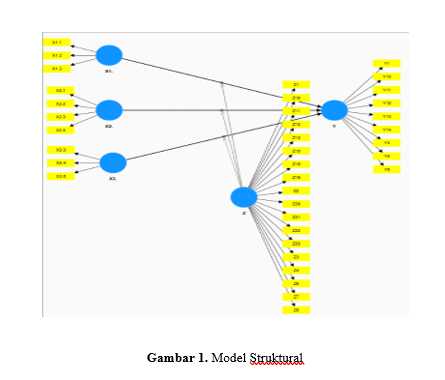
Turnover intention menjadi salah satu perhatian dalam pengelolaan sumber daya manusia karena berkaitan dengan keputusan karyawan untuk meninggalkan organisasi yang dapat memengaruhi keberlangsungan perusahaan. Penelitian ini bertujuan menganalisis pengaruh Skill Variety, Task Identity, dan Servant Leadership terhadap Turnover Intention serta menguji peran Locus of Control sebagai variabel moderasi pada karyawan PT. Sandang Asia Maju Abadi. Penelitian ini menggunakan pendekatan kuantitatif dengan melibatkan 158 responden yang dipilih melalui teknik purposive sampling. Data dianalisis menggunakan metode Partial Least Square Structural Equation Modeling (PLS-SEM) dengan bantuan SmartPLS 4. Hasil penelitian menunjukkan bahwa Skill Variety dan Task Identity berpengaruh positif dan signifikan terhadap Turnover Intention, sedangkan Servant Leadership tidak berpengaruh signifikan. Locus of Control mampu memoderasi hubungan Skill Variety dan Task Identity terhadap Turnover Intention, namun tidak memoderasi hubungan Servant Leadership terhadap Turnover Intention.
##plugins.themes.academic_pro.article.details##

This work is licensed under a Creative Commons Attribution-NonCommercial 4.0 International License.
LPPM Politeknik Piksi Ganesha Indonesia
References
Atikah Haasyimiyah, S. (2025). The Influence Of Self-Efficacy, Locus Of Control, Quality Of Work Life On Employee Performance. Journal of Sharia Economics (IIJSE) E, 8(3), 13654–13662.
Authors, F. (2015). Journal of Chinese Human Resource Management Article information : Journal of Chinese Human Resource Management, Vol. 6 Iss(1).
Bae, M. N., Cho, S. E., Ryu, J. H., Kim, M. H., Jeon, H. J., Shin, E. J., Lee, S. A., Hwang, T. Y., & Kang, S. G. (2022). Psychiatric and Psychosocial Factors of Suicide Decedents and Survivor of Suicide Loss: Psychological Autopsy Study of Incheon City in South Korea. International Journal of Environmental Research and Public Health, 19(13). https://doi.org/10.3390/ijerph19137895
Chen, X., Al Mamun, A., Hussain, W. M. H. W., Jingzu, G., Yang, Q., & Al Shami, S. S. A. (2023). Envisaging the job satisfaction and turnover intention among the young workforce: Evidence from an emerging economy. PLoS ONE, 18(6 JUNE), 1–21. https://doi.org/10.1371/journal.pone.0287284
Com, D. (2008). Organisational Culture Of Hospitals To Predict Turnover Intentions Prof G Roodt Background And Problem State- Ment Organisational Culture. 13(1), 63–78.
Cotič, L. P., Man, M. M. K., Soga, L. R., Konstantopoulou, A., & Lodorfos, G. (2025). Job Characteristics for Work Engagement: Autonomy, Feedback, Skill Variety, Task Identity, and Task Significance. Global Business and Organizational Excellence , 44(5), 75–85. https://doi.org/10.1002/joe.22295
Dewi, R., Mansyur, A., & Semarang, U. S. (2022). Turnover Intention : Effect Of Leadership Style And Reward. Jurnal Ekonomi, 11(03), 278–288.
Grobler, A., & Flotman, A. P. (2020). The validation of the servant leadership scale. SA Journal of Industrial Psychology, 46, 1–12. https://doi.org/10.4102/SAJIP.V46I0.1754
Groza, M. P., & Groza, M. D. (2022). Enhancing Volunteer Pride and Retention Rates: The Role of Organizational Reputation, Task Significance, and Skill Variety. Journal of Nonprofit and Public Sector Marketing, 34(3), 351–370. https://doi.org/10.1080/10495142.2021.1926043
Hair, J. F., Black, W. C., Babin, B. J., & Anderson, R. E. (2019). Multivariate Data Analysis Eighth Edition.
Hall, E. (2001). Feelings about drug use: Drug-related locus of control. Criminal Justice Research Group Integrated Substance Abuse Programs, 1–22.
Komatsubara, K., Keeley, A. R., & Managi, S. (2023). Revisiting the Value of Various Ecosystems: Considering Spatiality and Disaster Concern. Sustainability (Switzerland), 15(4). https://doi.org/10.3390/su15043154
Le, G. H. K., & Vo, P. H. (2024). The relationships between servant leadership, job embeddedness, and turnover intention of information technology employees. Ho Chi Minh City Open University Journal of Science - Economics and Business Administration, 14(4), 140–156. https://doi.org/10.46223/hcmcoujs.econ.en.14.4.2859.2024
Liden, R. C., Wayne, S. J., Zhao, H., & Henderson, D. (2008). Servant leadership: Development of a multidimensional measure and multi-level assessment. Leadership Quarterly, 19(2), 161–177. https://doi.org/10.1016/j.leaqua.2008.01.006
Long, C. S., Thean, L. Y., Khairuzzaman, W., Ismail, W., & Jusoh, A. (2012). Leadership Styles and Employees ’ Turnover Intention : Exploratory Study of Academic Staff in a Malaysian College. 19(4), 575–581. https://doi.org/10.5829/idosi.wasj.2012.19.04.155
Mahmoud, A. B., Reisel, W. D., Fuxman, L., & Hack-Polay, D. (2022). Locus of control as a moderator of the effects of COVID-19 perceptions on job insecurity, psychosocial, organisational, and job outcomes for MENA region hospitality employees. European Management Review, 19(2), 313–332. https://doi.org/10.1111/emre.12494
Massop, I. M. (Iris). (n.d.). LIVING ONE’S CALLING: THE ROLE OF SKILL VARIETY AND TASK IDENTITY.
Morgeson, F. P., & Humphrey, S. E. (2006). The Work Design Questionnaire (WDQ): Developing and validating a comprehensive measure for assessing job design and the nature of work. Journal of Applied Psychology, 91(6), 1321–1339. https://doi.org/10.1037/0021-9010.91.6.1321
Muharraq, E. H. Al, Alallah, S. M., & Baker, O. G. (2022). The Prevalence and The Relationship of Workplace Bullying and Nurses Turnover Intentions : A Cross Sectional Study. https://doi.org/10.1177/23779608221074655
Pamungkas, G. B., & Sulistyo, H. (2020). Peran Organizational Justice Dan Spiritual Management Terhadap Employee Engagement Dan Turnover Intention Dengan Dimoderasi Locus of Control. JBTI : Jurnal Bisnis Teori Dan Implementasi, 11(2), 166–181. https://doi.org/10.18196/bti.112138
Pro, D., Interdisipliner, J., & Syariah, E. (2025). Kata kunci: 8(3).
Resga, A., & Nurhasanah, N. (2025). Pengaruh Servant Leadership terhadap Perceived Organizational Support, Job Embeddedness, Job Satisfaction, dan Turnover Intentions pada Bank Swasta di Jakarta Barat. Kompak :Jurnal Ilmiah Komputerisasi Akuntansi, 18(2), 550–562. https://doi.org/10.51903/kompak.v18i2.3043
Sami, A. A., & Iqbal, D. A. (2024). The Impact Of Job Characteristics On Employee Turnover Intention Through Psychological Contract In The Pharmaceutical Industry Of Pakistan. Migration Letters, 21(S14), 325–350. https://doi.org/10.59670/ml.v21is14.11210
Suárez-Álvarez, J., Pedrosa, I., García-Cueto, E., & Muñiz, J. (2016). Locus of Control revisited: Development of a new bi-dimensional measure. Anales de Psicología, 32(2), 578. https://doi.org/10.6018/analesps.32.2.200781
Zaniboni, S., Truxillo, D. M., & Fraccaroli, F. (2013). Differential effects of task variety and skill variety on burnout and turnover intentions for older and younger workers. European Journal of Work and Organizational Psychology, 22(3), 306–317. https://doi.org/10.1080/1359432X.2013.782288