Pengaruh Authentic Leadership dan Emotional Engagement terhadap Quality of Work Life Petugas Penyelenggara Pemilu dengan Job Satisfaction Sebagai Variabel Mediasi
##plugins.themes.academic_pro.article.sidebar##
Downloads
##plugins.themes.academic_pro.article.main##
Abstract
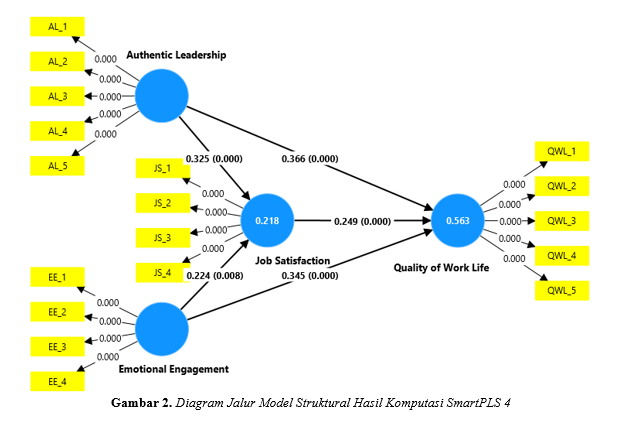
Penelitian ini bertujuan menganalisis pengaruh Authentic Leadership Pimpinan KPU dan Emotional Engagement terhadap Quality of Work Life petugas panitia pemilihan kecamatan, baik secara langsung maupun tidak langsung melalui Job Satisfaction sebagai variabel mediator. Data primer yang diperoleh melalui kuesioner terhadap 130 petugas panitia pemilihan kecamatan dianalisis menggunakan SEM-PLS. Hasil pengujian membuktikan bahwa Authentic Leadership Pimpinan KPU dan Emotional Engagement berpengaruh positif signifikan terhadap Quality of Work Life. Pengujian efek tidak langsung mengonfirmasi bahwa Job Satisfaction bertindak sebagai partial mediation yang mengakselerasi dampak positif kepemimpinan institusional terhadap kualitas kehidupan kerja petugas. Simpulan riset menegaskan bahwa perlindungan kesejahteraan panitia pemilihan kecamatan memerlukan integrasi kokoh antara integritas kepemimpinan autentik dan pemenuhan faktor hygiene ekstrinsik pada lokasi operasional nyata.
##plugins.themes.academic_pro.article.details##

This work is licensed under a Creative Commons Attribution-NonCommercial 4.0 International License.
LPPM Politeknik Piksi Ganesha Indonesia
References
Ayça, B. (2023). Association between Authentic Leadership and Job Performance—The Moderating Roles of Trust in the Supervisor and Trust in the Organization: The Example of Türkiye. Sustainability, 15(8), 6539. https://doi.org/10.3390/su15086539
Bakker, A. B., & Albrecht, S. (2018). Work engagement: current trends. Career Development International, 23(1), 4–11. https://doi.org/10.1108/CDI-11-2017-0207
Bakker, A. B., Demerouti, E., & Sanz-Vergel, A. (2023). Job Demands–Resources Theory: Ten Years Later. Annual Review of Organizational Psychology and Organizational Behavior, 10(1), 25–53. https://doi.org/10.1146/annurev-orgpsych-120920-053933
Bakker, A. B., Demerouti, E., & Sanz-Vergel, A. I. (2014). Burnout and Work Engagement: The JD–R Approach. Annual Review of Organizational Psychology and Organizational Behavior, 1(1), 389–411. https://doi.org/10.1146/annurev-orgpsych-031413-091235
Demerouti, E., Bakker, A. B., Nachreiner, F., & Schaufeli, W. B. (2001). The job demands-resources model of burnout. Journal of Applied Psychology, 86(3), 499–512. https://doi.org/10.1037/0021-9010.86.3.499
Dobnik, M., & Lorber, M. (2023). Management Support for Healthcare Workers’ Mental Health and Burnout during the COVID-19 Pandemic: A Cohort Study. Sustainability, 15(17), 12766. https://doi.org/10.3390/su151712766
Hair, J. F., Risher, J. J., Sarstedt, M., & Ringle, C. M. (2019). When to use and how to report the results of PLS-SEM. European Business Review, 31(1), 2–24. https://doi.org/10.1108/EBR-11-2018-0203
Halbesleben, J. R. B., Harvey, J., & Bolino, M. C. (2009). Too engaged? A conservation of resources view of the relationship between work engagement and work interference with family. Journal of Applied Psychology, 94(6), 1452–1465. https://doi.org/10.1037/a0017595
Hünefeld, L., Gerstenberg, S., & Hüffmeier, J. (2020). Job satisfaction and mental health of temporary agency workers in Europe: a systematic review and research agenda. Work & Stress, 34(1), 82–110. https://doi.org/10.1080/02678373.2019.1567619
Husnyanati, A., & Febriansyah, R. (2025). Kesiapan Dan Profesionalisme Badan Ad Hoc Dalam Pemanfaatan Sirekap pada Pemilu Tahun 2024. Jurnal Inovasi Daerah, 4(1), 66–81. https://doi.org/10.56655/jid.v4i1.346
Kahn, W. A. (1990). Psychological Conditions of Personal Engagement and Disengagement at Work. Academy of Management Journal, 33(4), 692–724. https://doi.org/10.5465/256287
Lopez-Zafra, E., Pulido-Martos, M., & Cortés-Denia, D. (2022). Vigor at work mediates the effect of transformational and authentic leadership on engagement. Scientific Reports, 12(1), 17127. https://doi.org/10.1038/s41598-022-20742-2
Mahyadi, M., & Safrizal, H. B. A. (2023). Gaya kepemimpinan Transformasi terhadap kinerja Karyawan: A Literatur Review. Public Service and Governance Journal, 4(1), 66–76. https://doi.org/10.56444/psgj.v4i1.799
Martel, J.-P., & Dupuis, G. (2006). Quality of Work Life: Theoretical and Methodological Problems, and Presentation of a New Model and Measuring Instrument. Social Indicators Research, 77(2), 333–368. https://doi.org/10.1007/s11205-004-5368-4
Nienaber, H., & Martins, N. (2020). Exploratory study. The TQM Journal, 32(3), 475–495. https://doi.org/10.1108/TQM-05-2019-0151
Penger, S., & Černe, M. (2014). Authentic leadership, employees’ job satisfaction, and work engagement: a hierarchical linear modelling approach. Economic Research-Ekonomska Istraživanja, 27(1), 508–526. https://doi.org/10.1080/1331677X.2014.974340
Razak, A. (2023). Mewujudkan Pemilu Adil dan Bermartabat: Suatu Tinjauan Sistem Hukum Lawrence M. Friedman. Fundamental: Jurnal Ilmiah Hukum, 12(2), 471–488. https://doi.org/10.34304/jf.v12i2.185
Read, E. A., & Laschinger, H. K. S. (2015). The influence of authentic leadership and empowerment on nurses’ relational social capital, mental health and job satisfaction over the first year of practice. Journal of Advanced Nursing, 71(7), 1611–1623. https://doi.org/10.1111/jan.12625
Saks, A. M. (2006). Antecedents and consequences of employee engagement. Journal of Managerial Psychology, 21(7), 600–619. https://doi.org/10.1108/02683940610690169
Singh, Y. (2019). Employee Engagement as a Contemporary Issue in HRM (pp. 20–45). https://doi.org/10.4018/978-1-5225-7799-7.ch002
Surbakti, R., Supriyanto, D., & Asy’ari, H. (2011). Merancang Sistem Politik Demokratis Menuju Pemerintahan Presidensial Yang Efektif, Kemitraan Bagi Pembaharuan Tata Pemerintah.
Turner, P. (2020). Employee Engagement in Contemporary Organizations. Springer International Publishing. https://doi.org/10.1007/978-3-030-36387-1
Walumbwa, F. O., Avolio, B. J., Gardner, W. L., Wernsing, T. S., & Peterson, S. J. (2008). Authentic Leadership: Development and Validation of a Theory-Based Measure†. Journal of Management, 34(1), 89–126. https://doi.org/10.1177/0149206307308913
Wong, C. A., & Laschinger, H. K. S. (2013). Authentic leadership, performance, and job satisfaction: the mediating role of empowerment. Journal of Advanced Nursing, 69(4), 947–959. https://doi.org/10.1111/j.1365-2648.2012.06089.x
Zhao, X., Lynch, J. G., & Chen, Q. (2010). Reconsidering Baron and Kenny: Myths and Truths about Mediation Analysis. Journal of Consumer Research, 37(2), 197–206. https://doi.org/10.1086/651257