Green Lifestyle, Ethical Consumption, Social Norm terhadap Repurchase Intention Skincare Ramah Lingkungan dalam Perspektif Islamic Business Ethics
##plugins.themes.academic_pro.article.sidebar##
Downloads
##plugins.themes.academic_pro.article.main##
Abstract
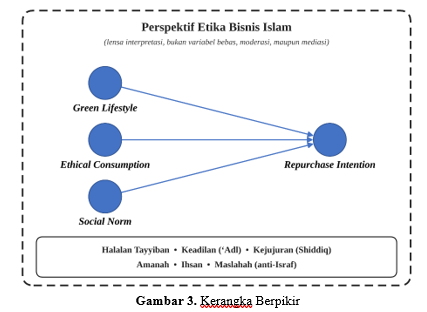
Penelitian ini bertujuan menganalisis pengaruh green lifestyle, ethical consumption, dan social norm terhadap repurchase intention produk skincare ramah lingkungan pada pengguna Avoskin Generasi Z di Kota Bandar Lampung dalam perspektif Etika Bisnis Islam. Penelitian menggunakan pendekatan kuantitatif dengan desain asosiatif. Data primer diperoleh melalui penyebaran kuesioner kepada 100 responden yang dipilih menggunakan teknik purposive sampling. Data dianalisis menggunakan metode PLS-SEM melalui pengujian model pengukuran, model struktural, hipotesis, dan koefisien determinasi. Hasil penelitian menunjukkan bahwa green lifestyle, ethical consumption, dan social norm berpengaruh positif dan signifikan terhadap repurchase intention. Social norm menjadi variabel yang memiliki pengaruh paling dominan. Temuan tersebut menunjukkan bahwa gaya hidup ramah lingkungan, pertimbangan etis dalam konsumsi, dan dukungan lingkungan sosial dapat meningkatkan niat pembelian ulang pengguna Avoskin. Dalam perspektif Etika Bisnis Islam, hasil penelitian mencerminkan pentingnya perilaku konsumsi dan praktik bisnis yang berlandaskan kejujuran, tanggung jawab, kemaslahatan, serta kepedulian terhadap lingkungan.
##plugins.themes.academic_pro.article.details##

This work is licensed under a Creative Commons Attribution-NonCommercial 4.0 International License.
LPPM Politeknik Piksi Ganesha Indonesia
References
Carrington, M. J., Neville, B. A., & Whitwell, G. J. (2010). Why Ethical Consumers Don’t Walk Their Talk: Towards a Framework for Understanding the Gap Between the Ethical Purchase Intentions and Actual Buying Behaviour of Ethically Minded Consumers. Journal of Business Ethics, 97(1), 139–158. https://doi.org/10.1007/s10551-010-0501-6
Cartwright, J., McCormick, H., & Warnaby, G. (2016). Consumers’ emotional responses to the Christmas TV advertising of four retail brands. Journal of Retailing and Consumer Services, 29, 82–91. https://doi.org/https://doi.org/10.1016/j.jretconser.2015.11.001
Chen, J., Xia, S., & Lin, T. (2024). A framework of moderators in social norm-based message persuasiveness based on a systematic review. Human Communication Research, 50(2), 285–298. https://doi.org/10.1093/hcr/hqad043
Efrial, A. F. S., Hati, S. R. H., & Efrial, A. S. (2026). Religiosity, Attitude, and Ethical Consumption in Counterfeit Fashion Luxury Purchase Intention: Evidence from Muslim Consumers in Indonesia.
Fahlevi, R., Kevin, V. L., & Sinambela, F. A. (2024). Factors Influencing Generation Z’s Intention to Purchase Environmentally Friendly Skincare Products. Journal of Enterprise and Development (JED), 6(3), 756–767.
Hellier, P. K., Geursen, G. M., Carr, R. A., & Rickard, J. A. (2003). Customer repurchase intention: A general structural equation model. European Journal of Marketing, 37(11–12), 1762–1800.
Huda, N., Manek, A., Taolin, M. L., & Aziz, S. (2025). Metodologi penelitian manajemen dan bisnis: Pendekatan kuantitatif, kualitatif & campuran. Nurul Huda.
Jakobsen, J., Roussanaly, S., & Anantharaman, R. (2017). A techno-economic case study of CO2 capture, transport and storage chain from a cement plant in Norway. Journal of Cleaner Production, 144, 523–539. https://doi.org/https://doi.org/10.1016/j.jclepro.2016.12.120
Lubis, H. A. S., & Ricka Handayani, M. M. (2023). Generasi Z dan entrepreneurship. Bypass.
Mawardi, M. K., Iqbal, M., Astuti, E. S., Alfisyahr, R., & Mappatompo, A. (2024). Determinants of green trust on repurchase intentions: a survey of Quick Service Restaurants in Indonesia. Cogent Business & Management, 11(1), 2318806.
MUHAMMAD, N. F. E. (2025). Pengaruh Consumer Ethical Beliefs dan Product Knowledge terhadap Repurchase Intention dalam Perspektif Bisnis Islam (Studi pada Pengguna Produk Skincare Daviena di Kota Bandar Lampung). UIN Raden Intan Lampung.
Risnita, R. (2024). Pendekatan penelitian kuantitatif dan kualitatif serta tahapan penelitian. Jurnal Genta Mulia, 15(1), 82–92.
Ruslim, T. S., Kartika, Y., & Hapsari, C. G. (2022). Effect of environmental concern, attitude, subjective norms, perceived behavioral control and availability on purchase of green skincare products with intention to purchase as a mediation variable. Jurnal Ilmiah Manajemen Dan Bisnis, 8(1), 120–137.
Shaw, D., Shiu, E., & Clarke, I. (2000). The contribution of ethical obligation and self-identity to the theory of planned behaviour: An exploration of ethical consumers. Journal of Marketing Management, 16(8), 879–894.
Stern, P. C. (2000). New Environmental Theories: Toward a Coherent Theory of Environmentally Significant Behavior. Journal of Social Issues, 56(3), 407–424. https://doi.org/https://doi.org/10.1111/0022-4537.00175
Valendia, I. A. S., & Purwanegara, M. S. (2022). Greenwash online marketing: Does indonesian gen-z still have the intention to repurchase green products? Indonesian Journal of Business & Entrepreunership, 8(3), 397.
Yadav, R., & Pathak, G. S. (2017). Faktor-faktor penentu perilaku pembelian ramah lingkungan konsumen di negara berkembang: Penerapan dan pengembangan Theory of Planned Behavior. Journal of Cleaner Production, 732–739. https://doi.org/https://doi.org/10.1016/j.jclepro.2016.12.120
Yeon Kim, H., & Chung, J. (2011). Consumer purchase intention for organic personal care products. Journal of Consumer Marketing, 28(1), 40–47. https://doi.org/10.1108/07363761111101930