Determinan Profitabilitas Perusahaan Otomotif Indonesia di Era Transisi Kendaraan Listrik
##plugins.themes.academic_pro.article.sidebar##
Downloads
##plugins.themes.academic_pro.article.main##
Abstract
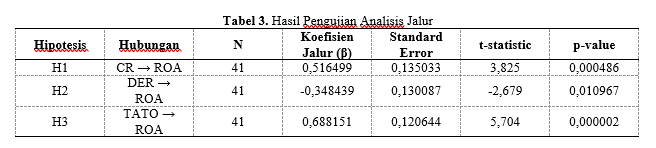
Penelitian ini menguji hubungan antara likuiditas, leverage, dan pemanfaatan aset terhadap profitabilitas perusahaan otomotif dan komponen yang terdaftar di Indonesia selama periode 2021–2025. Dengan menggunakan 41 observasi perusahaan-tahun yang lengkap dari sembilan perusahaan, penelitian ini menerapkan metode partial least squares structural equation modeling (PLS-SEM), yang dilengkapi dengan regresi panel dan uji ketahanan (*robustness tests*). Temuan menunjukkan bahwa efisiensi aset memiliki hubungan positif terkuat dengan profitabilitas, sementara hubungan untuk likuiditas dan leverage tidak didukung secara konsisten oleh inferensi bootstrap pada tingkat perusahaan. Model ini menjelaskan 57,59% dari variasi yang teramati pada return on assets (ROA). Hasil penelitian ini menegaskan pentingnya pemanfaatan aset secara produktif, sekaligus mencatat bahwa hubungan yang diestimasi tersebut tidak menyiratkan adanya hubungan kausal terhadap peralihan ke kendaraan listrik.
##plugins.themes.academic_pro.article.details##

This work is licensed under a Creative Commons Attribution-NonCommercial 4.0 International License.
LPPM Politeknik Piksi Ganesha Indonesia
References
Agrawal, A. (2024). Impact of EV disruption on auto-ancillary sector: Exploring resilience enablers for long-term sustainability. Journal of Cleaner Production, 483. https://doi.org/10.1016/j.jclepro.2024.144179
Ahmed, F., Rahman, M. U., Rehman, H. M., Imran, M., Dunay, A., & Hossain, M. B. (2024). Corporate capital structure effects on corporate performance pursuing a strategy of innovation in manufacturing companies. Heliyon, 10(3). https://doi.org/10.1016/j.heliyon.2024.e24677
Al-Hamshary, F. S. A., Ariff, A. M., Kamarudin, K. A., & Abd Majid, N. (2025). Corporate risk-taking, financial constraints and cash holdings: Evidence from Saudi Arabia. International Journal of Islamic and Middle Eastern Finance and Management, 18(1), 166–183. https://doi.org/10.1108/IMEFM-11-2023-0455
Al Barak, T. I. (2025). Corporate cash holdings, working capital, and profitability: Evidence from Saudi Arabia. Investment Management and Financial Innovations, 22(1), 257–265. https://doi.org/10.21511/imfi.22(1).2025.19
Almomani, M. A., Obeidat, M. I. S., Al-Athamneh, M., Almomani, T. M., & Darkel, N. M. A. M. (2025). Towards understanding the firm specific determinants of corporate financial flexibility. International Journal of Economics and Financial Issues, 15(1), 148–158. https://doi.org/10.32479/ijefi.17373
Bagh, T., Hunjra, A. I., Ntim, C. G., & Naseer, M. M. (2025). Capitalizing on risk: How corporate financial flexibility, investment efficiency, and institutional ownership shape risk-taking dynamics. International Review of Economics & Finance, 99. https://doi.org/10.1016/j.iref.2025.104068
Bagh, T., Khan, M. A., Naseer, M. M., & Iftikhar, K. (2024). Does financial flexibility drive firm’s risk-taking in emerging markets? The moderating role of investment efficiency. Managerial and Decision Economics, 45(8), 5541–5561. https://doi.org/10.1002/mde.4337
Bawono, I. R., & Handika, R. (2023). How do accounting records affect corporate financial performance? Empirical evidence from the Indonesian public listed companies. Heliyon, 9(4). https://doi.org/10.1016/j.heliyon.2023.e14950
Bensaadi, I. (2025). The U-shaped effects of financial leverage and firm size on cash holding in Indonesia. Journal of Economics, Business, & Accountancy Ventura, 27(3), 400–410. https://doi.org/10.14414/jebav.v27i3.4380
Charupat, N., & Sarkar, S. (2025). Operating flexibility and optimal capital structure. Accounting & Finance, 65(2), 1863–1887. https://doi.org/10.1111/acfi.13391
Dawar, V., & Chaudhury, A. (2025). Working capital efficiency and firm performance: Empirical evidence from an emerging market. International Journal of Business Performance Management, 26(6), 767–778. https://doi.org/10.1504/IJBPM.2025.149013
Fairfield, P. M., & Yohn, T. L. (2001). Using asset turnover and profit margin to forecast changes in profitability. Review of Accounting Studies, 6, 371–385. https://doi.org/10.1023/A:1012430513430
Ferdiansyah, D., & Ramadhan, Z. (2026). Likuiditas, leverage dan aktivitas serta pengaruhnya terhadap profitabilitas perusahaan sub sektor otomotif dan komponen. ECo-Fin, 8(1), 111–121. https://doi.org/10.32877/ef.v8i1.3543
Garg, M. C., & Singh, M. (2024). Does working capital management affect financial performance: Empirical evidence of Indian manufacturing sector. Journal of Operations and Strategic Planning, 7(1). https://doi.org/10.1177/2516600X241245808
Gasbarro, D., Miao, H., Schwebach, R. G., & Zumwalt, J. K. (2025). Cash holdings and risk-adjusted returns: The role of business strategy, life cycle, and managerial ability. International Review of Financial Analysis, 105. https://doi.org/10.1016/j.irfa.2025.104376
Hartanti, I. T., Ruhadi, R., & Suryani, A. (2023). Effect of CR and DAR on ROA in Automotive and Component Companies Listed on the IDX. Indonesian Journal of Economics and Management, 3(1), 122–129. https://doi.org/10.35313/ijem.v3i1.3870
Hu, W., Li, K., & Zhang, X. (2024). Financial constraints, cash flow timing patterns, and asset prices. Journal of Financial Economics, 157. https://doi.org/10.1016/j.jfineco.2024.103855
Jagani, S., Marsillac, E., & Hong, P. (2024). The electric vehicle supply chain ecosystem: Changing roles of automotive suppliers. Sustainability, 16(4). https://doi.org/10.3390/su16041570
Jiang, Q., Kuang, X., Mei, S., & Zhao, Z. (2026). Manufacturing enterprise digital transformation and financial flexibility improvement. Finance Research Letters, 91. https://doi.org/10.1016/j.frl.2026.109489
Jum’a, L., Qamardin, S., & Ikram, M. (2024). Developing resilience strategies amid supply chain risks in the automotive industry: A stakeholder theory perspective. Business Strategy and the Environment, 33(8), 9197–9213. https://doi.org/10.1002/bse.3977
Kiymaz, H., Haque, S., & Choudhury, A. A. (2024). Working capital management and firm performance: A comparative analysis of developed and emerging economies. Borsa Istanbul Review, 24(3), 634–642. https://doi.org/10.1016/j.bir.2024.03.004
Kristiana, D., & Karnasi, R. (2024). The effect of working capital management on profitability in manufacturing companies listed on the Indonesia Stock Exchange. Journal of Applied Business, Taxation and Economics Research, 3(3). https://doi.org/10.54408/jabter.v3i3.255
Lumban Gaol, G. F., Simanjuntak, A., Saragih, R., & Gultom, R. (2026). Sales Growth, Liquidity, and Firm Size on Profitability of Manufacturing Companies Listed on the Indonesia Stock Exchange. Jurnal Ilmiah Accusi, 8(1), 52–61. https://doi.org/10.36985/jnmamt06
Rachmandes, R. A., Fauzi, A., & Handarini, D. (2026). The effect of financial performance using the DuPont system on stock returns for companies in the energy sector listed on the Indonesia Stock Exchange (IDX) for the 2022–2024 period. Journal Research of Social Science, Economics, and Management, 6(1), 221–238. https://doi.org/10.59141/jrssem.v6i1.1602
Raung, R. Z., Sutopo, W., Hisjam, M., & Hartono, D. (2025). Scenario analysis of subsidy policies on electric motorcycle market in Indonesia using system dynamics simulation. Transportation Research Interdisciplinary Perspectives, 32. https://doi.org/10.1016/j.trip.2025.101487
Sahbany, S., Riscal, D. A., & Irawansyah. (2025). The effect of financial ratios on financial profitability in manufacturing companies listed on the IDX in 2022-2024. Indo-Fintech Intellectuals: Journal of Economics and Business, 5(3), 7148–7164. https://doi.org/10.54373/ifijeb.v5i3.4265
Samour, A., AlGhazali, A., Gadoiu, M., & Banuta, M. (2024). Capital structure and financial performance of China’s energy industry: What can we infer from COVID-19? PLOS ONE, 19(6). https://doi.org/10.1371/journal.pone.0300936
Soliman, M. T. (2008). The use of DuPont analysis by market participants. The Accounting Review, 83(3), 823–853. https://doi.org/10.2308/accr.2008.83.3.823
Syafruddin, M., Weinanto, C. J., & Haryani, H. (2023). Evidence of Financial Ratio Impact on Non-Financial Firm Profitability. Accounting Analysis Journal, 12(2), 102–111. https://doi.org/10.15294/aaj.v12i2.70466
Vuong, T. H. G., Nguyen, V. P., & Nguyen, H. M. (2025). Does stock liquidity matter for corporate cash holdings? Insights from a transition economy. Global Finance Journal, 65. https://doi.org/10.1016/j.gfj.2025.101102
Wu, S., & Jiang, J. (2026). Earnings Predictability of DuPont Factors: Impact of Mean Reversion and Competitiveness. Journal of Risk and Financial Management, 19(6). https://doi.org/10.3390/jrfm19060408
Zhou, Z., & Zhang, J. (2025). Manufacturing enterprise digital transformation, financial flexibility, and financial risk—Evidence from China. International Review of Financial Analysis, 104. https://doi.org/10.1016/j.irfa.2025.104279