Sustainable Waste Management Assessment of Small–Medium Motorcycle Workshops
##plugins.themes.academic_pro.article.sidebar##
Downloads
##plugins.themes.academic_pro.article.main##
Abstract
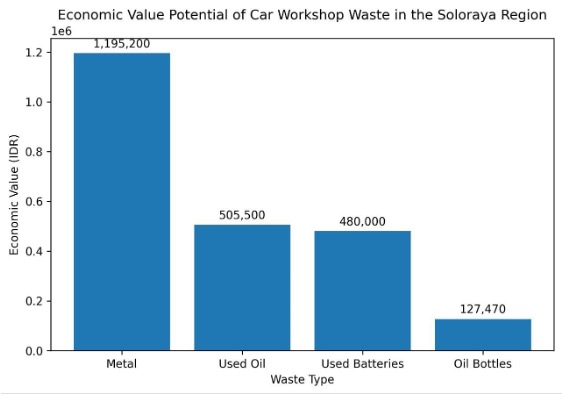
The growth of small-to-medium-sized motorcycle repair shops in Soloraya has increased the amount of waste that has the potential to pollute the environment if not managed properly. This study analyzes the characteristics of repair shops, the types and amounts of waste, management practices, and the potential economic value from a sustainability perspective. The study was conducted at ten repair shops (n = 10) through observation, structured interviews, and surveys. In one month, the ten workshops produced 1,214 used oil bottles, 337 liters of used oil, and 20 used batteries, as well as non-hazardous waste in the form of metal components and brake pads. The dominance of used bottles and oil reflects the high level of routine maintenance. Management is still limited to temporary storage and delivery to third parties with substandard facilities. Waste has economic value: oil at Rp1,500/liter, batteries and metal at Rp12,000/kg, indicating both environmental risks and circular economic opportunities.
##plugins.themes.academic_pro.article.details##

This work is licensed under a Creative Commons Attribution-NonCommercial 4.0 International License.
References
[2] V. Azteria and R. A. Gani, “Pengelolaan Limbah Minyak Pelumas Sebagai Upaya Pengendalian Pencemaran Lingkungan,” BIOLINK (Jurnal Biol. Lingkung. Ind. Kesehatan), vol. 6, no. 2, pp. 178–185, 2020, doi: 10.31289/biolink.v6i2.2725.
[3] E. Kristanti, A. Muharamin, and A. C. Ni’am, “Identifikasi Limbah Berbahaya Dan Beracun (B3) Di Bengkel Xyz Lamongan,” Environ. Eng. J. ITATS, vol. 1, no. 1, pp. 1–6, 2021, doi: 10.31284/j.envitats.2021.v1i1.2174.
[4] T. N. Sari, M. Pradipto, and S. Hartini, “Sosialisasi perbaikan metode kerja dengan prinsip keselamatan dan kesehatan kerja pada bengkel kendaraan bermotor,” J. Apl. Tek. dan Pengabdi. Masy., vol. 5, no. 1, pp. 9–14, 2021, doi: https://doi.org/10.36339/je.v5i1.378.
[5] E. Wardhani and A. P. Triatmaja, “Identifikasi dan Kuantifikasi Limbah Bahan Berbahaya dan Beracun (LB3) pada Industri X di Kota Bandung,” Serambi Eng., vol. 6, no. 3, pp. 2128–2134, 2021, doi: https://doi.org/10.32672/jse.v6i3.3246.
[6] T. Herdito, Risna, and M. Lutfi, “1121-3579-3-Pb,” J. Sains Terap., vol. 7, no. 2, pp. 57–63, 2021.
[7] M. Hidayat, M. Raharjo, and A. Wibowo, “Tantangan pengelolaan limbah B3 pada usaha mikro dan kecil,” 2022.
[8] A. R. Putra and S. Wahyuni, “Tingkat kepatuhan pengelolaan limbah B3 pada UMKM sektor otomotif,” 2023.
[9] B. Susanto and P. Lestari, “Pengelolaan limbah bengkel kendaraan bermotor berbasis lingkungan,” 2021.
[10] P. R. Indonesia, “Peraturan Pemerintah Republik Indonesia Nomor 22 Tahun 2021 tentang Penyelenggaraan Perlindungan dan Pengelolaan Lingkungan Hidup,” 2021. [Online]. Available: https://peraturan.go.id/id/pp-no-22-tahun-2021?utm_source
[11] M. Geissdoerfer, P. Savaget, N. M. P. Bocken, and E. J. Hultink, “The circular economy – A new sustainability paradigm,” 2017.
[12] A. Kumar, R. K. Singh, and S. Modgil, “Exploring the relationship between sustainable supply chain management practices and organizational performance: A circular economy perspective,” J. Clean. Prod., vol. 277, pp. 124–147, 2020, doi: https://doi.org/10.1016/j.jclepro.2020.124147.
[13] D. Mmereki, A. Baldwin, and B. Li, “A comparative analysis of solid waste management practices in small-scale enterprises: Implications for circular economy,” Waste Manag., vol. 119, pp. 98–108, 2021, doi: https://doi.org/10.1016/j.wasman.2020.11.047.
[14] N. van Buren, M. Demmers, R. van der Heijden, and F. Witlox, “Towards a circular economy: The role of Dutch logistics industries and governments,” Sustain., vol. 8, no. 7, pp. 1–17, 2016, doi: 10.3390/su8070647.
[15] A. Silva, M. Rosano, and L. Stocker, “Hazardous waste management practices in small automotive workshops,” 2021.
[16] Y. Zhang, H. Li, and X. Chen, “Automotive waste management and circular economy practices,” 2022.
[17] E. Commission, “Circular economy action plan: For a cleaner and more competitive Europe,” 2022.
[18] O. for E. C. and Development, “Business models for the circular economy: Opportunities and challenges,” 2021.
[19] U. N. E. Programme, “Waste management and circular economy approaches for SMEs,” 2021.
[20] F. Rahman, I. Nugraha, and A. Setyawan, “Economic value of waste recovery in small-scale industries,” 2023.
[21] J. E. Elektro-komputer-teknik et al., “Perancangan Sistem Informasi Alumni Berbasis Website,” vol. 4, no. 2, pp. 191–199, 2020.
[22] A. Z. Yusuf et al., “Pemberdayaan Indsustri Bengkel Sepeda Motor Melalui daur Ulang Sampah Komponen Otomotif,” vol. 3, pp. 323–329, 2025.