Weaving Architecture Effects on Mechanical and Chemical Performance of Alkali-Treated Coconut Fiber Composites
##plugins.themes.academic_pro.article.sidebar##
Downloads
##plugins.themes.academic_pro.article.main##
Abstract
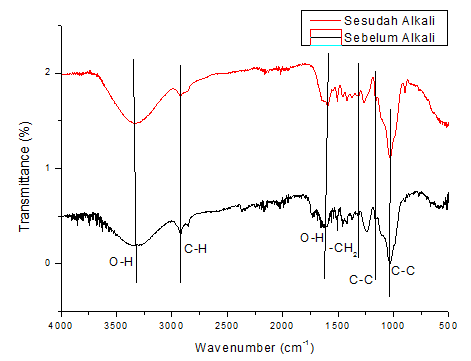
This study examines the effect of fabric architecture and alkali treatment on the properties of coconut fiber–polyester composites as an alternative environmentally friendly material. Coconut fibers were treated with 15% NaOH for 2 hours and woven in basket weave and twill weave patterns. The composites were made using a vacuum-assisted resin infusion method with a fiber fraction of 40%, and compared with E-glass composites as a control. FTIR analysis showed a decrease in the intensity of the absorption band in the range of 1200–1300 cm⁻¹, indicating a reduction in lignin content after alkali treatment. The mechanical test results showed that the basket weave composite had higher tensile and flexural strengths, respectively, of 20.40 N/mm² and 78.45 N/mm², compared to the twill weave at 12.98 N/mm² and 52.31 N/mm². However, the highest impact resistance was obtained in the twill weave at 23.61 J/mm². The results of the study indicate that the weave architecture has a significant effect on the mechanical performance of the composite and has the potential to support the development of sustainable composite materials for engineering applications.
##plugins.themes.academic_pro.article.details##

This work is licensed under a Creative Commons Attribution-NonCommercial 4.0 International License.
References
[2] S. Sathish, L. Prabhu, S. Gokulkumar, N. Karthi, D. Balaji, and N. Vigneshkumar, ‘Extraction, Treatment and Applications of Natural Fibers for Bio-Composites – A Critical Review’, Int. Polym. Process., vol. 36, no. 2, pp. 114–130, May 2021, doi: 10.1515/ipp-2020-4004.
[3] J. S. S. Neto, H. F. M. de Queiroz, R. A. A. Aguiar, and M. D. Banea, ‘A Review on the Thermal Characterisation of Natural and Hybrid Fiber Composites’, Polymers, vol. 13, no. 24, p. 4425, Jan. 2021, doi: 10.3390/polym13244425.
[4] J. Kaufmann, A. G. Temesgen, and H. Cebulla, ‘A comprehensive review on natural fiber reinforced hybrid composites processing techniques, material properties and emerging applications’, Discov. Mater., vol. 5, no. 1, p. 227, Nov. 2025, doi: 10.1007/s43939-025-00419-z.
[5] D. K. Rajak, D. D. Pagar, P. L. Menezes, and E. Linul, ‘Fiber-Reinforced Polymer Composites: Manufacturing, Properties, and Applications’, Polymers, vol. 11, no. 10, p. 1667, Oct. 2019, doi: 10.3390/polym11101667.
[6] A. Vinod, M. R. Sanjay, S. Suchart, and P. Jyotishkumar, ‘Renewable and sustainable biobased materials: An assessment on biofibers, biofilms, biopolymers and biocomposites’, J. Clean. Prod., vol. 258, p. 120978, Jun. 2020, doi: 10.1016/j.jclepro.2020.120978.
[7] B. De, M. Bera, D. Bhattacharjee, B. C. Ray, and S. Mukherjee, ‘A comprehensive review on fiber-reinforced polymer composites: Raw materials to applications, recycling, and waste management’, Prog. Mater. Sci., vol. 146, p. 101326, Dec. 2024, doi: 10.1016/j.pmatsci.2024.101326.
[8] K. L. Pickering, M. G. A. Efendy, and T. M. Le, ‘A review of recent developments in natural fibre composites and their mechanical performance’, Compos. Part Appl. Sci. Manuf., vol. 83, pp. 98–112, Apr. 2016, doi: 10.1016/j.compositesa.2015.08.038.
[9] Y. G. Thyavihalli Girijappa, S. Mavinkere Rangappa, J. Parameswaranpillai, and S. Siengchin, ‘Natural Fibers as Sustainable and Renewable Resource for Development of Eco-Friendly Composites: A Comprehensive Review’, Front. Mater., vol. 6, Sep. 2019, doi: 10.3389/fmats.2019.00226.
[10] S. Harish, Sanjeevamurthy, and N. S. Venkatesh Guptha, ‘The study of tensile and flexural strength of cattle bone particulate reinforced epoxy’, Mater. Today Proc., vol. 5, no. 10, Part 1, pp. 20927–20931, Jan. 2018, doi: 10.1016/j.matpr.2018.06.481.
[11] N. Ajayi, S. Rusnakova, A. Ajayi, R. Ogunleye, A. Onyedikachi Stanley, and A. Amenaghawon, ‘A comprehensive review of natural fiber reinforced Polymer composites as emerging materials for sustainable applications’, Appl. Mater. Today, vol. 43, Mar. 2025, doi: 10.1016/j.apmt.2025.102666.
[12] P. Peças, H. Carvalho, H. Salman, and M. Leite, ‘Natural Fibre Composites and Their Applications: A Review’, J. Compos. Sci., vol. 2, no. 4, p. 66, Dec. 2018, doi: 10.3390/jcs2040066.
[13] Sanjay M.r., S. Siengchin, J. Parameswaranpillai, M. Jawaid, C. I. Pruncu, and A. Khan, ‘A comprehensive review of techniques for natural fibers as reinforcement in composites: Preparation, processing and characterization’, Carbohydr. Polym., vol. 207, pp. 108–121, Mar. 2019, doi: 10.1016/j.carbpol.2018.11.083.
[14] J. Agarwal, S. Sahoo, S. Mohanty, and S. K. Nayak, ‘Progress of novel techniques for lightweight automobile applications through innovative eco-friendly composite materials: A review’, J. Thermoplast. Compos. Mater., vol. 33, no. 7, pp. 978–1013, Jul. 2020, doi: 10.1177/0892705718815530.
[15] M. Asim et al., ‘A Review on Pineapple Leaves Fibre and Its Composites’, Int. J. Polym. Sci., vol. 2015, no. 1, p. 950567, 2015, doi: 10.1155/2015/950567.
[16] P. Senthamaraikannan and M. Kathiresan, ‘Characterization of raw and alkali treated new natural cellulosic fiber from Coccinia grandis.L’, Carbohydr. Polym., vol. 186, pp. 332–343, Apr. 2018, doi: 10.1016/j.carbpol.2018.01.072.
[17] A. Shalwan and B. F. Yousif, ‘In State of Art: Mechanical and tribological behaviour of polymeric composites based on natural fibres’, Mater. Des., vol. 48, pp. 14–24, Jun. 2013, doi: 10.1016/j.matdes.2012.07.014.
[18] V. Fiore, T. Scalici, G. Di Bella, and A. Valenza, ‘A review on basalt fibre and its composites’, Compos. Part B Eng., vol. 74, pp. 74–94, Jun. 2015, doi: 10.1016/j.compositesb.2014.12.034.
[19] X. Li, L. G. Tabil, and S. Panigrahi, ‘Chemical Treatments of Natural Fiber for Use in Natural Fiber-Reinforced Composites: A Review’, J. Polym. Environ., vol. 15, no. 1, pp. 25–33, Jan. 2007, doi: 10.1007/s10924-006-0042-3.
[20] R. Yahaya, S. M. Sapuan, M. Jawaid, Z. Leman, and E. S. Zainudin, ‘Effect of fibre orientations on the mechanical properties of kenaf–aramid hybrid composites for spall-liner application’, Def. Technol., vol. 12, no. 1, pp. 52–58, Feb. 2016, doi: 10.1016/j.dt.2015.08.005.
[21] S. Ru, C. Zhao, and S. Yang, ‘Multi-Objective Optimization and Analysis of Mechanical Properties of Coir Fiber from Coconut Forest Waste’, Forests, vol. 13, no. 12, p. 2033, Dec. 2022, doi: 10.3390/f13122033.
[22] K. A. Olonade and H. Savastano Junior, ‘Performance evaluation of treated coconut fibre in cementitious system’, SN Appl. Sci., vol. 5, no. 8, p. 218, Jul. 2023, doi: 10.1007/s42452-023-05444-2.
[23] Y. Buelvas Arrieta, L. Díaz Reyes, C. Ávila-Díaz, J. Altamiranda Suárez, O. Rivero-Romero, and J. Unfried-Silgado, ‘Effects of drying temperature, mercerizing, and coating on the properties of Colombian Coir fibers and their interfacial adhesion with polylactic acid’, Sci. Rep., vol. 15, no. 1, p. 32346, Sep. 2025, doi: 10.1038/s41598-025-18240-2.
[24] K. M. F. Hasan, P. G. Horváth, Z. Kóczán, and T. Alpár, ‘Thermo-mechanical properties of pretreated coir fiber and fibrous chips reinforced multilayered composites’, Sci. Rep., vol. 11, no. 1, p. 3618, Feb. 2021, doi: 10.1038/s41598-021-83140-0.
[25] A. Alavudeen, N. Rajini, S. Karthikeyan, M. Thiruchitrambalam, and N. Venkateshwaren, ‘Mechanical properties of banana/kenaf fiber-reinforced hybrid polyester composites: Effect of woven fabric and random orientation’, Mater. Des. 1980-2015, vol. 66, pp. 246–257, Feb. 2015, doi: 10.1016/j.matdes.2014.10.067.