The Effect of Tool Type and Vertical Milling Machine Feeding Depth on ST 42 Steel Surface Roughness
##plugins.themes.academic_pro.article.sidebar##
Downloads
##plugins.themes.academic_pro.article.main##
Abstract
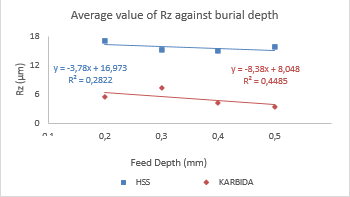
The quality of the final surface finish in machining operations is a critical parameter that dictates the performance and wear resistance of mechanical components. This study aims to analyze the effect of tool types (High-Speed Steel [HSS] and Carbide) and variations in depth of cut (0.2 mm, 0.3 mm, 0.4 mm, and 0.5 mm) on the surface roughness of ST 42 steel utilizing a vertical milling machine. The experimental method integrated real-time machine vibration monitoring using a LUTRON VB-8201HA Vibration Meter during the up-milling process. The evaluation of surface topography was measured based on average roughness (Ra), ten-point roughness (Rz), and root-mean-square roughness (Rq) parameters using a Mitutoyo SJ-301 Surface Roughness Tester, which were subsequently correlated with the ISO 1302 roughness grade standard. The results indicated that the cutting tool material characteristics exerted a dominant influence, with the Carbide tool consistently producing significantly superior surfaces compared to the HSS tool. The Carbide tool achieved an overall average Ra value of 0.77 µm, classifying it into the N6 roughness grade (finishing standard), along with 5.12 µm for Rz and 0.97 µm for Rq. Conversely, the HSS tool yielded sub-optimal surface quality with an average Ra of 2.65 µm, classifying it into the N8 roughness grade (roughing standard), alongside 15.65 µm for Rz and 3.41 µm for Rq. Increasing the depth of cut triggered a linear increase in Ra for the HSS tool due to amplified cutting forces however, a contrasting phenomenon occurred with the Carbide tool, where the surface became smoother due to local thermal softening of the workpiece material. In conclusion, the optimum machining combination to achieve minimum surface roughness at the N6 grade standard on ST 42 steel is accomplished by utilizing a Carbide cutting tool operated at deeper depth of cut parameters.
##plugins.themes.academic_pro.article.details##

This work is licensed under a Creative Commons Attribution-NonCommercial 4.0 International License.
References
[2] Raudy, A., Afriany, R., & Budiman, A. Y. (2026). Analisa Pengaruh Kecepatan Spindel dan Kedalaman Pemakanan Terhadap Kekasaran Permukaan Pada Proses Frais Muka dengan Material Baja ST 37. 5(1), 37–42.
[3] Hidayat, M. F., & Ahmad, F. (2025). Pengaruh Kedalaman Pemakanan dan Feedrate pada Mesin Frais Terhadap Hasil Getaran dan Kekasaran Permukaan. Jurnal Teknik Mesin Cakram, 8(1), 27–33. https://doi.org/10.32493/jtc.v8i1.48184
[4] Asep Wahyu Herman, A. M. S. (2014). Asep Wahyu Hermawan Arya Mahendra Sakti. Jurusan Teknik Mesin, 03, 147–154.
[5] Jumlah, P., Sayat, M., & Cutter, E. (2023). Permukaan Spesimen Pada Proses Pengefraisan.
[6] Hariyanto, S., Anjani, R. D., & Aripin. (2024). Study of the Effect of Infeed Depth on the Surface Roughness and Tensile Strength of S45C Steel in the CNC Machine Lathe Process. Jurnal Pendidikan Teknik Mesin Undiksha, 12(1), 43–52.
[7] Rizza, M. A., & Pratama, I. (2021). Pengaruh Parameter Pemotongan Pada Proses Frais Terhadap Kekasaran Permukaan Material Aluminium 6061. Jurnal Teknik Ilmu Dan Aplikasi, 2, 49. https://jurnal.polinema.ac.id/index.php/jtia/article/view/1654
[8] Manta, F., Qalbi A.M., C., & Abdul Basith, R. (2023). Analisis Proses Pembubutan AISI 1020 Pada Kekasaran Permukaan Material Dan Keausan Pahat. Journal of Mechanical Engineering Manufactures Materials and Energy, 7(1), 54–63. https://doi.org/10.31289/jmemme.v7i1.7703
[9] Fauzi, A., & Sumbodo, W. (2021). Pengaruh Parameter Pemakanan Terhadap Kekasaran Permukaan ST 40 pada Mesin Bubut CNC. Jurnal Dinamika Vokasional Teknik Mesin, 6(1), 46–57. https://doi.org/10.21831/dinamika.v6i1.38114
[10] Darto. (2007). Pendekatan Sistematik Penentuan Parameter Proses Freis Tegak Untuk Meminimalkan. Transmisi, 3(2), 307–316.
[11] Muttahid, M., Nurrohkayati, A. S., & Nugroho, A. (2023). Pengaruh Sudut Potong Utama Endmill, Kecepatan dan Arah Pemakanan Terhadap Kekasaran Permukaan Material St 37 Pada Proses Frais Konvensional. Journal Technology Urgency Breakthrough in Engineering, 1(1), 150–164. http://ejournal.umm.ac.id/index.php/turbine
[12] Burhanuddin, Y., Harun, S., Afriant, E., & D.A., T. (2013). Penerapan Penilaian Kekasaran Permukaan (Surface Roughness Assessment) Berbasis Visi Pada Proses Pembubutan Baja S45C. Jurnal Mechanical, 4(1), 22–29.
[13] Adinnandha, R., & Sakti, A. M. (2015). Analisa Jenis Pahat Dan Kedalaman Pemakanan Terhadap Tingkat Kekasaran Permukaan Pada Benda Kerja Alumunium Dan Baja St. 37 Dengan Perlakuan Mesin Frais Vertikal. Jurnal Mahasiswa Universitas Negeri Surabaya, 01(Analisa Jenis Pahat dan Kedalaman Pemakanan pada Frais Vertikal), 23–29.