Penguatan Konsep Diri dan Pelatihan Konseling Dasar Sebagai Pencegahan Bullying di MI Maarif NU 1 Gunung Lurah
##plugins.themes.academic_pro.article.sidebar##
Downloads
##plugins.themes.academic_pro.article.main##
Abstract
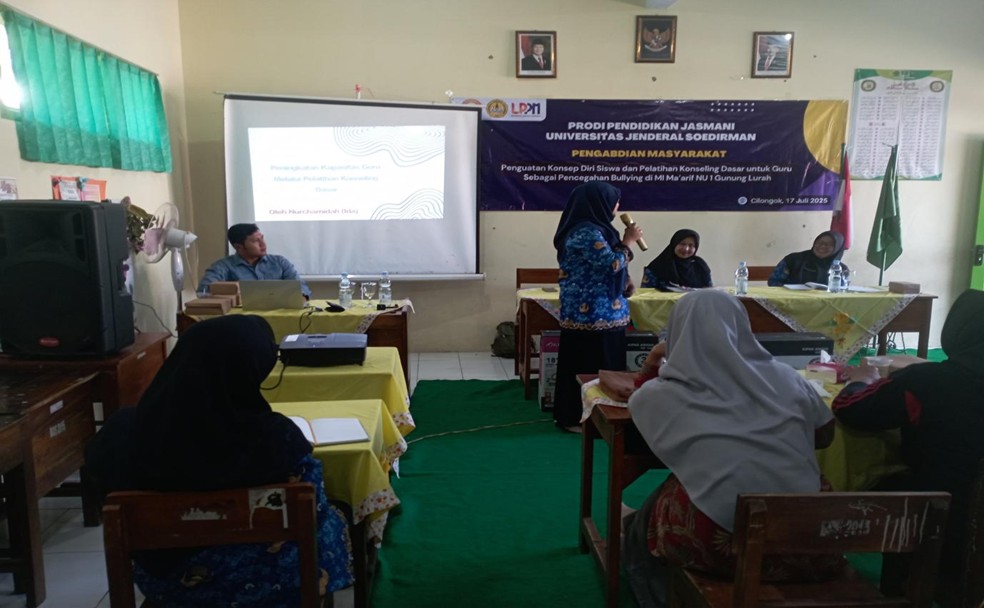
Bullying in elementary schools has become a serious issue as it affects students’ social and emotional development. This community service focused on bullying prevention by enhancing students’ self-awareness and teachers’ empathetic communication skills. The objective was to build a healthy, safe school ecosystem that supports character development. The program was implemented at MI Ma’arif NU 1 Gunung Lurah using the Participatory Action Research (PAR) approach, involving the school community actively. The strategy included socialization, self-analysis training for students, basic counseling training for teachers, and structured mentoring. The results showed that students were able to recognize themselves, express emotions, and commit to rejecting bullying, while teachers successfully applied empathetic communication and developed simple counseling modules. The impact of this program was evident in the creation of a reflective culture in the classroom through reflection corners, as well as improved openness in interactions between teachers and students.
##plugins.themes.academic_pro.article.details##

This work is licensed under a Creative Commons Attribution-NonCommercial 4.0 International License.
JURPIKAT (Jurnal Pengabdian Kepada Masyarakat) accepts manuscripts that have not been published elsewhere and are not under consideration for publication by other print or electronic media. Authors retain copyright and grant the journal right of first publication with the work simultaneously licensed under a Creative Commons BY-NC License that allows others to share the work with an acknowledgment of the work's authorship and initial publication in this journal.
Authors are able to enter into separate, additional contractual arrangements for the non-exclusive distribution of the journal's published version of the work (eg, post it to an institutional repository, in a journal or publish it in a book), with an acknowledgment of its initial publication in this journal.
License to Publish
The non-commercial use of the article will be governed by the Attribution-NonCommercial 4.0 International (CC BY-NC 4.0). The author hereby grants JURPIKAT (Jurnal Pengabdian Kepada Masyarakat) an exclusive publishing and distribution license in the manuscript include tables, illustrations or other material submitted for publication as part of the manuscript (the “Articleâ€) in print, electronic and all other media (whether now known or later developed), in any form, in all languages, throughout the world, for the full term of copyright, and the right to license others to do the same, effective when the article is accepted for publication. This license includes the right to enforce the rights granted hereunder against third parties.
References
Ima Rotul, N. (2022). Pembentukan Karakter Disiplin Dan Tanggung Jawab Siswa Di Mi Ma’Arif Nu 1 Gununglurah Kecamatan Cilongok Kabupaten Banyumas (Doctoral dissertation, UIN Prof. KH Saifuddin Zuhri).
Muzzamil, F. (2021). Pengaruh lingkungan terhadap perkembangan sosial emosional anak. Murangkalih: Jurnal Pendidikan Anak Usia Dini, 2(2). https://doi.org/10.35706/murangkalih.v2i02.5811
Sofriyana, W. E. (2018). Implementasi Program Tahfidzul Qur’an di MI Ma’arif NU 01 Gununglurah Kecamatan Cilongok Kabupaten Banyumas. Tesis. IAIN Purwokerto.
Puspitasari, P. (2024). Mengembangkan Kesadaran Diri Pada Siswa Untuk Mencegah Tindak Perundungan Di Sekolah Dasar. Dharmas Education Journal (DE_Journal), 4(1), 16–22. https://doi.org/10.56667/dejournal.v4i1.901
Yum'na, M. (2022). Implementasi Pembelajaran Pendidikan Agama Islam Berbasis Pesantren Di Smp Ma'Had Darussa'Adah Gununglurah Cilongok Banyumas (Doctoral dissertation, UIN Prof. KH Saifuddin Zuhri).
Zuafah, L., Husni Wakhyudin, & Ikha Listyarini. (2023). Optimalisasi Kemampuan Literasi Melalui Sarana Pojok Baca di Kelas IV Sd N Peterongan. Didaktik : Jurnal Ilmiah PGSD STKIP Subang, 9(2), 4901 - 4909. https://doi.org/10.36989/didaktik.v9i2.1148