Assessing Digital Readiness of Indonesian Hajj Pilgrims for Mobile Translation Tools
##plugins.themes.academic_pro.article.sidebar##
Downloads
##plugins.themes.academic_pro.article.main##
Abstract
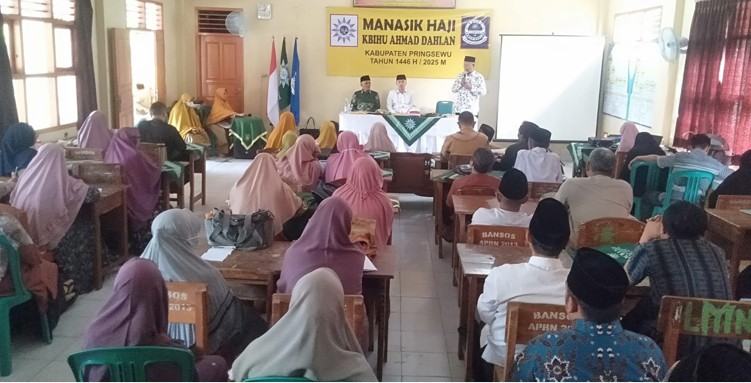
The Hajj pilgrimage takes place in a multilingual environment that requires adequate communication skills from pilgrims. Indonesian Hajj pilgrims, particularly middle-aged and elderly individuals, often face language barriers when interacting with service providers and local communities. This community service activity aimed to assess pilgrims’ digital readiness as a foundational step toward the use of technology-based communication support. Conducted in collaboration with KBIHU Ahmad Dahlan Pringsewu, Lampung, the activity involved socialization sessions, hands-on assistance, and questionnaire-based feedback from 46 Hajj pilgrims. The findings indicate that 97.8% of participants reported sufficient to excellent smartphone literacy, reflecting a strong baseline of digital readiness. Nevertheless, communication support remains an unmet need, as 69.6% of participants preferred offline-capable application features. These results suggest that mobile translation tools, such as Google Translate, have strong potential as practical communication aids during Hajj. A follow-up community service program focused on hands-on training in the use of mobile translation tools is therefore recommended.
##plugins.themes.academic_pro.article.details##

This work is licensed under a Creative Commons Attribution-NonCommercial 4.0 International License.
JURPIKAT (Jurnal Pengabdian Kepada Masyarakat) accepts manuscripts that have not been published elsewhere and are not under consideration for publication by other print or electronic media. Authors retain copyright and grant the journal right of first publication with the work simultaneously licensed under a Creative Commons BY-NC License that allows others to share the work with an acknowledgment of the work's authorship and initial publication in this journal.
Authors are able to enter into separate, additional contractual arrangements for the non-exclusive distribution of the journal's published version of the work (eg, post it to an institutional repository, in a journal or publish it in a book), with an acknowledgment of its initial publication in this journal.
License to Publish
The non-commercial use of the article will be governed by the Attribution-NonCommercial 4.0 International (CC BY-NC 4.0). The author hereby grants JURPIKAT (Jurnal Pengabdian Kepada Masyarakat) an exclusive publishing and distribution license in the manuscript include tables, illustrations or other material submitted for publication as part of the manuscript (the “Articleâ€) in print, electronic and all other media (whether now known or later developed), in any form, in all languages, throughout the world, for the full term of copyright, and the right to license others to do the same, effective when the article is accepted for publication. This license includes the right to enforce the rights granted hereunder against third parties.
References
Albalawi, A., Aljohani, E. J., Alqulaity, E. Y., Almukhalfi, H. M., & Yafooz, W. M. S. (2023). An Analytical Study of Mobile Applications Recommended by the Ministry of Hajj and Umrah. 2023 3rd International Conference on Computing and Information Technology (ICCIT), 605–610. https://doi.org/10.1109/ICCIT58132.2023.10273907
Alfian, R., & Rafianti, F. (2023). Problematics Of The Implementation Of Hajj And Umrah (Study Of Law Number 8 Of 2019 Concerning The Implementation Of Hajj And Umrah). International Journal of Management, Economic and Accounting, 1. https://doi.org/10.61306/ijmea
Asrin, A. (2025). Integration of Islamic Educational Values in the Practice of Hajj Worship (Spiritual Experience of Hajj Trip in 1444H/2023M). Pusat Studi Aswaja Unisnu Jepara JASNA, 5(1).
Binsawad, M., & Albahar, M. (2022). A Technology Survey on IoT Applications Serving Umrah and Hajj. Applied Computational Intelligence and Soft Computing, 2022(1), 1919152. https://doi.org/https://doi.org/10.1155/2022/1919152
Chelloug, S. A., Muthanna, M. S. A., Jamil, F., Al-Gaashani, M. S. A. M., Alhelaly, S., Aziz, A., & Muthanna, A. (2025). Enhancing Hajj and Umrah Services Through Predictive Social Media Classification. IEEE Access, 13, 67220–67238. https://doi.org/10.1109/ACCESS.2025.3559204
Felemban, E. A., Rehman, F. U., Biabani, S. A. A., Ahmad, A., Naseer, A., Majid, A. R. M. A., Hussain, O. K., Qamar, A. M., Falemban, R., & Zanjir, F. (2020). Digital Revolution for Hajj Crowd Management: A Technology Survey. IEEE Access, 8, 208583–208609. https://doi.org/10.1109/ACCESS.2020.3037396
Huda, Q., & Haeba, I. D. (2021). Hajj, Istitā’ah, and Waiting List Regulation in Indonesia. Al-‘Adalah, 18. https://doi.org/https://doi.org/10.24042/al-’adalah.v18i2.9903
Khairul Azahari Abdul Rani, M., & Ramli, S. (2022). Development of Tawaf Simulation in Hajj Training in New Norms. International Virtual Colloquium on Multi-Disciplinary Research Impact (2nd Series). https://doi.org/10.21834/ebpj.v7iSI7%20(Special%20Issue).3831
Nurhalida HS, & Isbah, M. F. (2023). Hajj and Hajj Attire for Bugis Women: A Phenomenological Study in Bone District, South Sulawesi, Indonesia. DINIKA : Academic Journal of Islamic Studies, 8(1), 44–68. https://doi.org/10.22515/dinika.v8i1.7484
Probosuseno, Fidiansjah, Rochmah, W., & Mukti, A. G. (2022). Innovative Education Training Program of Hajj Healthcare Workers Improves the Outcomes of Indonesian Elderly Hajj Pilgrims. Cakrawala Pendidikan, 41(2), 365–376. https://doi.org/10.21831/cp.v41i2.47490
Putra, A. R., & Gunawan, D. (2025). Development of Game Hijaiyah Letter for Kindergarten at KB/TK Islam International Al Abidin Surakarta. JIPI (Jurnal Ilmiah Penelitian Dan Pembelajaran Informatika), 10(4), 3291–3300. https://doi.org/10.29100/jipi.v10i4.6450
Rakhmadi, A., Hartono, S., & Yudhana, A. (2025). Sosialisasi Aplikasi Digital Haji Pintar-Satu Haji dan Kawal Haji untuk Meningkatkan Pemahaman Jamaah KBIHU Ahmad Dahlan Pringsewu. In DEdikasi nuSAntara (Vol. 1, Issue 2). https://desa-indocompt.org
Rakhmadi, A., Rochmijatun, S., Nurgiyatna, N., & Triyono, A. (2025). The Impact of Android Applications on Hajj Pilgrims’ Comprehension: A Technological Approach to Religious Guidance. SHAHIH: Journal of Islamicate Multidisciplinary, 10(1), 65–84. https://doi.org/10.22515/shahih.v10i1.11202
Rmili, H., Yousaf, J., Boularess, O., Noman, M., Hakim, B., Aseeri, M., Bensaleh, M., & Tahir, F. A. (2025). Enhancing Hajj pilgrimage experience and crowd management through Hajj-related keywords-based chipless RFID tags. Alexandria Engineering Journal, 119, 56–63. https://doi.org/10.1016/j.aej.2025.01.125
Setiawan, N., & Soewarno, N. (2024). Protection of Hajj and Umrah Pilgrims from Fraud: Evidence from Indonesia. Share: Jurnal Ekonomi Dan Keuangan Islam, 13(1), 276. https://doi.org/10.22373/share.v13i1.22865