Optimalisasi Literasi Keuangan di Komunitas Online untuk Penguatan Kapasitas Finansial Rumah Tangga
##plugins.themes.academic_pro.article.sidebar##
Downloads
##plugins.themes.academic_pro.article.main##
Abstract
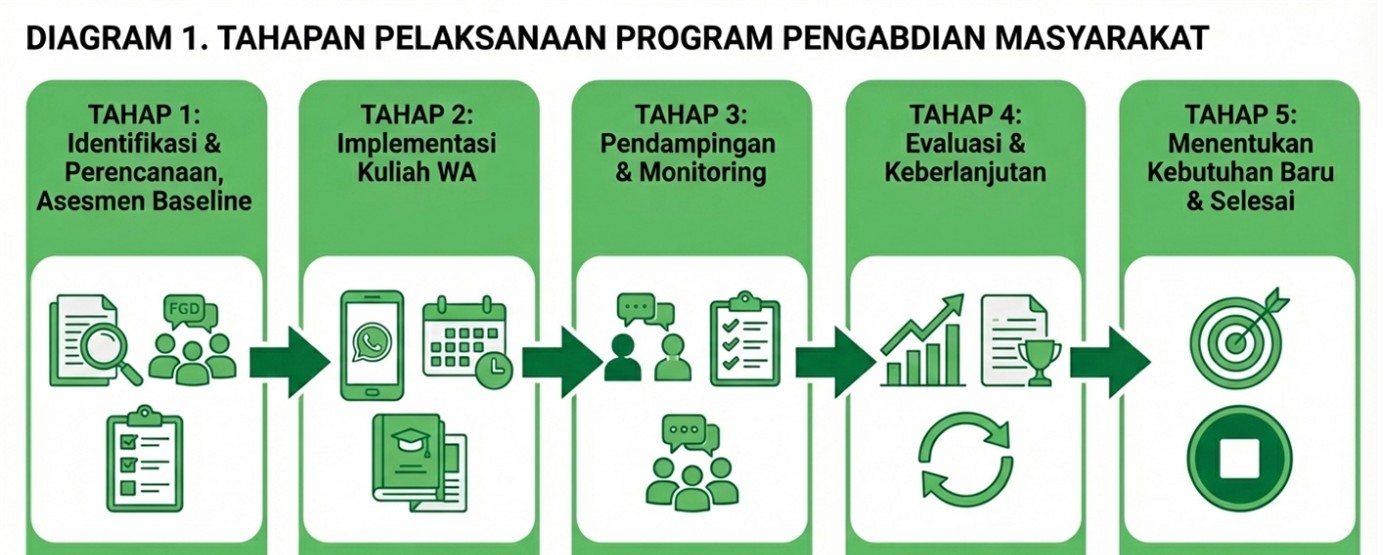
The financial literacy gap among Indonesian women, particularly housewives who shoulder primary responsibility for household financial management, presents a pressing concern that motivated this community service program. Employing a participatory action research (PAR) approach through WhatsApp-based lectures, the program was designed to strengthen financial literacy knowledge, encourage positive financial behavioral change, and improve the financial well-being of S****.id community members. Program material covered six core topics: budgeting, saving and emergency funds, debt management, basic investment, long-term financial planning, and financial goal setting. A total of 87 out of 124 participants completed the full program series, yielding a 70.2% retention rate. Average financial literacy scores rose from 46.4% to 73.4% (gain score +27.0 points), all financial behavior indicators showed significant improvement, and the post-program financial well-being index reached 62.37—accompanied by a meaningful growth in financial agency and transformative women's empowerment.
##plugins.themes.academic_pro.article.details##

This work is licensed under a Creative Commons Attribution-NonCommercial 4.0 International License.
JURPIKAT (Jurnal Pengabdian Kepada Masyarakat) accepts manuscripts that have not been published elsewhere and are not under consideration for publication by other print or electronic media. Authors retain copyright and grant the journal right of first publication with the work simultaneously licensed under a Creative Commons BY-NC License that allows others to share the work with an acknowledgment of the work's authorship and initial publication in this journal.
Authors are able to enter into separate, additional contractual arrangements for the non-exclusive distribution of the journal's published version of the work (eg, post it to an institutional repository, in a journal or publish it in a book), with an acknowledgment of its initial publication in this journal.
License to Publish
The non-commercial use of the article will be governed by the Attribution-NonCommercial 4.0 International (CC BY-NC 4.0). The author hereby grants JURPIKAT (Jurnal Pengabdian Kepada Masyarakat) an exclusive publishing and distribution license in the manuscript include tables, illustrations or other material submitted for publication as part of the manuscript (the “Articleâ€) in print, electronic and all other media (whether now known or later developed), in any form, in all languages, throughout the world, for the full term of copyright, and the right to license others to do the same, effective when the article is accepted for publication. This license includes the right to enforce the rights granted hereunder against third parties.
References
Amagir, A., Groot, W., Maassen van den Brink, H., & Wilschut, A. (2020). A review of financial-literacy education programs for children and adolescents. Citizenship, Social and Economics Education, 17(1), 56–80. https://doi.org/10.1177/2047173417719555
Archuleta, K. L., Dale, A., & Spann, S. M. (2020). College students and financial distress: Exploring debt, financial satisfaction, and financial anxiety. Journal of Financial Counseling and Planning, 24(2), 50–62.
Banerjee, A., Duflo, E., & Glennerster, R. (2020). Putting a band-aid on a corpse: Incentives for nurses in the Indian public health care system. Journal of the European Economic Association, 6(2–3), 487–500. https://doi.org/10.1162/JEEA.2008.6.2-3.487
Boisclair, D., Lusardi, A., & Michaud, P. C. (2023). Financial literacy and retirement planning in Canada. Journal of Pension Economics & Finance, 16(3), 277–296. https://doi.org/10.1017/S1474747215000311
Bottazzi, R., & Lusardi, A. (2021). Stereotypes in financial literacy: Evidence from PISA. Journal of Corporate Finance, 71, 101998. https://doi.org/10.1016/j.jcorpfin.2021.101998
Bruhn, M., & Zia, B. (2023). Stimulating managerial capital in emerging markets: The impact of business and financial literacy for young entrepreneurs. Journal of Development Effectiveness, 5(2), 232–266. https://doi.org/10.1080/19439342.2013.764390
Brüggen, E. C., Hogreve, J., Holmlund, M., Kabadayi, S., & Löfgren, M. (2022). Financial well-being: A conceptualization and research agenda. Journal of Business Research, 79, 228–237. https://doi.org/10.1016/j.jbusres.2017.03.013
Carpena, F., Cole, S., Shapiro, J., & Zia, B. (2021). Unpacking the causal chain of financial literacy. World Bank Policy Research Working Paper, No. 5798. World Bank.
Consumer Financial Protection Bureau (CFPB). (2021). Financial well-being: The goal of financial education. U.S. Consumer Financial Protection Bureau. https://www.consumerfinance.gov/data-research/research-reports/financial-well-being-the-goal-of-financial-education/
Cupák, A., Fessler, P., Hsu, J. W., & Kalleitner, F. (2021). Literacy and financial literacy: Evidence from a nationally representative sample. Journal of Financial Literacy, 10(2), 1–23.
Drexler, A., Fischer, G., & Schoar, A. (2020). Keeping it simple: Financial literacy and rules of thumb. American Economic Journal: Applied Economics, 6(2), 1–31. https://doi.org/10.1257/app.6.2.1
Frisancho, V. (2020). The impact of financial education for youth. IDB Working Paper Series, No. IDB-WP-1038. Inter-American Development Bank.
García, M. J. R., Junquera, B., & Ordiz, M. (2020). Using financial education to promote entrepreneurship in developing countries. International Journal of Finance & Economics, 14(3), 21–35.
Grohmann, A., Klühs, T., & Menkhoff, L. (2021). Does financial literacy improve financial inclusion? Cross country evidence. World Development, 111, 84–96. https://doi.org/10.1016/j.worlddev.2018.06.020
Hasler, A., & Lusardi, A. (2022). The gender gap in financial literacy: A global perspective. Global Financial Literacy Excellence Center (GFLEC), George Washington University.
Kabeer, N. (2020). Women's economic empowerment and inclusive growth: Labour markets and enterprise development. International Development Research Centre, 44(10), 1–70.
Kaiser, T., & Menkhoff, L. (2020). Financial education in schools: A meta-analysis of experimental studies. Economics of Education Review, 78, 101930. https://doi.org/10.1016/j.econedurev.2019.101930
Kaiser, T., Lusardi, A., Menkhoff, L., & Urban, C. (2021). Financial education affects financial knowledge and downstream behaviors. Journal of Financial Economics, 145(2), 255–272. https://doi.org/10.1016/j.jfineco.2021.09.022
Klapper, L., & Lusardi, A. (2020). Financial literacy and financial resilience: Evidence from around the world. Financial Management, 49(3), 589–614. https://doi.org/10.1111/fima.12283
Lührmann, M., Serra-Garcia, M., & Winter, J. (2020). Teaching teenagers in finance: Does it work? Journal of Banking & Finance, 54, 160–174. https://doi.org/10.1016/j.jbankfin.2014.11.009
Lusardi, A., Mitchell, O. S., & Oggero, N. (2023). Debt and financial vulnerability on the verge of retirement. Journal of Money, Credit and Banking, 52(5), 1005–1034. https://doi.org/10.1111/jmcb.12664
Mayne, J. (2020). Theory of change: Documenting contributions to results. Evaluation, 21(1), 70–78. https://doi.org/10.1177/1356389014558944
Morgan, P. J., & Trinh, L. Q. (2020). Fintech and financial literacy in Viet Nam. ADBI Working Paper Series, No. 1154. Asian Development Bank Institute.
Netemeyer, R. G., Warmath, D., Fernandes, D., & Lynch, J. G. (2022). How am I doing? Perceived financial well-being, its potential antecedents, and its relation to overall well-being. Journal of Consumer Research, 45(1), 68–89. https://doi.org/10.1093/jcr/ucx109
Otoritas Jasa Keuangan (OJK). (2021). Strategi Nasional Literasi Keuangan Indonesia (SNLKI) 2021–2025. Otoritas Jasa Keuangan Republik Indonesia. https://www.ojk.go.id/id/berita-dan-kegiatan/publikasi/Pages/Strategi-Nasional-Literasi-Keuangan-Indonesia-2021-2025.aspx
Otoritas Jasa Keuangan (OJK). (2022). Survei Nasional Literasi dan Inklusi Keuangan (SNLIK) 2022. Otoritas Jasa Keuangan Republik Indonesia. https://www.ojk.go.id/id/berita-dan-kegiatan/siaran-pers/Pages/Survei-Nasional-Literasi-dan-Inklusi-Keuangan-2022.aspx
Stolper, O. A., & Walter, A. (2021). Financial literacy, financial advice, and financial behavior. Journal of Business Economics, 87(5), 581–643. https://doi.org/10.1007/s11573-017-0853-9
United Nations. (2022). The sustainable development goals report 2022. United Nations Department of Economic and Social Affairs. https://unstats.un.org/sdgs/report/2022
Wallerstein, N., Duran, B., Oetzel, J., & Minkler, M. (2020). Community-based participatory research for health: Advancing social and health equity (3rd ed.). Jossey-Bass.
Wenger-Trayner, E., & Wenger-Trayner, B. (2020). Learning to make a difference: Value creation in social learning spaces. Cambridge University Press.
Xiao, J. J., Chen, C., & Chen, F. (2020). Consumer financial capability and financial satisfaction. Social Indicators Research, 118(1), 415–432. https://doi.org/10.1007/s11205-013-0414-8