Integrasi Mata Kuliah DKV Identitas Visual dalam Pemberdayaan UMKM untuk Meningkatkan Visual Branding Produk
##plugins.themes.academic_pro.article.sidebar##
Downloads
##plugins.themes.academic_pro.article.main##
Abstract
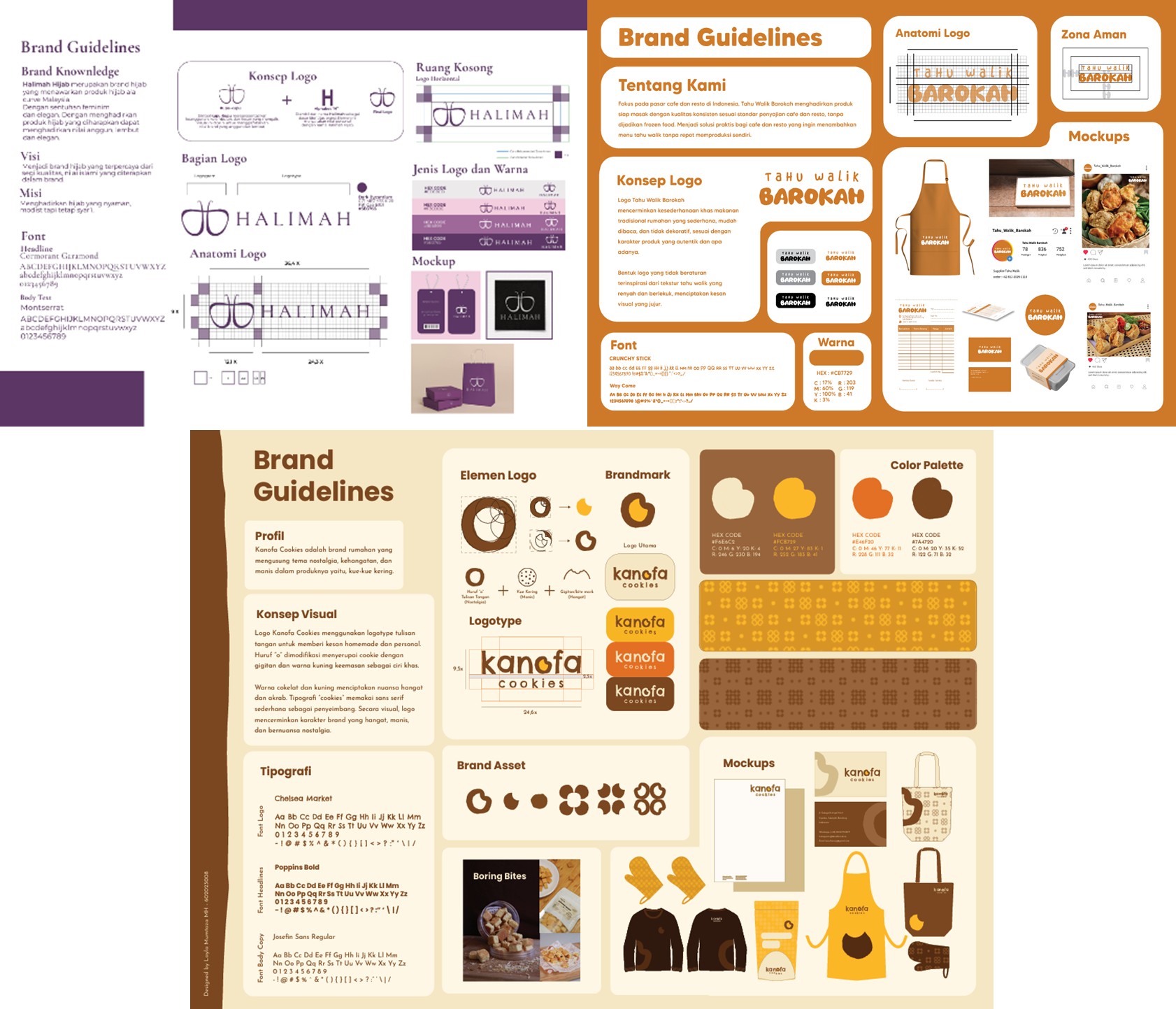
This Community Service Program (PKM) aims to integrate the Visual Identity course in Visual Communication Design into the empowerment of Micro, Small, and Medium Enterprises (MSMEs) to enhance product visual branding. The main issue faced by MSME partners is the lack of understanding of visual identity as a strategic marketing component, which impacts their competitiveness in the market. The method employed is a participatory approach using a project-based learning model, involving students actively in problem identification, analysis, design development, and implementation of visual identity. The results indicate a significant improvement in visual branding quality, including the development of more representative logos, consistent color schemes, appropriate typography. Furthermore, this program provides contextual learning experiences for students in applying design theories to real-world cases. The impact of this program benefits both MSMEs, through improved product image, and students, through enhanced professional competencies. Therefore, the integration of academic learning and community service proves to be an effective strategy in bridging academic objectives and societal needs..
##plugins.themes.academic_pro.article.details##

This work is licensed under a Creative Commons Attribution-NonCommercial 4.0 International License.
JURPIKAT (Jurnal Pengabdian Kepada Masyarakat) accepts manuscripts that have not been published elsewhere and are not under consideration for publication by other print or electronic media. Authors retain copyright and grant the journal right of first publication with the work simultaneously licensed under a Creative Commons BY-NC License that allows others to share the work with an acknowledgment of the work's authorship and initial publication in this journal.
Authors are able to enter into separate, additional contractual arrangements for the non-exclusive distribution of the journal's published version of the work (eg, post it to an institutional repository, in a journal or publish it in a book), with an acknowledgment of its initial publication in this journal.
License to Publish
The non-commercial use of the article will be governed by the Attribution-NonCommercial 4.0 International (CC BY-NC 4.0). The author hereby grants JURPIKAT (Jurnal Pengabdian Kepada Masyarakat) an exclusive publishing and distribution license in the manuscript include tables, illustrations or other material submitted for publication as part of the manuscript (the “Articleâ€) in print, electronic and all other media (whether now known or later developed), in any form, in all languages, throughout the world, for the full term of copyright, and the right to license others to do the same, effective when the article is accepted for publication. This license includes the right to enforce the rights granted hereunder against third parties.
References
Atmami, Harry & Sumarna, Imam Budi. (2026). Kolaborasi Branding 50 Tahun Sindang Reret: Strategi Sinergis Antara Dunia Usaha dan Akademisi dalam Penguatan Identitas Budaya . JURPIKAT, 7(1), 555-565. https://doi.org/10.37339/jurpikat.v7i1.2977
Bell, S. (2010). Project-based learning for the 21st century: Skills for the future. The Clearing House: A Journal of Educational Strategies, Issues and Ideas, 83(2), 39–43. https://doi.org/10.1080/00098650903505415
Best, K. (2015). Design management: Managing design strategy, process and implementation (2nd ed.). Bloomsbury Publishing.
Creswell, J. W. (2014). Research design: Qualitative, quantitative, and mixed methods approaches (4th ed.). SAGE Publications.
Klimchuk, M. R., & Krasovec, S. A. (2012). Packaging design: Successful product branding from concept to shelf (2nd ed.). John Wiley & Sons.
Kolb, D. A. (1984). Experiential learning: Experience as the source of learning and development. Prentice Hall.
Kotler, P., & Keller, K. L. (2016). Marketing management (15th ed.). Pearson Education.
Landa, R. (2014). Graphic design solutions (5th ed.). Cengage Learning.
Prince, M. J., & Felder, R. M. (2006). Inductive teaching and learning methods: Definitions, comparisons, and research bases. Journal of Engineering Education, 95(2), 123–138. https://doi.org/10.1002/j.2168-9830.2006.tb00884.x
Rustan, S. (2013). Mendesain logo. PT Gramedia Pustaka Utama.
Sugiyono. (2015). Metode penelitian pendidikan: Pendekatan kuantitatif, kualitatif, dan R&D. Alfabeta.
Thomas, J. W. (2000). A review of research on project-based learning. Autodesk Foundation.
Tjiptono, F. (2019). Strategi pemasaran: Prinsip dan penerapan. Andi.
Wheeler, A. (2017). Designing brand identity: An essential guide for the whole branding team (5th ed.). John Wiley & Sons.