Becoming a Digital Creator: Fostering an Adaptive Entrepreneurial Mindset Through the Use of Digital Technology
##plugins.themes.academic_pro.article.sidebar##
Downloads
##plugins.themes.academic_pro.article.main##
Abstract
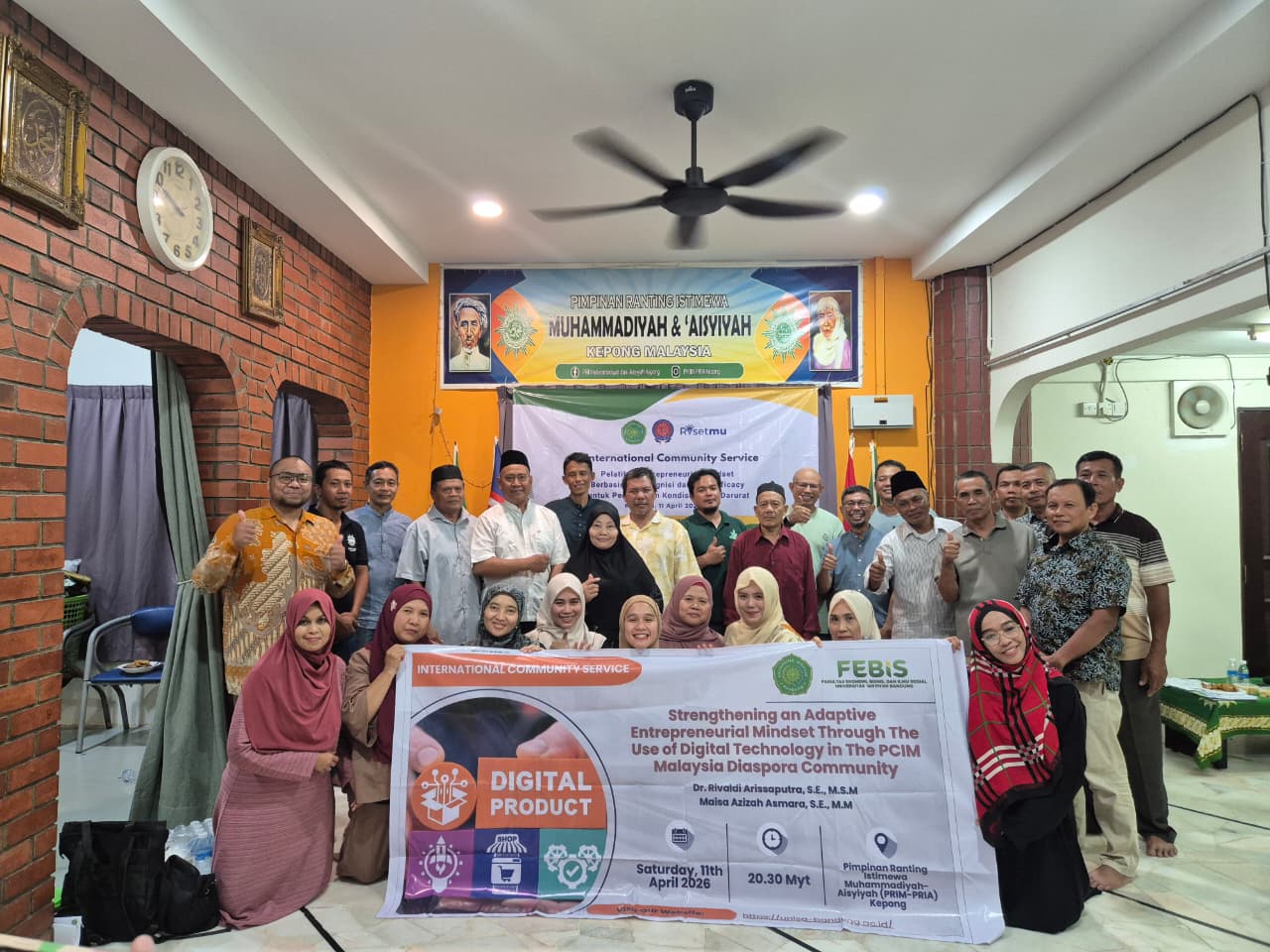
The Indonesian diaspora community in Malaysia, particularly members of Pimpinan Cabang Istimewa Muhammadiyah (PCIM) and Pimpinan Cabang Istimewa 'Aisyiyah (PCIA) Malaysia, faces limited understanding of digital products as tools for supporting adaptive economic activities within a multicultural environment. This community service activity aimed to strengthen the adaptive entrepreneurial mindset through enhanced understanding of digital products among the PCIM-PCIA Malaysia community. The program was implemented using a community-based, educative, and participatory counseling method, involving 20 purposively selected participants from PCIM and PCIA Malaysia members. Program effectiveness was measured using a pre-test and post-test design covering ten indicators of digital product understanding. Evaluation results demonstrated a significant improvement across all indicators, with average pre-test scores ranging from 2.10 to 3.10 increasing to 4.15 to 5.00 on a five-point scale following the intervention. The most notable gains were recorded in the Definition of Digital Products indicator (2.25 to 5.00) and the Practical Application of Digital Products in Daily Economic Activities indicator (3.10 to 4.95). These findings affirm that a structured, contextually grounded, and participatory counseling approach is effective in enhancing digital product literacy and strengthening the foundation of an adaptive entrepreneurial mindset within diaspora communities. It is recommended that the program be further developed through practical training, digital platform simulation, and ongoing mentoring to ensure the sustainability of the outcomes achieved.
##plugins.themes.academic_pro.article.details##

This work is licensed under a Creative Commons Attribution-NonCommercial 4.0 International License.
JURPIKAT (Jurnal Pengabdian Kepada Masyarakat) accepts manuscripts that have not been published elsewhere and are not under consideration for publication by other print or electronic media. Authors retain copyright and grant the journal right of first publication with the work simultaneously licensed under a Creative Commons BY-NC License that allows others to share the work with an acknowledgment of the work's authorship and initial publication in this journal.
Authors are able to enter into separate, additional contractual arrangements for the non-exclusive distribution of the journal's published version of the work (eg, post it to an institutional repository, in a journal or publish it in a book), with an acknowledgment of its initial publication in this journal.
License to Publish
The non-commercial use of the article will be governed by the Attribution-NonCommercial 4.0 International (CC BY-NC 4.0). The author hereby grants JURPIKAT (Jurnal Pengabdian Kepada Masyarakat) an exclusive publishing and distribution license in the manuscript include tables, illustrations or other material submitted for publication as part of the manuscript (the “Articleâ€) in print, electronic and all other media (whether now known or later developed), in any form, in all languages, throughout the world, for the full term of copyright, and the right to license others to do the same, effective when the article is accepted for publication. This license includes the right to enforce the rights granted hereunder against third parties.
References
Aisiyah, M. P. (2024). Peningkatan Pemahaman Analisis Pasar Berbasis Bussiness Model Canvas (BMC) bagi Santri Pondok Pesantren Al-Muhajirin III Bahrul Ulum Jombang. BUDIMAS: JURNAL PENGABDIAN MASYARAKAT, 6(3).
Alcántara-Rubio, L., Valderrama-Hernández, R., Solís-Espallargas, C., & Ruiz-Morales, J. (2022). The implementation of the SDGs in universities: a systematic review. Environmental Education Research, 28(11), 1585–1615.
Altsaury, R. A. A., Hidayatullah, M. S., Lutfi, J., & As’ ad, A. (2024). Analisis Fatwa MUI No. 24 Tahun 2017 Dalam Menjawab Tantangan Etika Dan Transparansi Transaksi Virtual: Studi Kasus Pada Platform E-Commerce Shopee Dan Tokopedia. Jurnal Hukum Ekonomi Syariah: AICONOMIA, 3(2), 79–91.
Hijriah, H. Y. (2016). Spiritualitas Islam dalam kewirausahaan. Tsaqafah, 12(1), 187–208.
Jabeen, S., Haq, S., Jameel, A., Hussain, A., Asif, M., Hwang, J., & Jabeen, A. (2020). Impacts of rural women’s traditional economic activities on household economy: Changing economic contributions through empowered women in rural Pakistan. Sustainability, 12(7), 2731.
Kardaya, D. (2022). Strategi Pengembangan Program Pembelajaran MBKM Dalam Rangka Peningkatan Indikator Kinerja Utama Perguruan Tinggi. Jurnal Sosial Humaniora, 13(1), 71–81.
Kowarin, L. R. N., Fitriana, F., & Santoso, R. A. (2024). PEMBERDAYAAN PEREMPUAN PAPUA UNTUK KEMAJUAN EKONOMI LOKAL. Jurnal Bina Bangsa Ekonomika, 17(2), 1882–1898.
Machmud, A., & Hidayat, Y. M. (2020). Characteristics of Islamic entrepreneurship and the business success of SMEs in Indonesia. Journal of Entrepreneurship Education, 23(2), 1–16.
Maulena, M., Zulkarnain, T., & Mariana, M. (2024). Transformasi Bisnis dengan Etika Bisnis Islam: Keadilan dan Tanggung Jawab dalam Ekonomi Syariah. Jurnal Sosial Humaniora Sigli, 7(2).
Mehtap, S., Ozmenekse, L., & Caputo, A. (2019). “I’ma stay at home businesswoman”: an insight into informal entrepreneurship in Jordan. Journal of Entrepreneurship in Emerging Economies, 11(1), 44–65.
Muhammad, N., Robinson, D., & Nisar, M. (2019). The influence of Muslim marriages on entrepreneurial intentions of women entrepreneurs: Evidence from Pakistan. International Journal of Entrepreneurial Behavior & Research, 25(7), 1389–1409.
Okolie, U. C., Ehiobuche, C., Igwe, P. A., Agha-Okoro, M. A., & Onwe, C. C. (2022). Women entrepreneurship and poverty alleviation: Understanding the economic and socio-cultural context of the Igbo Women’s basket weaving enterprise in Nigeria. In Entrepreneurship and the Informal Sector (pp. 8–27). Routledge.
Polas, M. R. H., Raju, V., Muhibbullah, M., & Tabash, M. I. (2022). Rural women characteristics and sustainable entrepreneurial intention: a road to economic growth in Bangladesh. Journal of Enterprising Communities: People and Places in the Global Economy, 16(3), 421–449.
Shastri, S., Shastri, S., & Pareek, A. (2019). Motivations and challenges of women entrepreneurs: Experiences of small businesses in Jaipur city of Rajasthan. International Journal of Sociology and Social Policy, 39(5/6), 338–355.
Ulya, S. (2025). PENERAPAN MODEL BISNIS KANVAS DALAM WIRAUSAHA HALAL BERBASIS PESANTREN. Jurnal Ekonomi Islam, 2(1), 118–143.
Ummiroh, I. R., Schwab, A., & Dhewanto, W. (2022). Women social entrepreneurs in a Muslim society: how to manage patriarchy and spouses. Social Enterprise Journal, 18(4), 660–690.
Whittle, J. (2019). A critique of approaches to ‘domestic work’: Women, work and the pre-industrial economy. Past & Present, 243(1), 35–70.
Winarsih, S., & Fasa, M. I. (2024). Penerapan etika bisnis Islam dalam strategi pemasaran syariah. Jurnal Intelek Dan Cendikiawan Nusantara, 1(5), 7730–7739.