Penguatan Literasi Teknologi IoT dan Machine Learning bagi Mahasiswa Vokasi melalui Diseminasi Pengetahuan Sistem Elektronika Modern Berbasis Kolaborasi Internasional
##plugins.themes.academic_pro.article.sidebar##
Downloads
##plugins.themes.academic_pro.article.main##
Abstract
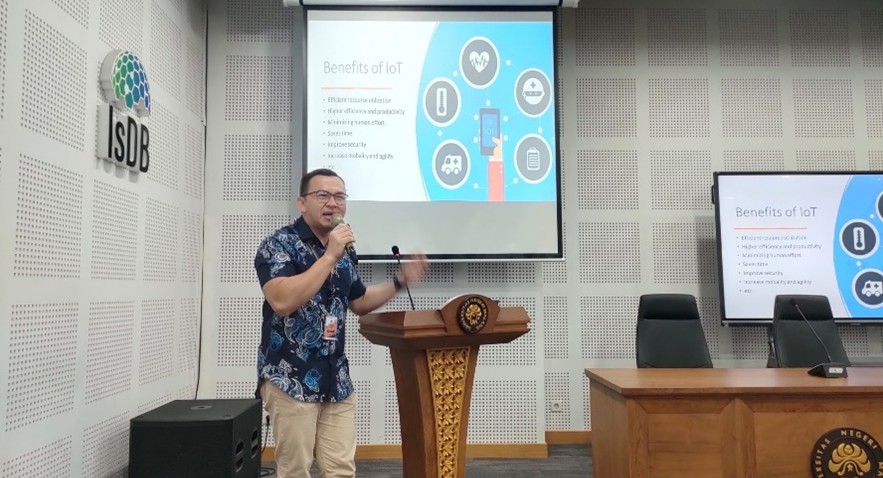
Perkembangan Internet of Things (IoT) dan Machine Learning menuntut mahasiswa vokasi memiliki literasi teknologi yang relevan dengan sistem elektronika modern. Kegiatan pengabdian ini bertujuan untuk memperkuat literasi teknologi mahasiswa melalui diseminasi pengetahuan berbasis kolaborasi internasional. Kegiatan dilaksanakan di Program Studi Teknologi Rekayasa Sistem Elektronika Fakultas Vokasi Universitas Negeri Malang dengan menghadirkan narasumber dari Universiti Teknologi MARA Malaysia. Peserta kegiatan berjumlah 40 mahasiswa, dan seluruh peserta mengisi angket evaluasi. Metode pelaksanaan meliputi identifikasi kebutuhan, perencanaan kegiatan, diseminasi pengetahuan, diskusi interaktif, serta evaluasi respons peserta menggunakan angket skala Likert 1–5. Hasil evaluasi menunjukkan respons sangat positif, dengan rata-rata keseluruhan skor 4,43 dan mayoritas aspek berada pada kategori sangat baik. Kegiatan ini menunjukkan respons positif terhadap penguatan literasi teknologi mahasiswa vokasi, terutama pada pemahaman konsep, relevansi materi, kebermanfaatan kegiatan, serta kebutuhan tindak lanjut berupa workshop teknis.
##plugins.themes.academic_pro.article.details##

This work is licensed under a Creative Commons Attribution-NonCommercial 4.0 International License.
JURPIKAT (Jurnal Pengabdian Kepada Masyarakat) accepts manuscripts that have not been published elsewhere and are not under consideration for publication by other print or electronic media. Authors retain copyright and grant the journal right of first publication with the work simultaneously licensed under a Creative Commons BY-NC License that allows others to share the work with an acknowledgment of the work's authorship and initial publication in this journal.
Authors are able to enter into separate, additional contractual arrangements for the non-exclusive distribution of the journal's published version of the work (eg, post it to an institutional repository, in a journal or publish it in a book), with an acknowledgment of its initial publication in this journal.
License to Publish
The non-commercial use of the article will be governed by the Attribution-NonCommercial 4.0 International (CC BY-NC 4.0). The author hereby grants JURPIKAT (Jurnal Pengabdian Kepada Masyarakat) an exclusive publishing and distribution license in the manuscript include tables, illustrations or other material submitted for publication as part of the manuscript (the “Articleâ€) in print, electronic and all other media (whether now known or later developed), in any form, in all languages, throughout the world, for the full term of copyright, and the right to license others to do the same, effective when the article is accepted for publication. This license includes the right to enforce the rights granted hereunder against third parties.
References
Astuti, M., Arifin, Z., Mutohhari, F., & Nurtanto, M. (2021). Competency of digital technology: The maturity levels of teachers and students in vocational education in Indonesia. Journal of Education Technology. https://doi.org/10.23887/jet.v5i3.35108
Boulton, H. (2019). Crossing boundaries: The affordances of new technologies in supporting a collaborative learning environment for doctoral students learning transnationally. Technology, Pedagogy and Education, 28, 255–267. https://doi.org/10.1080/1475939x.2018.1559761
Bzai, J., Alam, F., Dhafer, A., Bojovic, M., Altowaijri, S., Niazi, I., & Mehmood, R. (2022). Machine learning-enabled Internet of Things (IoT): Data, applications, and industry perspective. Electronics. https://doi.org/10.3390/electronics11172676
Guo, X., Zhang, Z., Ren, Z., Li, D., Xu, C., Wang, L., Liu, W., Zhuge, Y., Zhou, G., & Lee, C. (2025). Advances in intelligent nano-micro-scale sensors and actuators: Moving toward self-sustained edge AI microsystems. Advanced Materials, 37. https://doi.org/10.1002/adma.202510417
Jakubakynov, B., Tolegenuly, N., Naribai, R., Nurzhanova, Z., Shcherban, T., & Nebelenchuk, I. (2024). Innovative technologies in higher education: Developing international cooperation in professional training. Globalisation, Societies and Education. https://doi.org/10.1080/14767724.2024.2339309
Jatmoko, D., Suyitno, S., Sattar, M., Nurtanto, M., Kholifah, N., Masek, A., & Ramadhan, H. (2023). The factors influencing digital literacy practice in vocational education: A structural equation modeling approach. European Journal of Educational Research. https://doi.org/10.12973/eu-jer.12.2.1109
Kovalchuk, V., Maslich, S., & Movchan, L. (2023). Digitalization of vocational education under crisis conditions. Educational Technology Quarterly. https://doi.org/10.55056/etq.49
Lui, H., & Persson, M. (2025). Constructive alignment in diagnostic imaging—A multidisciplinary course in biomedical engineering over a decade and beyond. 2025 IEEE International Conference on Teaching, Assessment, and Learning for Engineering (TALE), 1–8. https://doi.org/10.1109/tale66047.2025.11346674
Mishra, S., & Tyagi, A. (2022). The role of machine learning techniques in Internet of Things-based cloud applications. In Internet of Things. https://doi.org/10.1007/978-3-030-87059-1_4
Morse, J., Bower, T., & Plett, E. (2024). An interdisciplinary curriculum in robotics and automation to fill an industry gap. 2023 ASEE Midwest Section Conference Proceedings. https://doi.org/10.18260/1-2-1115.1139-46363
Rossiter, J. (2025). Modernising the control curriculum and delivery to meet 21st century needs. Processes. https://doi.org/10.3390/pr13020531
Sokol, M., & Zhang, J. (2023). Expanding educational spaces of cooperation and social relations through technology-enhanced international virtual exchanges. Edukacja Międzykulturowa. https://doi.org/10.15804/em.2023.04.11
Tan, X., Lin, X., & Zhuang, R. (2024). Development and validation of a secondary vocational school students’ digital learning competence scale. Smart Learning Environments, 11. https://doi.org/10.1186/s40561-024-00325-6
Tjahjono, B., Hermawan, D., Millah, S., & Evans, R. (2025). Bridging the skills gap curriculum transformation for automation industries and the role of digital technopreneurship. Aptisi Transactions on Technopreneurship (ATT). https://doi.org/10.34306/att.v7i2.620
Wihlborg, M., Friberg, E., Rose, K., & Eastham, L. (2018). Facilitating learning through an international virtual collaborative practice: A case study. Nurse Education Today, 61, 3–8. https://doi.org/10.1016/j.nedt.2017.10.007
Widoyoko, E. P. (2012). Teknik penyusunan instrumen penelitian. Pustaka Pelajar.
Zamiri, M., & Esmaeili, A. (2024). Methods and technologies for supporting knowledge sharing within learning communities: A systematic literature review. Administrative Sciences. https://doi.org/10.3390/admsci14010017