Pencegahan Penurunan Kognitif pada Lansia melalui Finger Game
##plugins.themes.academic_pro.article.sidebar##
Downloads
##plugins.themes.academic_pro.article.main##
Abstract
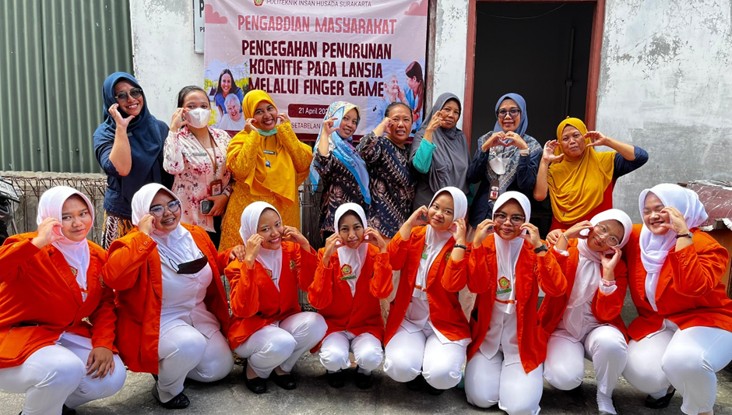
Finger games are an alternative activity for the elderly to prevent cognitive decline. Cognitive function is a person's ability to recognize and interpret things in the environment. Cognitive function is closely related to the human brain. The brain functions as a visual perception as well as the ability to calculate, speak, and process all information and memory. In some elderly who have entered the aging phase, symptoms of cognitive dysfunction include decreased concentration, difficulty memorizing information, greater forgetfulness, and difficulty describing certain forms or functions. The purpose of this health education activity is to demonstrate finger games as an alternative to prevent cognitive decline in the elderly. Participants in this activity were 12 elderly at the ILP Seruni-Setabelan Surakarta, which is one of the Posyandu supported by the Community Health Center Setabelan in Surakarta. The examination results showed that the average cognitive function score of respondents before the finger game intervention (pre- intervention) was 20.5, while after the finger game intervention (post- intervention) it increased to 25.6. There was a difference of 5.1 points in increase, indicating an increase in cognitive function in the elderly after the finger game intervention. And the elderly are able to redemonstrate finger games independently.
##plugins.themes.academic_pro.article.details##

This work is licensed under a Creative Commons Attribution-NonCommercial 4.0 International License.
JURPIKAT (Jurnal Pengabdian Kepada Masyarakat) accepts manuscripts that have not been published elsewhere and are not under consideration for publication by other print or electronic media. Authors retain copyright and grant the journal right of first publication with the work simultaneously licensed under a Creative Commons BY-NC License that allows others to share the work with an acknowledgment of the work's authorship and initial publication in this journal.
Authors are able to enter into separate, additional contractual arrangements for the non-exclusive distribution of the journal's published version of the work (eg, post it to an institutional repository, in a journal or publish it in a book), with an acknowledgment of its initial publication in this journal.
License to Publish
The non-commercial use of the article will be governed by the Attribution-NonCommercial 4.0 International (CC BY-NC 4.0). The author hereby grants JURPIKAT (Jurnal Pengabdian Kepada Masyarakat) an exclusive publishing and distribution license in the manuscript include tables, illustrations or other material submitted for publication as part of the manuscript (the “Articleâ€) in print, electronic and all other media (whether now known or later developed), in any form, in all languages, throughout the world, for the full term of copyright, and the right to license others to do the same, effective when the article is accepted for publication. This license includes the right to enforce the rights granted hereunder against third parties.
References
Istianti, D. W. 2025. “Pendampingan Dan Pembinaan Kesejahteraan Lansia Dengan Masalah Kognitif Melalui Kader Kesehatan.” Arreta: Community Health Service Journal 1(2): 47–54. https://jurnal.stikesbethesda.ac.id/index.php/arreta/article/view/1008.
Kementerian Kesehatan Republik Indonesia. 2021. Rencana Aksi Nasional Kesehatan Lanjut Usia Tahun 2020-2024. Jakarta: Kemenkes RI.
Mardiana, K. 2022. “Gambaran Fungsi Kognitif Berdasarkan Karakteristik Lansia Yang Tinggal Di Komunitas: Cognitive Functions Based on the Characteristics of Elderly Indwelling-Community.” Jurnal Ilmiah Keperawatan (Scientific Journal of Nursing) 8(4): 577–84.
Oriza, A., Putri, D. T., Nazhiefa, A., Rochmah, A. I., Adlina, N. S., Mulyati, M., & Riswano, R. 2026. “Implementasi Media Kognitif Brain Hand Challenge Edukasi Lansia Sehat Di Panti Jompo Wijaya Kusuma.” Eastasouth Journal of Impactive Community Services 4(02): 175–88.
Perim, C., Sousa, C., & Damásio, M. J. 2025. “Digital Literacy and Older People: A Case Study in Lifelong Learning Institutions in Lisbon.” Educational Gerontology.
Prahasasgita, M. S., & Lestari, M. D. 2023. “Stimulasi Fungsi Kognitif Pada Lanjut Usia Di Indonesia: Tinjauan Literatur.” Buletin Psikologi 31(2): 247–64.
Pratiwi, A., & Handayani, S. 2022. “Pengaruh Latihan Motorik Halus Terhadap Fungsi Kognitif Pada Lansia.” Jurnal Keperawatan Indonesia 25(2): 85–92.
Ratnasari, I. M., Witdiawati, W., & Lukman, M. 2025. “Intervensi Non–Farmakologi Melalui Cognitive Stimulation Therapy Dalam Peningkatan Fungsi Kognitif Pada Lansia Dengan Demensia.” Malahayati Nursing Journal 7(8): 3274–85. https://doi.org/10.33024/mnj.v7i8.16985.
Roziqin, M. 2018. Doctoral dissertation, Universitas Airlangga “Pengaruh Permainan Uno Stacko Terhadap Peningkatan Fungsi Kognitif Lansia Di Griya Usila Santo Yosef Surabaya.” http://lib.unair.ac.id/.
Utakrit, N., Anurak, P., Ngamwongwetchakul, T., & Faythet, P. 2025. “Engaging Older Adult Learners Through Learn n’ Play Technology Integrating with AI Image Generator.” In APIT 2025-2025 7th Asia Pacific Information Technology Conference, , 88–93.
Wibowo, A. S. H., & Irianto, K. D. 2024. “Pengembangan Gim Tebak Kata Berbasis Android Untuk Meningkatkan Fungsi Kognitif Lansia.” Technologia: Jurnal Ilmiah 15(3): 537–49. https://ojs.uniska-bjm.ac.id/index.php/JIT/article/view/15336.
Widodo, A. 2020. “Pengaruh Stimulasi Sensorimotor Terhadap Fungsi Kognitif Lansia.” Jurnal Kesehatan Masyarakat 15(2): 120–126.