Internalisasi Mitigasi Risiko Kebakaran Listrik melalui Gamifikasi Digital di SMP–SMA Islam Al-Falah Rempoa: Pendekatan Participatory Action Research untuk Membangun Budaya Keselamatan Siswa
##plugins.themes.academic_pro.article.sidebar##
Downloads
##plugins.themes.academic_pro.article.main##
Abstract
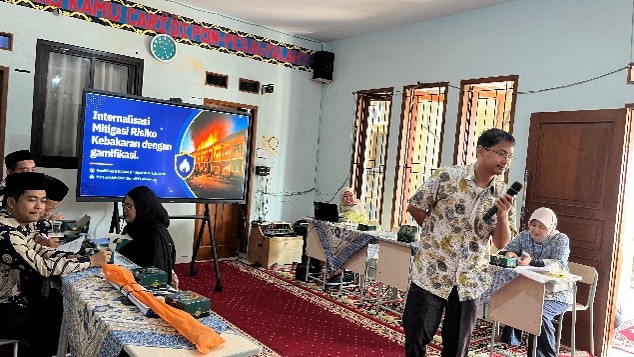
Risiko kebakaran di lingkungan sekolah sering terabaikan, padahal dampaknya dapat berupa kerugian aset hingga korban jiwa. Pengabdian ini bertujuan meningkatkan literasi mitigasi kebakaran siswa melalui media gamifikasi digital berbasis skenario. Metode Participatory Action Research (PAR) dilaksanakan di SMP–SMA Islam Al-Falah Rempoa melalui diagnosis bersama guru, pengembangan media gamifikasi, sosialisasi, pelatihan, dan evaluasi pada 43 siswa (desain one-group pretest–posttest). Rata-rata skor meningkat dari 9,16 (SD = 1,27) menjadi 9,88 (SD = 0,45) (selisih 0,72; 95% CI 0,41–1,03; p < 0,001). Item tentang tata letak stop kontak aman menunjukkan peningkatan tertinggi (67,4% menjadi 97,7%). Gamifikasi digital efektif sebagai media edukasi keselamatan kebakaran yang menarik bagi siswa
##plugins.themes.academic_pro.article.details##

This work is licensed under a Creative Commons Attribution-NonCommercial 4.0 International License.
JURPIKAT (Jurnal Pengabdian Kepada Masyarakat) accepts manuscripts that have not been published elsewhere and are not under consideration for publication by other print or electronic media. Authors retain copyright and grant the journal right of first publication with the work simultaneously licensed under a Creative Commons BY-NC License that allows others to share the work with an acknowledgment of the work's authorship and initial publication in this journal.
Authors are able to enter into separate, additional contractual arrangements for the non-exclusive distribution of the journal's published version of the work (eg, post it to an institutional repository, in a journal or publish it in a book), with an acknowledgment of its initial publication in this journal.
License to Publish
The non-commercial use of the article will be governed by the Attribution-NonCommercial 4.0 International (CC BY-NC 4.0). The author hereby grants JURPIKAT (Jurnal Pengabdian Kepada Masyarakat) an exclusive publishing and distribution license in the manuscript include tables, illustrations or other material submitted for publication as part of the manuscript (the “Articleâ€) in print, electronic and all other media (whether now known or later developed), in any form, in all languages, throughout the world, for the full term of copyright, and the right to license others to do the same, effective when the article is accepted for publication. This license includes the right to enforce the rights granted hereunder against third parties.
References
Bai, S., Zeng, H., Zhong, Q., Shen, Y., Cao, L., & He, M. (2024). Application of Gamification Teaching in Disaster Education: Scoping Review. JMIR Serious Games, 12, e64939–e64939. https://doi.org/10.2196/64939
Catedrilla, G. M. B., Lerios, J. L., Sapin, S. B., Lanuang, M. C., & Buama, C. A. C. (2021). An android-based mobile educational game for disaster preparedness: An input to risk reduction management. Indonesian Journal of Electrical Engineering and Computer Science, 22(2), 936. https://doi.org/10.11591/ijeecs.v22.i2.pp936-943
Kusumandari, R. B., Wibawa, B., & Muchtar, H. (2019). Game Learning to Optimize Learning in Disaster Area. KnE Social Sciences. https://doi.org/10.18502/kss.v3i18.4744
Moore, S., & Donaldson, L. P. (2022). Incorporating Community Based Participatory Action Research in Social Work Graduate Education. Journal of Teaching in Social Work, 42(4), 409–422. https://doi.org/10.1080/08841233.2022.2117761
Pooley, K., Nunez, S., & Whybro, M. (2021). Evidence-based practices of effective fire safety education programming for children. Australian Journal of Emergency Management, 10.47389/36(No 2), 34–41. https://doi.org/10.47389/36.2.34
Raharjo, A., Januar Ariyanto, & Farahul Jannah. (2025). Essential Competencies of Public Health Professionals in Disaster Management: A Scoping Review. Advances in Healthcare Research, 3(2), 80–102. https://doi.org/10.60079/ahr.v3i2.505
Raharjo, A., Suparni, S., Ariyanto, J., & Jannah, F. (2025). Pelatihan dan Edukasi Berbasis Digital dalam Mewujudkan Budaya Keselamatan di Perguruan Tinggi. Jurnal Pengabdian UNDIKMA, 6(1), 174. https://doi.org/10.33394/jpu.v6i1.14453
Rofiah, N. H., Kawai, N., & Nur Hayati, E. (2021). Key elements of disaster mitigation education in inclusive school setting in the Indonesian context. Jàmbá - Journal of Disaster Risk Studies, 13(1). https://doi.org/10.4102/jamba.v13i1.1159
Seyedin, H., Dowlati, M., Moslehi, S., & Sakhaei, F. S. (2020). Health, safety, and education measures for fire in schools: A review article. Journal of Education and Health Promotion, 9. https://doi.org/10.4103/jehp.jehp_665_19
Sirait, R., Fath, N., & Laksana, E. P. (2019). Socialization of the Right Electric Usage to Prevent Hazardous Fire in Tugu Selatan Village, Koja, North Jakarta. ICCD, 2(1), 363–368. https://doi.org/10.33068/iccd.Vol2.Iss1.232
Stringer, E. (2024). Action Research in Education (2. Auflage). Pearson Pearson Education Limited.
United Nations. (2015). Sendai Framework for Disaster Risk Reduction 2015—2030. https://www.undrr.org/publication/sendai-framework-disaster-risk-reduction-2015-2030
Yunus, S. (2024). Urban fire disaster response delay model revisited. Science World Journal, 19(3), 859–867. https://doi.org/10.4314/swj.v19i3.34
Zela Septikasari, Adi Atmoko, & Insih Wilujeng. (2024). Analysis on Disaster Education Urgency of Improving Preparedness at Elementary Schools in Disaster Prone Areas. Pegem Journal of Education and Instruction, 14(4). https://doi.org/10.47750/pegegog.14.04.28