Pemberdayaan Kelompok Wanita Tani SMART-W2V TUMI : Pengelolaan Limbah Ternak Berbasis Sistem Informasi dan Bisnis Digital
##plugins.themes.academic_pro.article.sidebar##
Downloads
##plugins.themes.academic_pro.article.main##
Abstract
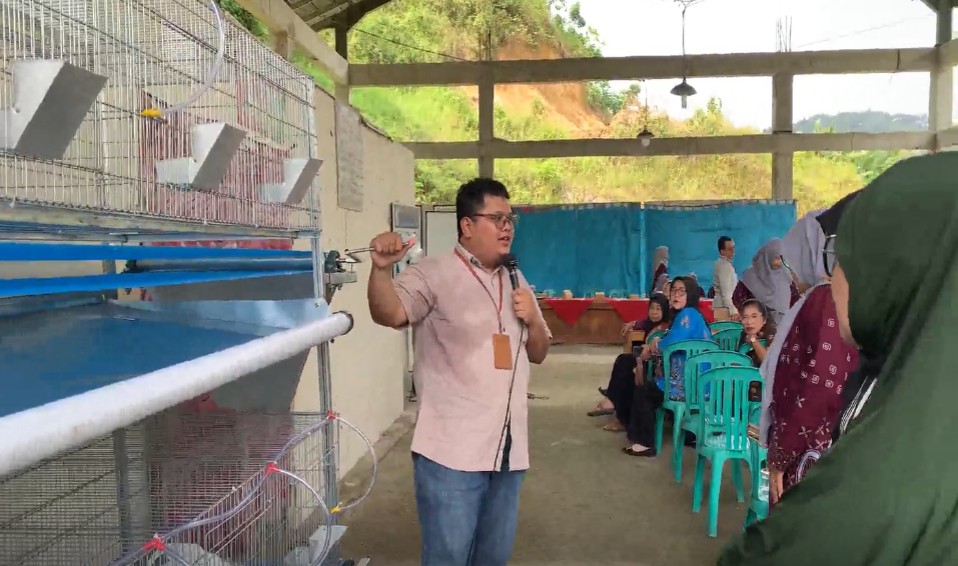
The Women Farmers Group (KWT) of Tumiyang Village holds significant potential in managing rabbit livestock waste, yet faces challenges including limited knowledge, skills, and access to appropriate technology and digital markets. This community service activity aimed to empower KWT economically through the SMART-W2V TUMI Model using two methods: livestock waste technology demonstration and a digital business workshop, involving 41 KWT members. The demonstration covered the production of solid organic fertilizer, liquid organic fertilizer (POC), and biopesticide from rabbit waste. Evaluation results showed significant improvement, with average pre-test scores rising from 70.9% to 81.6% in the post-test, yielding an N-Gain of 0.37 (moderate category). A total of 78.05% of participants achieved the Very Good category. The SMART-W2V TUMI Model proved effective as an integrated approach combining appropriate technology, information systems, and digital business strategies to foster economic empowerment based on local resources in Tumiyang Village.
##plugins.themes.academic_pro.article.details##

This work is licensed under a Creative Commons Attribution-NonCommercial 4.0 International License.
JURPIKAT (Jurnal Pengabdian Kepada Masyarakat) accepts manuscripts that have not been published elsewhere and are not under consideration for publication by other print or electronic media. Authors retain copyright and grant the journal right of first publication with the work simultaneously licensed under a Creative Commons BY-NC License that allows others to share the work with an acknowledgment of the work's authorship and initial publication in this journal.
Authors are able to enter into separate, additional contractual arrangements for the non-exclusive distribution of the journal's published version of the work (eg, post it to an institutional repository, in a journal or publish it in a book), with an acknowledgment of its initial publication in this journal.
License to Publish
The non-commercial use of the article will be governed by the Attribution-NonCommercial 4.0 International (CC BY-NC 4.0). The author hereby grants JURPIKAT (Jurnal Pengabdian Kepada Masyarakat) an exclusive publishing and distribution license in the manuscript include tables, illustrations or other material submitted for publication as part of the manuscript (the “Articleâ€) in print, electronic and all other media (whether now known or later developed), in any form, in all languages, throughout the world, for the full term of copyright, and the right to license others to do the same, effective when the article is accepted for publication. This license includes the right to enforce the rights granted hereunder against third parties.
References
Edya Moelia Moeis, Mukhlison Mukhlison, & Meisya Alma Azizah. (2025). Inovasi Teknologi Pengolahan Urin Kelinci Menjadi Pupuk Organik Cair : Perspektif Kewirausahaan dalam Peternakan Berkelanjutan. Jurnal Riset Rumpun Ilmu Tanaman, 4(2), 11–18. https://doi.org/10.55606/jurrit.v4i2.6581
Limbah, P., Sapi, K., Pupuk, M., Untuk, O., Masyarakat, P. E., Fuad, K., Fakultas Ekonomi, W., Islam, U., Agung, S., Raya, J., & Km, K. (2021). PEMANFAATAN LIMBAH KOTORAN SAPI MENJADI PUPUK ORGANIK UNTUK PENINGKATAN EKONOMI MASYARAKAT. In Jurnal Abdimas (Vol. 07).
Rifda Nur Azkiyah. (2026). Pemberdayaan Kelompok Wanita Tani Melalui Program Pertanian Terpadu dalam Ketahanan Pangan Keluarga. RISOMA : Jurnal Riset Sosial Humaniora Dan Pendidikan, 4(2), 126–135. https://doi.org/10.62383/risoma.v4i2.1576
Rosniawaty, S., Abdul Halim luthfi, Intan Ratna Dewi Anjarsari, Mira Ariyanti, & Rija Sudirja. (2025). UTILIZATION OF COW DUNG AND RABBIT URINE FERTILIZER TO OPTIMIZE THE GROWTH OF LIBERICA COFFEE SEEDLINGS (Coffea liberica L.). Agrisaintifika: Jurnal Ilmu-Ilmu Pertanian, 9(3), 508–516. https://doi.org/10.32585/ags.v9i3.7098
Sari, S. P., Kusumawati, A., & Saibi, I. R. A. (2025). INTEGRATED FARMING SYSTEM THAT INCREASES AGRICULTURAL PRODUCTIVITY ON YARD LAND. Jurnal Pertanian Agros, 27(1).
Siti M. Sholihah 1, M. A. W. 2. (2020). 19-44-1-PB. Jurnal Ilmiah Respati Pertanian Vol. 2, No. 9, 1411–7126.
Sukamta, S., Abdus Shomad, M., & Wisnujati, A. (2017). Pengelolaan Limbah Ternak Sapi Menjadi Pupuk Organik Komersial di Dusun Kalipucang, Bangunjiwo, Bantul, Yogyakarta. BERDIKARI : Jurnal Inovasi Dan Penerapan Ipteks, 5(1). https://doi.org/10.18196/bdr.5113
Utami, D. C., Swasono, Muh. A. H., & Ainiyah, R. (2025). Pelatihan dan Pendampingan Pembuatan Pupuk Organik dan Pestisida Nabati pada Perkumpulan Tani Pemuda. Jurnal Pengabdian Dan Peningkatan Mutu Masyarakat (Janayu), 6(1), 72–81. https://doi.org/10.22219/janayu.v6i1.36502
Yora, M., Elinda, F., Meyuliana, A., Jayagma Ilham, D., Agroteknologi, J., & Pertanian Universitas Mahaputra Muhammad Yamin, F. (2022). PEMANFAATAN LIMBAH URINE SAPI, SAMPAH ORGANIK DAN GULMA SEBAGAI PUPUK ORGANIK DAN PESTISIDA NABATI DI KELOMPOK TANI TERNAK SAPAKEK BASAMO. Communnity Development Journal, 3(2).