Optimalisasi Media Sosial sebagai Sarana Pemasaran Produk dan Jasa di Era Digital bagi Siswa Yayasan Global Cahaya Nubuwwah Insani (GCNI), Purwakarta
##plugins.themes.academic_pro.article.sidebar##
Downloads
##plugins.themes.academic_pro.article.main##
Abstract
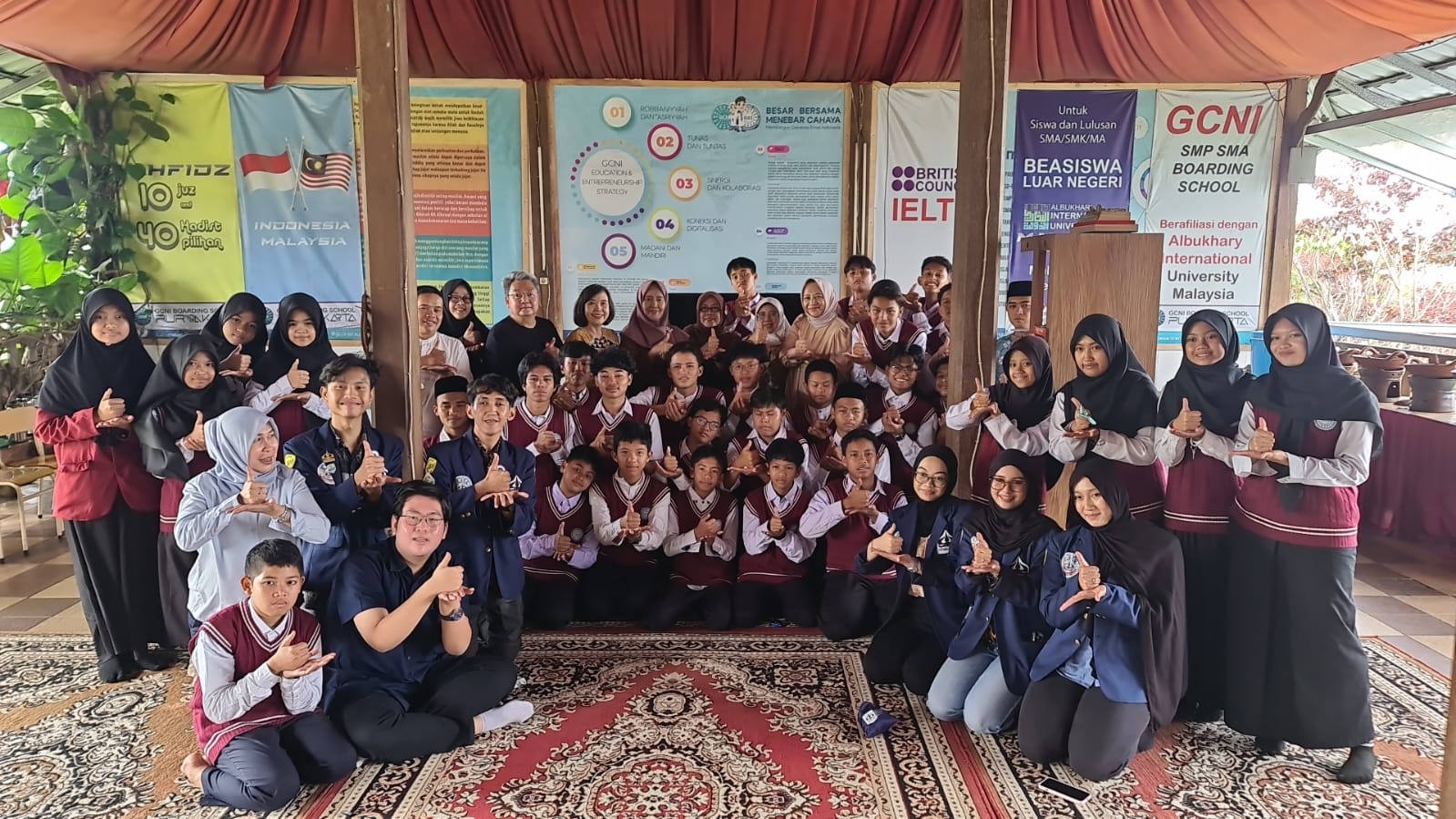
Perkembangan teknologi digital telah mengubah strategi pemasaran produk dan jasa melalui pemanfaatan media sosial yang semakin luas. Namun, masih banyak generasi muda yang belum memiliki literasi digital dan kemampuan memanfaatkan media sosial secara efektif sebagai media pemasaran. Oleh karena itu, Fakultas Ekonomi dan Bisnis Universitas Trisakti menyelenggarakan kegiatan Pengabdian kepada Masyarakat (PKM) bertema Optimalisasi Media Sosial sebagai Sarana Pemasaran Produk dan Jasa di Era Digital bekerja sama dengan Yayasan Global Cahaya Nubuwwah Insani (GCNI), Purwakarta. Kegiatan dilaksanakan secara luring pada 14 Maret 2026 dengan melibatkan 30 siswa-siswi Yayasan GCNI. Metode yang digunakan meliputi ceramah, diskusi interaktif, studi kasus, dan praktik sederhana mengenai pemasaran digital melalui media sosial. Materi mencakup konsep social media marketing, strategi pengelolaan konten, optimalisasi platform digital, customer engagement, dan pembangunan komunitas pelanggan. Hasil kegiatan menunjukkan peningkatan pemahaman peserta mengenai strategi pemasaran digital, kemampuan mengidentifikasi konten yang efektif, serta pentingnya membangun hubungan dengan pelanggan melalui media sosial. Program ini diharapkan mampu meningkatkan literasi digital dan menumbuhkan jiwa kewirausahaan berbasis teknologi pada generasi muda.
##plugins.themes.academic_pro.article.details##

This work is licensed under a Creative Commons Attribution-NonCommercial 4.0 International License.
JURPIKAT (Jurnal Pengabdian Kepada Masyarakat) accepts manuscripts that have not been published elsewhere and are not under consideration for publication by other print or electronic media. Authors retain copyright and grant the journal right of first publication with the work simultaneously licensed under a Creative Commons BY-NC License that allows others to share the work with an acknowledgment of the work's authorship and initial publication in this journal.
Authors are able to enter into separate, additional contractual arrangements for the non-exclusive distribution of the journal's published version of the work (eg, post it to an institutional repository, in a journal or publish it in a book), with an acknowledgment of its initial publication in this journal.
License to Publish
The non-commercial use of the article will be governed by the Attribution-NonCommercial 4.0 International (CC BY-NC 4.0). The author hereby grants JURPIKAT (Jurnal Pengabdian Kepada Masyarakat) an exclusive publishing and distribution license in the manuscript include tables, illustrations or other material submitted for publication as part of the manuscript (the “Articleâ€) in print, electronic and all other media (whether now known or later developed), in any form, in all languages, throughout the world, for the full term of copyright, and the right to license others to do the same, effective when the article is accepted for publication. This license includes the right to enforce the rights granted hereunder against third parties.
References
Bonwell, C. C., & Eison, J. A. (1991). Active learning: Creating excitement in the classroom. George Washington University.
Brodie, R. J., Hollebeek, L. D., Jurić, B., & Ilić, A. (2019). Customer engagement: Conceptual domain, fundamental propositions, and implications for research. Journal of Service Research, 14(3), 252–271. https://doi.org/10.1177/1094670511411703
Chaffey, D., & Ellis-Chadwick, F. (2022). Digital marketing: Strategy, implementation and practice (9th ed.). Pearson.
Chambers, R. (1994). Participatory rural appraisal (PRA): Analysis of experience. World Development, 22(9), 1253–1268. https://doi.org/10.1016/0305-750X(94)90003-5
Creswell, J. W., & Creswell, J. D. (2023). Research design: Qualitative, quantitative, and mixed methods approaches (6th ed.). Sage Publications.
DataReportal. (2025). Digital 2025: Indonesia. https://datareportal.com/reports/digital-2025-indonesia
Dwivedi, Y. K., Ismagilova, E., Hughes, D. L., Carlson, J., Filieri, R., Jacobson, J., Jain, V., Karjaluoto, H., Kefi, H., Krishen, A. S., Kumar, V., Rahman, M. M., Raman, R., Rauschnabel, P. A., Rowley, J., Salo, J., Tran, G. A., & Wang, Y. (2021). Setting the future of digital and social media marketing research: Perspectives and research propositions. International Journal of Information Management, 59, 102168. https://doi.org/10.1016/j.ijinfomgt.2020.102168
Felix, R., Rauschnabel, P. A., & Hinsch, C. (2017). Elements of strategic social media marketing: A holistic framework. Journal of Business Research, 70, 118–126. https://doi.org/10.1016/j.jbusres.2016.05.001
Gilster, P. (1997). Digital literacy. John Wiley & Sons.
Hisrich, R. D., Peters, M. P., & Shepherd, D. A. (2020). Entrepreneurship (11th ed.). McGraw-Hill Education.
Hollebeek, L. D., Srivastava, R. K., & Chen, T. (2022). Customer engagement research in evolving business environments: A review and research agenda. Journal of Business Research, 146, 693–706. https://doi.org/10.1016/j.jbusres.2022.03.041
Holliman, G., & Rowley, J. (2014). Business-to-business digital content marketing: Marketers’ perceptions of best practice. Journal of Research in Interactive Marketing, 8(4), 269–293. https://doi.org/10.1108/JRIM-02-2014-0013
Kaplan, A. M., & Haenlein, M. (2019). Social media: Back to the roots and back to the future. Journal of Systems and Information Technology, 14(2), 101–104.
Keller, K. L. (2020). Strategic brand management: Building, measuring, and managing brand equity (5th ed.). Pearson.
Kementerian Komunikasi dan Informatika Republik Indonesia. (2023). Status literasi digital Indonesia 2023. Kementerian Komunikasi dan Informatika Republik Indonesia.
Kolb, D. A. (2015). Experiential learning: Experience as the source of learning and development (2nd ed.). Pearson Education.
Kotler, P., & Keller, K. L. (2022). Marketing management (16th global ed.). Pearson.
Kotler, P., Kartajaya, H., & Setiawan, I. (2021). Marketing 5.0: Technology for humanity. Wiley.
Morgan, R. M., & Hunt, S. D. (1994). The commitment-trust theory of relationship marketing. Journal of Marketing, 58(3), 20–38. https://doi.org/10.1177/002224299405800302
Muniz, A. M., Jr., & O'Guinn, T. C. (2001). Brand community. Journal of Consumer Research, 27(4), 412–432. https://doi.org/10.1086/319618
Nambisan, S. (2017). Digital entrepreneurship: Toward a digital technology perspective of entrepreneurship. Entrepreneurship Theory and Practice, 41(6), 1029–1055. https://doi.org/10.1111/etap.12254
OECD. (2023). OECD digital economy outlook 2023. OECD Publishing.
Pulizzi, J. (2020). Epic content marketing: How to tell a different story, break through the clutter, and win more customers by marketing less (2nd ed.). McGraw-Hill Education.
Ryan, D. (2022). Understanding digital marketing: Marketing strategies for engaging the digital generation (5th ed.). Kogan Page.
Statista. (2024). Global social media users statistics and trends. Statista Research Department.
Tuten, T. L., & Solomon, M. R. (2023). Social media marketing (4th ed.). Sage Publications.
UNESCO. (2018). A global framework of reference on digital literacy skills for indicator 4.4.2. United Nations Educational, Scientific and Cultural Organization.
Verhoef, P. C., Broekhuizen, T., Bart, Y., Bhattacharya, A., Dong, J. Q., Fabian, N., & Haenlein, M. (2021). Digital transformation: A multidisciplinary reflection and research agenda. Journal of Business Research, 122, 889–901. https://doi.org/10.1016/j.jbusres.2019.09.022
Vivek, S. D., Beatty, S. E., & Morgan, R. M. (2012). Customer engagement: Exploring customer relationships beyond purchase. Journal of Marketing Theory and Practice, 20(2), 122–146. https://doi.org/10.2753/MTP1069-6679200201