Pemberdayaan Guru Sekolah Inklusif Melalui Implementasi Ai Literacy Untuk Mendukung Pembelajaran Adaptif Bagi Siswa dengan Hambatan Intelektual
##plugins.themes.academic_pro.article.sidebar##
Downloads
##plugins.themes.academic_pro.article.main##
Abstract
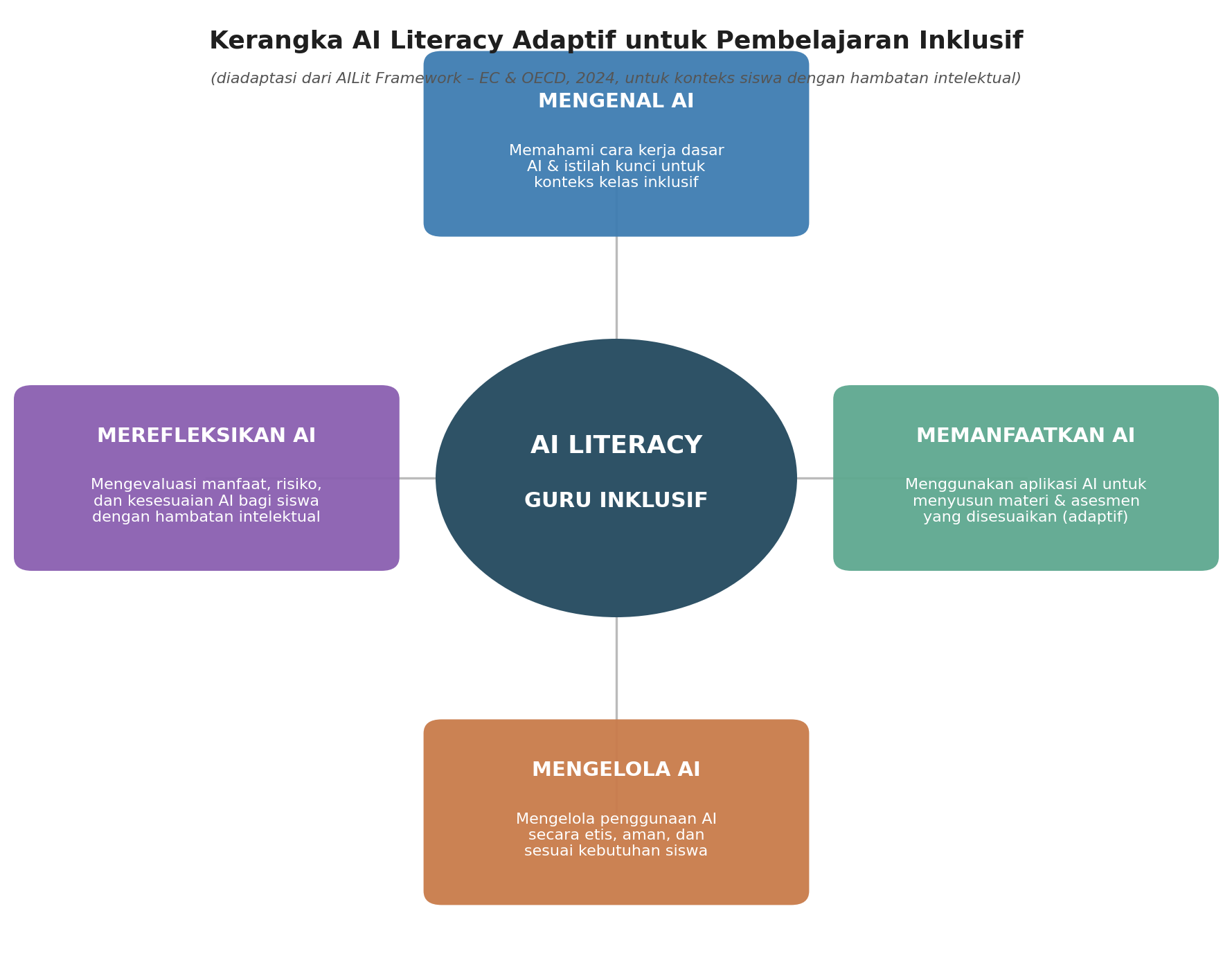
Inclusive education requires teachers to design responsive learning to the diverse needs of students, including those with intellectual disabilities. This community service activity aims to improve the artificial intelligence (AI) literacy of inclusive school teachers as a basis for developing adaptive learning. The activity was implemented through needs analysis, outreach, module development, training, implementation assistance, and evaluation and reflection. The material refers to the four domains of AI literacy: recognizing, utilizing, managing, and reflecting on AI. The activity results showed improved teacher competency in understanding AI, developing adaptive materials, using AI tools, implementing ethics, maintaining data security, and conducting differentiated assessments. The mentoring also increased teacher confidence and preparedness.
##plugins.themes.academic_pro.article.details##

This work is licensed under a Creative Commons Attribution-NonCommercial 4.0 International License.
JURPIKAT (Jurnal Pengabdian Kepada Masyarakat) accepts manuscripts that have not been published elsewhere and are not under consideration for publication by other print or electronic media. Authors retain copyright and grant the journal right of first publication with the work simultaneously licensed under a Creative Commons BY-NC License that allows others to share the work with an acknowledgment of the work's authorship and initial publication in this journal.
Authors are able to enter into separate, additional contractual arrangements for the non-exclusive distribution of the journal's published version of the work (eg, post it to an institutional repository, in a journal or publish it in a book), with an acknowledgment of its initial publication in this journal.
License to Publish
The non-commercial use of the article will be governed by the Attribution-NonCommercial 4.0 International (CC BY-NC 4.0). The author hereby grants JURPIKAT (Jurnal Pengabdian Kepada Masyarakat) an exclusive publishing and distribution license in the manuscript include tables, illustrations or other material submitted for publication as part of the manuscript (the “Articleâ€) in print, electronic and all other media (whether now known or later developed), in any form, in all languages, throughout the world, for the full term of copyright, and the right to license others to do the same, effective when the article is accepted for publication. This license includes the right to enforce the rights granted hereunder against third parties.
References
Du, C., binti Ahmad, N. K., binti Jamil, H., Wen, M., & Wu, W. (2026). Emotional identity construction in EFL teachers: An integrative approach. International Journal of Instruction, 19(1), 131–156.
Dumitru, C., Muttashar Abdulsahib, G., Ibrahim Khalaf, O., & Bennour, A. (2026). Integrating artificial intelligence in supporting students with disabilities in higher education: An integrative review. Technology and Disability, 38(1), 3–24.
Hendriani, M., & Gusteti, M. U. (2021). Validitas LKPD elektronik berbasis masalah terintegrasi nilai karakter percaya diri untuk keterampilan pemecahan masalah matematika SD di era digital. Jurnal Basicedu, 5(4), 2430–2439.
Lademann, J., Henze, J., Honke, N., Wollny, C., & Becker-Genschow, S. (2025). Teacher training in the age of AI: impact on AI literacy and teachers’ attitudes. Frontiers in Education, 10, 1671306.
Murniarti, E., & Anastasia, N. Z. (2016). Pendidikan inklusif di tingkat sekolah dasar: konsep, implementasi, dan strategi. Jurnal Dinamika Pendidikan, 9(1), 9–18.
Nasional, D. P. (2003). Undang-undang nomor 20 tahun 2003 tentang sistem pendidikan nasional. Jakarta: Depdiknas, 33(31), 79192564.
POLICY, O. P. G. (2024). Harnessing the green and digital transitions for gender equality: insights from the 2024 OECD forum on gender equality.
Trisnani, N., Hamzah, R. A., Effendi, E., Sari, D. D., Khofifah, S., Suparya, I. K., Binsa, A. A., Aisyah, A., Permatasari, M., & Rimbawati, N. (2025). Pendidikan Anak di Sekolah Dasar. Penerbit Mifandi Mandiri Digital, 1(02).
Yim, I. H. Y., & Su, J. (2025). Artificial intelligence (AI) learning tools in K-12 education: A scoping review. Journal of Computers in Education, 12(1), 93–131.