Product Differentiation Through Innovation of Jumputan Motifs and Coloring Based on Local Identity
##plugins.themes.academic_pro.article.sidebar##
Downloads
##plugins.themes.academic_pro.article.main##
Abstract
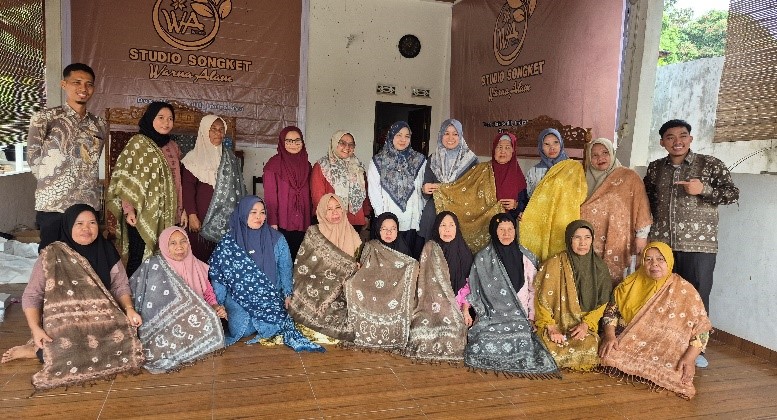
Developing a creative industry based on local potential is one strategy to increase the added value and economic competitiveness of rural communities. Ulak Bedil Village, Ogan Ilir Regency, has the potential for tie-dye handicrafts involving women, especially housewives. However, limited motif innovation, product differentiation, and the use of natural dyes remain obstacles in product development. This activity aims to improve participants' knowledge and skills in developing tie-dye motifs and natural dyes as a differentiation strategy based on local identity. The activity was carried out over four days with 15 participants using a participatory approach through material delivery, demonstrations, direct practice, and mentoring. The results of the activity showed an increase in participants' practical skills in the tie-dye production process and the creation of variations in motifs and colors through the use of natural materials. This activity contributes to strengthening the creative economic capacity of the community and supports SDGs 5, SDG 8, and SDG 12 through women's empowerment, economic capacity building, and the implementation of natural material-based production processes.
##plugins.themes.academic_pro.article.details##

This work is licensed under a Creative Commons Attribution-NonCommercial 4.0 International License.
JURPIKAT (Jurnal Pengabdian Kepada Masyarakat) accepts manuscripts that have not been published elsewhere and are not under consideration for publication by other print or electronic media. Authors retain copyright and grant the journal right of first publication with the work simultaneously licensed under a Creative Commons BY-NC License that allows others to share the work with an acknowledgment of the work's authorship and initial publication in this journal.
Authors are able to enter into separate, additional contractual arrangements for the non-exclusive distribution of the journal's published version of the work (eg, post it to an institutional repository, in a journal or publish it in a book), with an acknowledgment of its initial publication in this journal.
License to Publish
The non-commercial use of the article will be governed by the Attribution-NonCommercial 4.0 International (CC BY-NC 4.0). The author hereby grants JURPIKAT (Jurnal Pengabdian Kepada Masyarakat) an exclusive publishing and distribution license in the manuscript include tables, illustrations or other material submitted for publication as part of the manuscript (the “Articleâ€) in print, electronic and all other media (whether now known or later developed), in any form, in all languages, throughout the world, for the full term of copyright, and the right to license others to do the same, effective when the article is accepted for publication. This license includes the right to enforce the rights granted hereunder against third parties.
References
Azhari, A., Tanjung, M. A. J., Sagala, R. A., Manurung, W. C. S. R., & Hayati, Z. (2025). Strategi Inovasi dan Diferensiasi Produk untuk Meningkatkan Daya Saing UMKM di Era Digital. Makro: Jurnal Manajemen dan Kewirausahaan. DOI: https://doi.org/10.53712/jmm.v10i1.2688
Bow, Y., Hajar, I., & Ariyanti, I. (2020). Pengembangan desain kain jumputan Palembang untuk meningkatkan industri kreatif. Jurnal Pengabdian Kepada Masyarakat (APTEKMAS), 3(2), 14–19. https://doi.org/10.36257/apts.v3i2.2052
Dewi, N. R., Susanti, E., Hanum, H., Cahyawati, D., & Zayanti, D. A. (2022). Pengembangan Motif Fraktal pada Usaha Produksi Kain Jumputan Palembang. Pengabdian, 6(1), 84–91. DOI: https://doi.org/10.36841/integritas.v6i1.1335
Fajri, A., Suharti, & Purwanto, D. (2024). Pencapaian Diferensiasi Produk Melalui Strategi Inovasi dan Kreativitas Usaha Mikro Kecil dan Menengah. Kreativasi: Journal of Community Empowerment, 3(2), 214–221. DOI: https://doi.org/10.33369/kreativasi.v3i2.34872
Hamidi, I., Atiyatna, D. P., Bashir, A., Apriani, D., Sani, K., & Marissa, F. (2025). Transforming marginalized entrepreneurship: Digital skills and market adaptability for MSMEs in emerging economies. Pena Dimas: Jurnal Pengabdian Masyarakat, 4(1). https://doi.org/10.33474/penadimas.v4i1.27665
Harini, S., Kartini, T., Syabani’ah, N. Y., Amalia, D., Lestari, D., Nanda N., N., & Adzqiya, M. K. (2025). Pemberdayaan Masyarakat melalui Inovasi Produk Berbasis Kearifan Lokal Desa Benda. Jurnal Edukasi Pengabdian Masyarakat, 4(1). DOI: https://doi.org/10.36636/eduabdimas.v4i1.6168
Irmeilyana, I., Ngudiantoro, N., Desiani, Anita. (2018) Profil Pengrajin Songket di Desa Limbang Jaya I Kecamatan Tanjung Batu Kabupaten Ogan Ilir Provinsi Sumatera Selatan. Demography Journal of Sriwijaya (DeJoS), [S.l.], v. 2, n. 1, p. 40-47, july. http://ejournal-pps.unsri.ac.id/index.php/dejos/article/view/33
Iswandi, H. (2026). Makna Simbolik dan Fungsi Sosial Kain Jumputan Palembang dalam Perspektif Geertz dan Malinowski. Brikolase: Jurnal Kajian Teori, Praktik Dan Wacana Seni Budaya Rupa, 18(1), 60–83. https://doi.org/10.33153/brikolase.v18i1.8432
Juliani, J., Syawaluddin, S., Putra, A., & Goh, T. S. (2022). Sistem informasi pemasaran dan diferensiasi produk terhadap keputusan pembelian konsumen. Journal of Management and Business (JOMB), 4(2), 1598–1611. https://doi.org/10.31539/jomb.v4i2.4679
Kurniawan, D. T., Anugrahani, I. S., Prasasti, A., & Fitri, R. (2020). Pelatihandan pendampingan UMKM di desa gajahrejo dalam pembuatandesain kemasan inovatif oleh-oleh khas malang untuk meningkatkan daya saing produk. VIVABIO: Jurnal Pengabdian Multidisiplin, 3(1), 22-29. DOI: https://doi.org/10.35799/vivabio.3.1.2021.31380
Lenti M, Beni S, Sadewo YD, Usman. (2020). Strategi Diferensiasi Produk Line Untuk Menarik Minat Konsumen. Business, Econ Entrep 2:9–19. https://doi.org/10.46229/b.e.e..v2i2.190
Mukhlis, M., Saputra, A. J., Apriani, D., & Taufiq, T. (2023). E-commerce implementation in an effort to consolidate the competitiveness of small industry businesses. Sriwijaya International Journal of Dynamic Economics and Business, 7(2), 121–136. https://doi.org/10.29259/sijdeb.v7i2.121-136
Nisa, F. L. (2024). meningkatkan pertumbuhan ekonomi indonesia melalui ekonomi kreatif. Jurnal Inovasi Bisnis Indonesia (JIBI), 1(4), 216-224. DOI: https://doi.org/10.61896/jeki.v2i4.51
Nurvidia, H., Yuwono, T., Murniasih, T. R., & Suwanti, V. (2024). Pelatihan Batik Jumputan dengan Pewarna Alami. J-ADIMAS (Jurnal Pengabdian kepada Masyarakat), 12(1). https://garuda.kemdiktisaintek.go.id/documents/detail/4326369
Ocsanti, W. R., & Purnomo, H. (2025). Analisis Strategi Diferensiasi Produk Untuk Meningkatkan Volume Penjualan Produk Daster Pada Rosari Collection Nganjuk. Prosiding Simposium Nasional Manajemen dan Bisnis, 4, 281-291. DOI: https://doi.org/10.29407/m3s7nc74
Purnomo HSF. (2024). Marketing Efforts Through Social Media on Brand Equity and Consumer Behavior. Int J Econ Lit 2:3092–102. https://sociohum.net/index.php/INJOLE/article/view/1013
Puspita, V., & Safrianti, S. (2022). Pengaruh Inovasi Produk dan Diferensiasi Produk terhadap Keunggulan Bersaing Batik Besurek Bengkulu. Jurnal Bisnis, Manajemen, Dan Keuangan, 3(3), 665-673. DOI: https://doi.org/10.21009/jbmk.0303.05
Rahmawati, U., Afridhianika, A. N., Prihanto, P. H., & Irwansyah, R. (2025). Pelatihan kewirausahaan berbasis potensi lokal untuk meningkatkan ekonomi kreatif masyarakat desa. Jurnal Pengabdian Masyarakat dan Riset Pendidikan, 4(2), 9373–9381. https://doi.org/10.31004/jerkin.v4i2.3323
Viatra, A. W., Febriyanti, D., Ratu, M. K., Prasetya, D., Yazid, I. M., Yola, L. F., & Wulandari, F. (2025). Pemberdayaan Komunitas Forum Wirausaha Jumputan Muda (FORJUMA) melalui Inovasi Eco Jumputan untuk Mendorong Ekonomi Kreatif Berbasis Budaya Berkelanjutan. Jurnal Abdimas Mandiri, 9(3), 551–560. DOI: https://doi.org/10.36982/jam.v9i3.6230
Wahono, W., Abidin, R., & Hermoyo, R. P. (2023). Transformasi Digital Kampung UMKM (Usaha Mikro, Kecil dan Menengah) Kreatif Kelurahan Putat Jaya Kecamatan Sawahan Kota Surabaya. Society: Jurnal Pengabdian dan Pemberdayaan Masyarakat, 3(2), 156-164. DOI: https://doi.org/10.37802/society.v3i2.305