Penguatan Pengetahuan Keselamatan dan Kesehatan Kerja Mahasiswa Vokasi melalui Kuliah Tamu “Safety First” di Era Industri Modern
##plugins.themes.academic_pro.article.sidebar##
Downloads
##plugins.themes.academic_pro.article.main##
Abstract
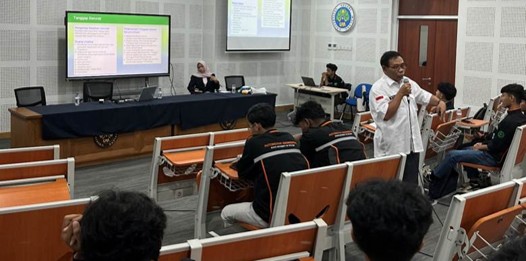
Occupational Health and Safety (OHS) is an important component of the professional competence of automotive workers. This community service activity aimed to strengthen students’ knowledge of OHS implementation through an expert guest lecture entitled “Safety First: Strategies for OHS Implementation in the Modern Industrial Era.” The activity was conducted by the Automotive Engineering Technology Study Program, Faculty of Vocational Studies, Universitas Negeri Malang, using a contextual and reflective learning approach through problem orientation, an expert lecture, work-situation-based discussion, and evaluation. A total of 30 students completed a 10-item evaluation instrument using a 1–5 Likert scale. The evaluation results showed an overall mean score of 4.48, categorized as very good, with the highest score obtained for the relevance of the material to Automotive Engineering Technology (4.57). The activity contributed to strengthening students’ understanding of workplace risks, personal protective equipment (PPE), safe work procedures, safety culture, and readiness to enter automotive work environments.
##plugins.themes.academic_pro.article.details##

This work is licensed under a Creative Commons Attribution-NonCommercial 4.0 International License.
JURPIKAT (Jurnal Pengabdian Kepada Masyarakat) accepts manuscripts that have not been published elsewhere and are not under consideration for publication by other print or electronic media. Authors retain copyright and grant the journal right of first publication with the work simultaneously licensed under a Creative Commons BY-NC License that allows others to share the work with an acknowledgment of the work's authorship and initial publication in this journal.
Authors are able to enter into separate, additional contractual arrangements for the non-exclusive distribution of the journal's published version of the work (eg, post it to an institutional repository, in a journal or publish it in a book), with an acknowledgment of its initial publication in this journal.
License to Publish
The non-commercial use of the article will be governed by the Attribution-NonCommercial 4.0 International (CC BY-NC 4.0). The author hereby grants JURPIKAT (Jurnal Pengabdian Kepada Masyarakat) an exclusive publishing and distribution license in the manuscript include tables, illustrations or other material submitted for publication as part of the manuscript (the “Articleâ€) in print, electronic and all other media (whether now known or later developed), in any form, in all languages, throughout the world, for the full term of copyright, and the right to license others to do the same, effective when the article is accepted for publication. This license includes the right to enforce the rights granted hereunder against third parties.
References
Afolabi, F., Beer, P., & Haafkens, J. (2021). Can occupational safety and health problems be prevented or not? Exploring the perception of informal automobile artisans in Nigeria. Safety Science. https://doi.org/10.1016/j.ssci.2020.105097
Afolabi, F., De Beer, P., & Haafkens, J. (2021). Occupational risk perception and the use of personal protective equipment (PPE): A study among informal automobile artisans in Osun State, Nigeria. SAGE Open, 11. https://doi.org/10.1177/2158244021994585
Ali, M., Arfandi, A., Lopa, A. T., & Fauzan, M. (2022). Evaluation of learning occupational safety and environmental health in vocational schools. Cypriot Journal of Educational Sciences. https://doi.org/10.18844/cjes.v17i9.7974
Alshahrani, A. (2024). The use of guest speakers in higher education and implications for pharmaceutical teaching: A systematic review of literature. F1000Research. https://doi.org/10.12688/f1000research.153968.1
Amalia, E., Tianisa, B. N., Nursucilowati, L. L., Rizallihadi, M. D., Mahartiko, A. H., Sabriyanti, F. A., Febrianti, A., Sanda, D. P., Nizam, M. F., Widowati, E., & Sulistyani, U. N. L. (2024). Identification of occupational safety and health hazards at paint and welding workshop using the HIRARC method. Journal of Safety Education, 2. https://doi.org/10.15294/jse.v2i1.78918
Bérubé, M., Chatigny, C., & Laberge, M. (2025). Gender differences in occupational health and safety perceptions: Insights from youth in dual vocational training. Safety Science. https://doi.org/10.1016/j.ssci.2025.106797
Casey, T. W., Turner, N., Hu, X., & Bancroft, K. (2021). Making safety training stickier: A richer model of safety training engagement and transfer. Journal of Safety Research, 78, 303–313. https://doi.org/10.1016/j.jsr.2021.06.004
Da Silva, P. A., Duarte Pasini, V., Cabrera Aguilera, M. V., Da Fonseca, B. B., De Souza Sampaio, N. A., Da Motta Reis, J. S., Santos, G., & Barbosa, L. C. F. M. (2023). Mapping the accidents and unsafe conditions of workers in the automotive sector. Quality Innovation Prosperity, 27(2). https://doi.org/10.12776/qip.v27i2.1849
Jablon-Roberts, S., & McCracken, A. (2022). Undergraduate student perceptions of industry guest speakers in the college classroom. Journal of the Scholarship of Teaching and Learning, 22(3). https://doi.org/10.14434/josotl.v22i3.32317
Jafari, F., & Redden, L. W. (2024). Incorporating industry professionals as guest speakers in construction management programs: Enhancing knowledge and learning experiences. EPiC Series in Built Environment. https://doi.org/10.29007/5thh
Khadka, R., Pandey, I., & Gautam, L. (2021). Occupational health hazards and use of personal protective equipment among auto mechanics in Kathmandu Metropolitan City, Nepal. International Journal of Occupational Safety and Health, 11, 16–24. https://doi.org/10.3126/ijosh.v11i1.33495
Khoshakhlagh, A., Malakoutikhah, M., Park, J., Kodnoueieh, M. D., Boroujeni, Z. R., Bahrami, M., & Ramezani, F. (2024). Assessing personal protective equipment usage and its correlation with knowledge, attitudes, performance, and safety culture among workers in small and medium-sized enterprises. BMC Public Health, 24. https://doi.org/10.1186/s12889-024-19517-3
Kavouras, S., Vardopoulos, I., Mitoula, R., Zorpas, A., & Kaldis, P. (2022). Occupational health and safety scope significance in achieving sustainability. Sustainability. https://doi.org/10.3390/su14042424
Laberge, M., MacEachen, E., & Calvet, B. (2014). Why are occupational health and safety training approaches not effective? Understanding young worker learning processes using an ergonomic lens. Safety Science, 68, 250–257. https://doi.org/10.1016/j.ssci.2014.04.012
Laberge, M., Vignet, M., & Chatigny, C. (2022). Development of a reflective learning method to support health and safety of adolescents with learning difficulties enrolled in a pre-work practicum. Ergonomics, 65, 1509–1524. https://doi.org/10.1080/00140139.2022.2099017
Małysa, T., Furman, J., Kuczyńska-Chałada, M., & Blaško, P. (2023). Survey of employees’ awareness regarding occupational health and safety in the automotive industry. Scientific Papers of Silesian University of Technology. Organization and Management Series. https://doi.org/10.29119/1641-3466.2023.182.14
Pepple, D., Akaighe, G., Sambo, A., George-Aremu, O., Bosah, G., & Trollman, H. (2025). Using guest lectures to enhance student employability: Pedagogical considerations. Cogent Education, 12. https://doi.org/10.1080/2331186X.2025.2452076
Rasoulzadeh, Y., Alizadeh, S. S., Valizadeh, S., Fakharian, H., & Varmazyar, S. (2015). Health, safety and ergonomically risk assessment of mechanicians using Job Safety Analysis (JSA) technique in an Iran city. Indian Journal of Science and Technology, 8. https://doi.org/10.17485/ijst/2015/v8i28/83377
Rodrigues, M., Vale, C., & Silva, M. V. (2018). Effects of an occupational safety programme: A comparative study between different training methods involving secondary and vocational school students. Safety Science. https://doi.org/10.1016/j.ssci.2018.06.013
Rohman, N., Sidik, R., & Suwantri, S. (2026). Bridging the competency gap: Aligning automotive vocational education with industrial standards in industrial work placement programs. Journal of General Education and Humanities. https://doi.org/10.58421/gehu.v5i2.1328
Salhi, M., Chater, Y., & Maurady, A. (2024). The impact of safety culture dimensions on workplace accidents: An application in the Moroccan automotive industry. International Journal of Occupational Safety and Health. https://doi.org/10.3126/ijosh.v14i1.55669
Santos, W., Lorente, A., Rojas, C., Mariscal, G., & Lorente, R. (2025). Impact of personal protective equipment in preventing occupational injuries: A systematic review and meta-analysis. Frontiers in Public Health, 13. https://doi.org/10.3389/fpubh.2025.1720363
Sayuti, M., Susanto, H. A., Hasanah, N., Biddinika, M. K., Wadiyo, W., Opwora, M., Kamis, A., & Rokhmah, N. (2024). Enhancing safety culture in vocational education: Insights from industrial workshops. Indonesian Journal on Learning and Advanced Education, 6(2). https://doi.org/10.23917/ijolae.v6i2.23532
Soeparno, S., Hidayatulloh, M. K. Y., Ashoumi, H., Alfian, M., & Çobanoğlu, Ö. (2025). Contribution of occupational health and safety knowledge and vocational high school students attitude towards OHS behavior awareness. E3S Web of Conferences. https://doi.org/10.1051/e3sconf/202564506008
Tureková, I., Hrmo, R., Marková, I., & Kordošová, M. (2021). Evaluation of acquired knowledge about occupational safety in dual education. TEM Journal. https://doi.org/10.18421/TEM104-39
Zengin, M., Sekmen, M., & Tekbalkan, M. (2025). Evaluation of occupational safety culture and awareness among vocational and technical Anatolian high school students. Gümüşhane Üniversitesi Sağlık Bilimleri Dergisi. https://doi.org/10.37989/gumussagbil.1505149