Penguatan Kompetensi Metrologi Otomotif Siswa SMK melalui Kompetisi Praktik Pengukuran Tingkat Nasional
##plugins.themes.academic_pro.article.sidebar##
Downloads
##plugins.themes.academic_pro.article.main##
Abstract
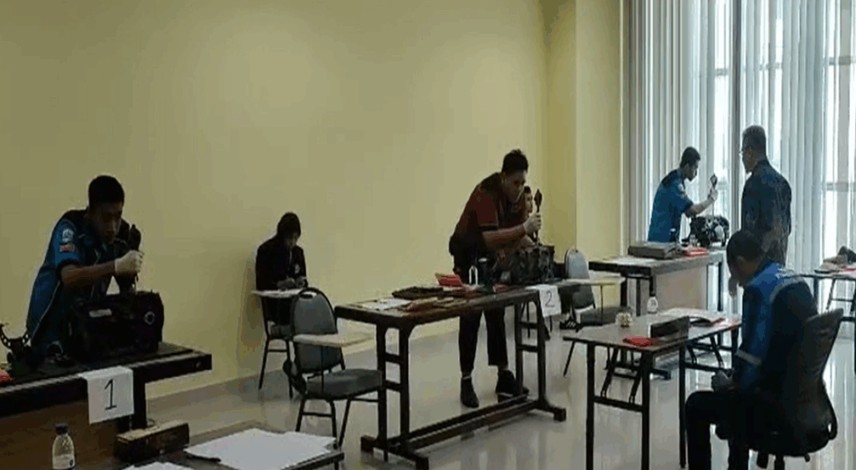
Automotive metrology competence is an important component of technical skills because it involves measurement accuracy, result interpretation, and technical decision-making. This community service activity aimed to strengthen the automotive metrology competence of vocational high school students through a national-level measurement skills competition. The activity was conducted as part of VOCASPIRA Fest 2025 and involved 88 students from automotive vocational schools across Indonesia. The activity used a competition-based learning approach consisting of technical orientation, practical measurement, performance assessment, finalist selection, and participant evaluation. A total of 88 participants were used as evaluation respondents using a 10-item questionnaire with a 1–5 Likert scale. The results showed an overall mean score of 4.48, categorized as very good, equivalent to 89.6% of the maximum score. The practical measurement experience aspect obtained the highest score of 91.0%, while participants’ ability to interpret measurement results reached 90.4%. The activity provided a competitive and structured practical learning experience to strengthen students’ accuracy, precision, measurement interpretation, and readiness to meet automotive industry competency requirements.
##plugins.themes.academic_pro.article.details##

This work is licensed under a Creative Commons Attribution-NonCommercial 4.0 International License.
JURPIKAT (Jurnal Pengabdian Kepada Masyarakat) accepts manuscripts that have not been published elsewhere and are not under consideration for publication by other print or electronic media. Authors retain copyright and grant the journal right of first publication with the work simultaneously licensed under a Creative Commons BY-NC License that allows others to share the work with an acknowledgment of the work's authorship and initial publication in this journal.
Authors are able to enter into separate, additional contractual arrangements for the non-exclusive distribution of the journal's published version of the work (eg, post it to an institutional repository, in a journal or publish it in a book), with an acknowledgment of its initial publication in this journal.
License to Publish
The non-commercial use of the article will be governed by the Attribution-NonCommercial 4.0 International (CC BY-NC 4.0). The author hereby grants JURPIKAT (Jurnal Pengabdian Kepada Masyarakat) an exclusive publishing and distribution license in the manuscript include tables, illustrations or other material submitted for publication as part of the manuscript (the “Articleâ€) in print, electronic and all other media (whether now known or later developed), in any form, in all languages, throughout the world, for the full term of copyright, and the right to license others to do the same, effective when the article is accepted for publication. This license includes the right to enforce the rights granted hereunder against third parties.
References
Bland, L., Kusano, S., & Johri, A. (2016). Engineering competitions as pathways to development of professional engineering skills. https://doi.org/10.18260/p.26629
Bukrieieva, О. S., & Medvedovska, Y. S. (2020). Active methods in teaching measurement uncertainty. https://doi.org/10.24027/2306-7039.3a.2020.217843
De Magalhães, W., Kalid, R., Da Cunha, F., Pellegrino, O., & De Oliveira, E. D. (2024). The importance of teaching metrology for chemistry undergraduate courses. Brazilian Journal of Analytical Chemistry. https://doi.org/10.30744/brjac.2179-3425.rv-98-2023
Dobilienė, J., & Meškuotienė, A. (2015). Importance of education and competence maintenance in metrology field (measurement science). Journal of Physics: Conference Series, 588, 012013. https://doi.org/10.1088/1742-6596/588/1/012013
Dobilienė, J., & Meškuotienė, A. (2024). Metrology personnel competencies: Their importance to the quality of measurements. Measurement: Sensors. https://doi.org/10.1016/j.measen.2024.101325
Fastré, G., Van Der Klink, M. R., & Van Merriënboer, J. V. (2010). The effects of performance-based assessment criteria on student performance and self-assessment skills. Advances in Health Sciences Education, 15, 517–532. https://doi.org/10.1007/s10459-009-9215-x
Gröschl, A., Gotz, J., Loderer, A., Bills, P., & Hausotte, T. (2015). Measures of improvement MUVoT, a blended learning course on the topic of measurement uncertainty for advanced vocational training. Procedia CIRP, 27, 111–116. https://doi.org/10.1016/j.procir.2015.04.052
Hardiyanta, R. A. P., Hermanto, H., Kurniawan, A., Purnawan, P., & Prakoso, I. E. (2024). Development of the automotive technology vocational education curriculum based on current needs of the automotive industry. Jurnal Pendidikan Vokasi Otomotif. https://doi.org/10.21831/jpvo.v6i2.73156
Ibrahim, S., Bills, P., & Allport, J. (2017). Situation of metrology education in developing countries using Nigeria as a case study. Literacy Information and Computer Education Journal, 8, 2751–2760. https://doi.org/10.20533/licej.2040.2589.2017.0363
Katona, A. (2021). Validation of risk-based quality control techniques: A case study from the automotive industry. Journal of Applied Statistics, 49, 3236–3255. https://doi.org/10.1080/02664763.2021.1936466
Kiraci, E., Palit, A., Donnelly, M. J., Attridge, A., & Williams, M. (2020). Comparison of in-line and off-line measurement systems using a calibrated industry representative artefact for automotive dimensional inspection. Measurement. https://doi.org/10.1016/j.measurement.2020.108027
Liang, M., Wang, S., Liang, M., & Zhang, J. (2023). The role of skills competitions in improving professional knowledge learning in vocational education. Scientific and Social Research. https://doi.org/10.26689/ssr.v5i5.4886
Li, W. (2025). Exploration on the construction and enhancement strategies of vocational competitiveness of higher vocational students from the perspective of vocational skills competitions. Journal of Exploration of Vocational Education. https://doi.org/10.63650/jeve.v1i1.23
Menoncin, M., Savio, E., Marxer, M., & Anwer, N. (2019). Integrated training in using different coordinate measuring systems to support digital manufacturing. Procedia Manufacturing. https://doi.org/10.1016/j.promfg.2019.09.052
Nurtanto, M., Sofyan, H., Pardjono, P., & Suyitno, S. (2020). Development model for competency improvement and national vocational qualification support frames in automotive technology. International Journal of Evaluation and Research in Education, 9, 168–176. https://doi.org/10.11591/ijere.v9i1.20447
Oroh, R., Attaufiq, M. M., Daud, M., & Roring, R. (2023). Analysis of vocational student performance criteria on work skills based on industry needs: An analysis for students' skill test instruments. International Journal of Learning, Teaching and Educational Research. https://doi.org/10.26803/ijlter.22.10.10
Pengabdian, J., Masyarakat, K., Harianto, A., Azhar, M. M., Razaq, R., Tambunan, D., Juliansyah, R., Mauliza, S., Sanjaya, M., Tanady, D., Rivai, A., & Razaq, M. R. (2026). The role of academics as judges at the 8th UINSU Accounting Fair in enhancing students’ accounting competencies. GANDRUNG: Jurnal Pengabdian Kepada Masyarakat. https://doi.org/10.36526/gandrung.v7i2.8262
Prianto, A., Qomariyah, U. K. N., & Firman, F. (2022). Does student involvement in practical learning strengthen deeper learning competencies? International Journal of Learning, Teaching and Educational Research. https://doi.org/10.26803/ijlter.21.2.12
Putra, B. J. M., Ichwanto, M. A., Suwarno, E., Alfianto, I., & Kiong, T. T. (2025). The effect of practical learning and field work practical experience on the work readiness of vocational school students. LITERACY: International Scientific Journals of Social, Education, Humanities. https://doi.org/10.56910/literacy.v4i3.3194
Rohman, N., Sidik, R., & Suwantri, S. (2026). Bridging the competency gap: Aligning automotive vocational education with industrial standards in industrial work placement programs. Journal of General Education and Humanities. https://doi.org/10.58421/gehu.v5i2.1328
Tsai, H.-C., Lee, A., Lee, H.-N., Chen, C.-N., & Liu, Y.-C. (2020). An application of the Fuzzy Delphi method and Fuzzy AHP on the discussion of training indicators for the regional competition, Taiwan National Skills Competition, in the trade of joinery. Sustainability. https://doi.org/10.3390/su12104290
Wang, C., & Gao, J. (2026). Enhancing the practical competence of undergraduates in big data majors through competition-based learning: A case study. Frontiers in Educational Research. https://doi.org/10.25236/fer.2026.090528
Wang, S., Peng, F., & Feng, Z. (2023). The role of skills competitions in improving the practical ability of vocational college students. Journal of Contemporary Educational Research. https://doi.org/10.26689/jcer.v7i2.4708
Yusop, S. R. M., Rasul, M., Yasin, R. M., Hashim, H., & Jalaludin, N. (2022). Assessment approaches and learning outcomes in technical and vocational education: A systematic review using PRISMA. Sustainability. https://doi.org/10.3390/su14095225