Penguatan Kesadaran Anti-Perundungan melalui Edukasi Partisipatif pada Siswa SD Negeri 2 Kalimanggis
##plugins.themes.academic_pro.article.sidebar##
Downloads
##plugins.themes.academic_pro.article.main##
Abstract
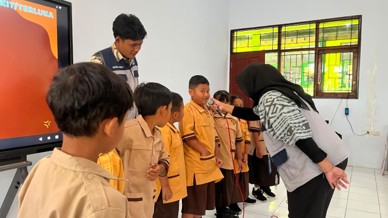
Bullying in primary schools may occur verbally, physically, socially, or digitally, while some harmful behaviors are still perceived as jokes. This community service activity aimed to strengthen anti-bullying awareness among students of SD Negeri 2 Kalimanggis through communicative and participatory education. Activities included school coordination, material delivery, video viewing, case discussion, question-and-answer sessions, reflection, and anti-bullying songs and chants. Evaluation was descriptive, based on student engagement, responses, and answers to scenarios. During the activity, students participated in identifying harmful behaviors, distinguishing healthy joking from actions that cause discomfort, and identifying safer responses when experiencing or witnessing bullying. The program also emphasized empathy, respect for differences, bystander responsibility, and help-seeking. These findings indicate learning processes during the activity rather than causal behavioral change. Continued reinforcement by teachers, families, and the school is needed to translate anti-bullying messages into safer everyday social practices.
##plugins.themes.academic_pro.article.details##

This work is licensed under a Creative Commons Attribution-NonCommercial 4.0 International License.
JURPIKAT (Jurnal Pengabdian Kepada Masyarakat) accepts manuscripts that have not been published elsewhere and are not under consideration for publication by other print or electronic media. Authors retain copyright and grant the journal right of first publication with the work simultaneously licensed under a Creative Commons BY-NC License that allows others to share the work with an acknowledgment of the work's authorship and initial publication in this journal.
Authors are able to enter into separate, additional contractual arrangements for the non-exclusive distribution of the journal's published version of the work (eg, post it to an institutional repository, in a journal or publish it in a book), with an acknowledgment of its initial publication in this journal.
License to Publish
The non-commercial use of the article will be governed by the Attribution-NonCommercial 4.0 International (CC BY-NC 4.0). The author hereby grants JURPIKAT (Jurnal Pengabdian Kepada Masyarakat) an exclusive publishing and distribution license in the manuscript include tables, illustrations or other material submitted for publication as part of the manuscript (the “Articleâ€) in print, electronic and all other media (whether now known or later developed), in any form, in all languages, throughout the world, for the full term of copyright, and the right to license others to do the same, effective when the article is accepted for publication. This license includes the right to enforce the rights granted hereunder against third parties.
References
Axford, N. … Hutchings, J. (2020). The Effectiveness of the KiVa Bullying Prevention Program in Wales, UK: Results from a Pragmatic Cluster Randomized Controlled Trial. Prevention Science, 21(5), 615–626. https://doi.org/10.1007/s11121-020-01103-9
Beran, T., & Shapiro, B. (2005). Evaluation of an anti-bullying program: Student reports of knowledge and confidence to manage bullying. Canadian Journal of Education, 28(4), 700–717. https://doi.org/10.2307/4126451
Bowes, L. … Hutchings, J. (2024). The effects and costs of an anti-bullying program (KiVa) in UK primary schools: a multicenter cluster randomized controlled trial. Psychological Medicine, 54(15), 4362–4373. https://doi.org/10.1017/S0033291724002666
Chaux, E. … Bustamante, A. (2017). Classrooms in Peace Within Violent Contexts: Field Evaluation of Aulas en Paz in Colombia. Prevention Science, 18(7), 828–838. https://doi.org/10.1007/s11121-017-0754-8
Chu Fung, A. L. … Wong, M. K. (2026). Impact of group storytelling intervention on young schoolchildren’s aggression: a focus group analysis. Children and Youth Services Review, 186. https://doi.org/10.1016/j.childyouth.2026.109027
Dai, C. … Shi, C. (2026). Unleashing the superpowers of peer group empathy: a study on bullying intervention tendency and behavior in primary school students. Children and Youth Services Review, 182. https://doi.org/10.1016/j.childyouth.2026.108762
Doumas, D. M. … Peck, M. (2023). The Association between Internalizing Symptoms and Witnessing School Bullying and Defending Behavior: An Analysis of Gender Differences among Elementary and Middle School Students. Children, 10(7). https://doi.org/10.3390/children10071199
Eekhout, I. … Pronk, J. (2026). Teachers as Informant for Students’ Bullying Involvement: The Impact of Teacher Training on Agreement between Teacher vs. Self- and Peer Reports. International Journal of Bullying Prevention. https://doi.org/10.1007/s42380-026-00350-8
Fisher, K. … Mitchell, A. M. (2018). Implementation o. School-Based Bullying Program. Journal of Community Health Nursing, 35(2), 41–48. https://doi.org/10.1080/07370016.2018.1446631
Fonagy, P. … Little, T. D. (2005). Creating a peaceful school learning environment: The impact of an antibullying program on educational attainment in elementary schools. Medical Science Monitor, 11(7), CR317–CR325.
Fredrick, S. S. … Ray, K. (2020). Dimensions of empathy and bystander intervention in bullying in elementary school. Journal of School Psychology, 79, 31–42. https://doi.org/10.1016/j.jsp.2020.03.001
Freeman, I. M. … Jones, A. (2024). Effectiveness of School Violence Prevention Programs in Elementary Schools in the United States: A Systematic Review. Social Sciences, 13(4). https://doi.org/10.3390/socsci13040222
Garandeau, C. F. … Salmivalli, C. (2023). Effects of the KiVa anti-bullying program on defending behavior: Investigating individual-level mechanisms of change. Journal of School Psychology, 99. https://doi.org/10.1016/j.jsp.2023.101226
Hikmat, R. … Jeharsae, R. (2024). Empathy’s Crucial Role: Unraveling Impact on Students Bullying Behavior - A Scoping Review. Journal of Multidisciplinary Healthcare, 17, 3483–3495. https://doi.org/10.2147/JMDH.S469921
Hoglund, W. L. G. … Leadbeater, B. J. (2012). Using your wits: A 6-year follow-up of a peer victimization prevention program. School Psychology Review, 41(2), 193–214. https://doi.org/10.1080/02796015.2012.12087520
Jennifer, D. … Bray, D. (2006). ‘Bully dance’: Animation as a tool for conflict resolution. Pastoral Care in Education, 24(1), 27–32. https://doi.org/10.1111/j.1468-0122.2006.00358.x
Joo, H. … Chatters, S. J. (2020). Why witnesses of bullying tell: Individual and interpersonal factors. Children and Youth Services Review, 116. https://doi.org/10.1016/j.childyouth.2020.105198
Joosten, D. H. J., & Orobio de Castro, B. (2026). Practicing defending in virtual reality: A feasibility study among primary school children. International Journal of Educational Research, 140. https://doi.org/10.1016/j.ijer.2026.103061
Juvonen, J. … Salmivalli, C. (2016). Can a school-wide bullying prevention program improve the plight of victims? Evidence for risk × intervention effects. Journal of Consulting and Clinical Psychology, 84(4), 334–344. https://doi.org/10.1037/ccp0000078
Khoury-Kassabri, M. (2011). Student victimization by peers in elementary schools: Individual, teacher-class, and school-level predictors. Child Abuse and Neglect, 35(4), 273–282. https://doi.org/10.1016/j.chiabu.2011.01.004
Kilian, J. M. … Maniago, E. B. (2006). Making schools safe: A system-wide school intervention to increase student prosocial behaviors and enhance school climate. Journal of Applied School Psychology, 23(1), 1–30. https://doi.org/10.1300/J370v23n01_01
Kozaner, Ç. … Erdem, Y. (2025). Teaching social skills in primary school: an action research. Egitim ve Bilim, 50(223), 27–54. https://doi.org/10.15390/ES.2025.2576
Letendre, J. … Mickens, A. (2016). Teacher and staff voices: Implementation of a positive behavior bullying prevention program in an Urban School. Children and Schools, 38(4), 237–245. https://doi.org/10.1093/cs/cdw032
Li, J., & Hesketh, T. (2026). Intervention to address bullying in primary schools in rural China: implementing a social emotional learning (SEL) program. BMC Psychology, 14(1). https://doi.org/10.1186/s40359-026-04261-7
Liu, W. … Chang, F. (2025). Uncovering the prevalence, risk factors and consequences of school bullying in China’s rural primary schools. BMC Public Health, 25(1). https://doi.org/10.1186/s12889-025-25101-0
McCarty, S. … Geller, E. S. (2016). Actively caring to prevent bullying in an elementary school: Prompting and rewarding prosocial behavior. Journal of Prevention and Intervention in the Community, 44(3), 164–176. https://doi.org/10.1080/10852352.2016.1166809
Meraviglia, M. G. … Robertson, T. (2003). The Expect Respect Project: Creating a Positive Elementary School Climate. Journal of Interpersonal Violence, 18(11), 1347–1360. https://doi.org/10.1177/0886260503257457
Nickerson, A. B. (2019). Preventing and Intervening with Bullying in Schools: A Framework for Evidence-Based Practice. School Mental Health, 11(1), 15–28. https://doi.org/10.1007/s12310-017-9221-8
Nieh, H.-P., & Wu, W.-C. (2018). Effects of a Collaborative Board Game on Bullying Intervention: A Group-Randomized Controlled Trial. Journal of School Health, 88(10), 725–733. https://doi.org/10.1111/josh.12675
O’Moore, A. M., & Minton, S. J. (2005). Evaluation of the effectiveness of an anti-bullying programme in primary schools. Aggressive Behavior, 31(6), 609–622. https://doi.org/10.1002/ab.20098
Olweus, D. … Breivik, K. (2020). Long-term school-level effects of the Olweus Bullying Prevention Program (OBPP). Scandinavian Journal of Psychology, 61(1), 108–116. https://doi.org/10.1111/sjop.12486
Pérez-Jorge, D. … Ariño-Mateo, E. (2023). Restorative methods as a strategy for the prevention of violence and bullying in primary and secondary schools in Mexico: An exploratory study. Heliyon, 9(7). https://doi.org/10.1016/j.heliyon.2023.e18267
Ramos-Diaz, J. … Diestra-Quiñones, R. (2026). Peruvian elementary teachers evaluation of bullying behaviors: Perceptions of severity, empathy, and intent to intervene. Teaching and Teacher Education, 171. https://doi.org/10.1016/j.tate.2025.105348
Raskauskas, J. L. … Evans, I. M. (2010). Bullying among primary school children in New Zealand: Relationships with prosocial behaviour and classroom climate. Educational Research, 52(1), 1–13. https://doi.org/10.1080/00131881003588097
Rawlings, J. R., & Stoddard, S. A. (2019). A Critical Review of Anti-Bullying Programs in North American Elementary Schools. Journal of School Health, 89(9), 759–780. https://doi.org/10.1111/josh.12814
Razzaq, F. … bin Ashfaq, M. (2023). Efficacy of an anti-bullying video literacy program in Pakistani primary school children. Current Psychology, 42(33), 29524–29538. https://doi.org/10.1007/s12144-022-03870-w
Richters, S. … Veenstra, R. (2026). On risks and rewards: A longitudinal network analysis of defending and popularity in late childhood. Developmental Psychology. https://doi.org/10.1037/dev0002136
Romanova, K. … Bowes, L. (2026). Cognitive and affective empathy predict young children’s involvement in bullying one year later. JCPP Advances. https://doi.org/10.1002/jcv2.70127
Şahin, M. (2012). An investigation into the efficiency of empathy training program on preventing bullying in primary schools. Children and Youth Services Review, 34(7), 1325–1330. https://doi.org/10.1016/j.childyouth.2012.03.013
Salmivalli, C. … Poskiparta, E. (2011). Bystanders matter: Associations between reinforcing, defending, and the frequency of bullying behavior in classrooms. Journal of Clinical Child and Adolescent Psychology, 40(5), 668–676. https://doi.org/10.1080/15374416.2011.597090
Shao, J. … Chen, C. (2025). Gamified interactive e-books for bullying prevention: enhancing knowledge and motivation in Chinese primary schools. Frontiers in Psychology, 16. https://doi.org/10.3389/fpsyg.2025.1509549
Slee, P. T., & Mohyla, J. (2007). The PEACE Pack: An evaluation of interventions to reduce bullying in four Australian primary schools. Educational Research, 49(2), 103–114. https://doi.org/10.1080/00131880701369610
Swift, L. E. … Morrow, M. T. (2017). Teacher factors contributing to dosage of the KiVa anti-bullying program. Journal of School Psychology, 65, 102–115. https://doi.org/10.1016/j.jsp.2017.07.005
Thornberg, R. … Vanegas, G. (2012). Bystander motivation in bullying incidents: To intervene or not to intervene? Western Journal of Emergency Medicine, 13(3), 247–252. https://doi.org/10.5811/westjem.2012.3.11792
Touloupis, T., & Athanasiades, C. (2022). Cyberbullying and empathy among elementary school students: Do special educational needs make a difference? Scandinavian Journal of Psychology, 63(6), 609–623. https://doi.org/10.1111/sjop.12838
Tucker, E., & Maunder, R. (2015). Helping children to get along: teachers’ strategies for dealing with bullying in primary schools. Educational Studies, 41(4), 466–470. https://doi.org/10.1080/03055698.2015.1043980
Valido, A. … LoMurray, S. (2023). Pilot Evaluation of the Elementary Social-Emotional Learning Program Sources of Strength. School Mental Health, 15(2), 528–539. https://doi.org/10.1007/s12310-023-09567-0
Wang, C., & Goldberg, T. S. (2017). Using children’s literature to decrease moral disengagement and victimization among elementary school students. Psychology in the Schools, 54(9), 918–931. https://doi.org/10.1002/pits.22042
Yang, K.-H., & Lu, Y. (2024). Combating school bullying through multi-role experience-based virtual scenario learning model: Assessing empathy, problem-solving, and self-efficacy from a multi-stakeholder perspective. Heliyon, 10(10). https://doi.org/10.1016/j.heliyon.2024.e31044