Model Pentahelix Collaboration Berbasis Power–Interest Matrix Untuk Penguatan Kapabilitas Umkm Ekonomi Sirkular
##plugins.themes.academic_pro.article.sidebar##
Downloads
##plugins.themes.academic_pro.article.main##
Abstract
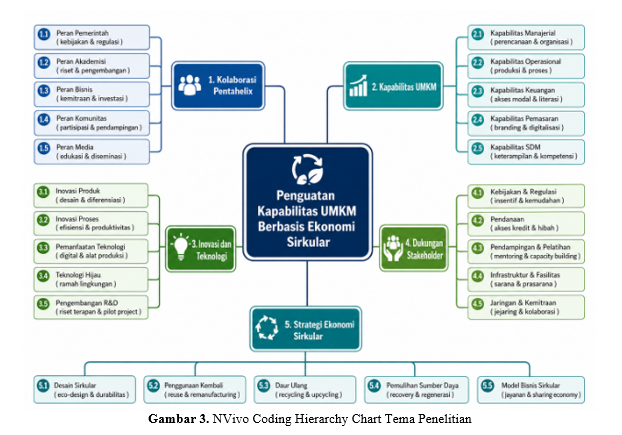
Penguatan kapabilitas UMKM berbasis ekonomi sirkular menghadapi kendala keterbatasan teknologi, sumber daya, akses pasar, dan koordinasi antarpemangku kepentingan. Penelitian ini bertujuan mengembangkan model Pentahelix Collaboration berbasis Power–Interest Matrix untuk memperkuat kapabilitas UMKM di Kota Samarinda. Penelitian menggunakan pendekatan kualitatif eksploratif dengan melibatkan 20 informan melalui purposive sampling. Pengumpulan data mencakup wawancara, observasi, dokumentasi, dan Focus Group Discussion (FGD). Analisis menggunakan pendekatan tematik dan pemetaan pemangku kepentingan berdasarkan tingkat pengaruh serta kepentingannya. Hasil penelitian mengidentifikasi lima tema utama serta menempatkan pemerintah dan dunia usaha sebagai aktor strategis yang memerlukan koordinasi intensif. Model konseptual mengintegrasikan pemetaan pemangku kepentingan, pembagian peran pentahelix, dan strategi penguatan kapabilitas UMKM sirkular. Penelitian merekomendasikan pembentukan forum koordinasi lintas sektor, penguatan pendampingan teknologi, dan perluasan kemitraan pasar. Penelitian lanjutan perlu menguji efektivitas implementasi model secara empiris.
##plugins.themes.academic_pro.article.details##

This work is licensed under a Creative Commons Attribution-NonCommercial 4.0 International License.
LPPM Politeknik Piksi Ganesha Indonesia
References
Anwar, K., Nurrohman, R., Hetami, A. A., Prajuliyanto, A., Alfathir, M. S. A., & Aprilianur, M. R. (2026). Green competency as a mediator between ecopreneurial capacity building and circular economy adoption. Jurnal Manajemen dan Bisnis, 5(1), 1–22.
Braun, V., & Clarke, V. (2022). Thematic analysis: A practical guide. SAGE Publications.
Eden, C., & Ackermann, F. (1998). Making strategy: The journey of strategic management. SAGE Publications.
Engelmann, A. (2024). A performative perspective on sensing, seizing, and transforming in small- and medium-sized enterprises. Entrepreneurship & Regional Development, 36(5–6), 632–658.
Furqoniah, F., Nurrohman, R., Bharata, W., Malle, N. M., Priyanto, A., Kuncoro, S., Nurqamarani, A. S., & Utami, R. A. (2026). Tinjauan sistematis PRISMA dan bibliometrik: Digital capabilities, circular economy practices terhadap kinerja UMKM Indonesia. JAMBURA: Jurnal Ilmiah Manajemen dan Bisnis, 9(2), 2699–2716.
Geissdoerfer, M., Savaget, P., Bocken, N. M. P., & Hultink, E. J. (2017). The circular economy: A new sustainability paradigm? Journal of Cleaner Production, 143, 757–768.
Kaswan, M. S., Sabale, D. B., & Rathi, R. (2023). Integrating circular economy aspects with manufacturing planning: An MSME perspective. E3S Web of Conferences.
Keivanpour, S. (2023). Circular economy in engineering design and production: Concepts, methods, and applications. Springer.
Kelman, C. C., Brady, U., Raschke, B. A., & Schoon, M. L. (2023). A systematic review of key factors of effective collaborative governance of social-ecological systems. Society & Natural Resources, 36(11), 1452–1470.
Khaerani, T. R., Alvianolita, P., Sarai, M. V., et al. (2024). Collaborative governance in the development of MSME in Samarinda City through the penta helix approach. SSRN.
Kirchherr, J., Yang, N.-H. N., Schulze-Spüntrup, F., Heerink, M. J., & Hartley, K. (2023). Conceptualizing the circular economy (revisited): An analysis of 221 definitions. Resources, Conservation and Recycling, 194, 107001.
Kujala, J., Sachs, S., Leinonen, H., Heikkinen, A., & Laude, D. (2022). Stakeholder engagement: Past, present, and future. Business & Society, 61(5), 1136–1196.
Mahajan, R., Lim, W. M., Sareen, M., Kumar, S., & Panwar, R. (2023). Stakeholder theory. Journal of Business Research, 166, 114104.
Mishra, S., Sahoo, D., & Mohapatra, S. (2024). Circular economy adoption in MSMEs: Unveiling enablers and barriers. International Journal of Digital Innovation.
Mitchell, R. K., Agle, B. R., & Wood, D. J. (1997). Toward a theory of stakeholder identification and salience: Defining the principle of who and what really counts. Academy of Management Review, 22(4), 853–886.
Nurqamarani, A. S., Utami, R. A., Prasetyo, A., Bharata, W., Nurrohman, R., & Hikmah, M. (2026). Linking digitalization to circular economy practices and MSME performance: A mixed-methods study in Indonesia. Journal of the International Council for Small Business.
Nurrohman, R., Bharata, W., Hikmah, M., Nurqamarani, A. S., Utami, R. A., et al. (2025). Inclusivity in the circular economy: A systematic review of social innovation in developing regions. Jurnal Manajemen dan Bisnis, 4(2), 472–498.
Nurrohman, R., & Hijrah, L. (2026). Pengembangan UMKM berbasis green economy melalui sistem informasi kolaboratif: Inovasi model penta helix di urban-rural Samarinda. Jurnal Manajemen dan Bisnis, 4(3), 887–910.
Oktiwanti, L., Herwina, W., Sumantri, A., et al. (2025). Mapping pentahelix collaboration for human resource development of micro, small, and medium enterprises: A bibliometric analysis. Jurnal Pemberdayaan Masyarakat.
Raha, A., Hajdini, I., & Windsperger, J. (2021). A multilateral stakeholder salience approach: An extension of the stakeholder identification and salience framework. Industrial Marketing Management, 97, 1–9.
Rahmawaty, L., Mulyani, N. S., Faturrahman, T., et al. (2023). Developing micro, small and medium enterprises (MSMEs) using the pentahelix system collaborative governance strategy. JIANA: Jurnal Ilmu Administrasi Negara.
Sarami-Foroushani, T., Balali, H., & Movahedi, R. (2024). Assessing the role of stakeholders in sustainable groundwater resources management using power-interest matrix (PIM): In Hamedan-Bahar plain, Iran. Frontiers in Water, 6, 1344856.
Sugiyono. (2022). Metode penelitian kualitatif. Alfabeta.
Teece, D. J. (2007). Explicating dynamic capabilities: The nature and microfoundations of (sustainable) enterprise performance. Strategic Management Journal, 28(13), 1319–1350.
Teece, D. J., Pisano, G., & Shuen, A. (1997). Dynamic capabilities and strategic management. Strategic Management Journal, 18(7), 509–533.
Utami, S., Siskawati, E., & Fauzi, N. (2024). Resource utilization, innovation, and MSME performance: A circular economy perspective. Economics, Business, Accounting & Society Review.
Vásquez, P., Gallego, V., & Soto, J. D. (2024). Transforming MSMEs towards circularity: An attainable challenge with appropriate technologies and approaches. Environment Systems and Decisions.