Chili Price Prediction Model in Banyumas and Cilacap Regencies Using Comparative Machine Learning Algorithm
##plugins.themes.academic_pro.article.sidebar##
Downloads
##plugins.themes.academic_pro.article.main##
Abstract
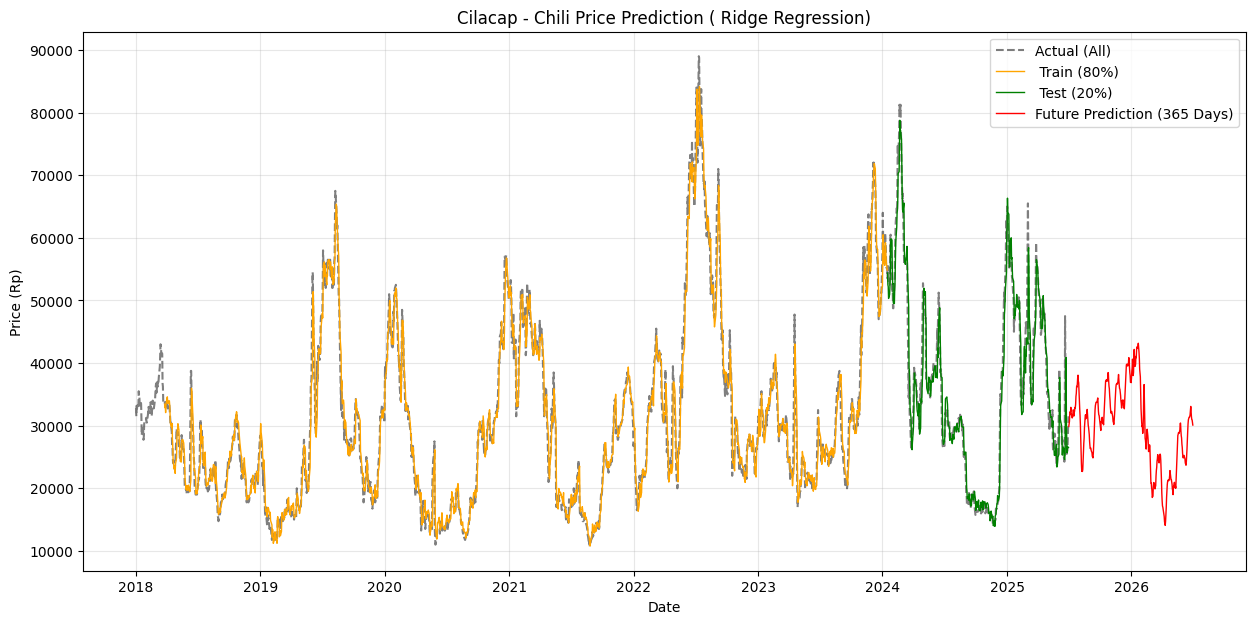
Fluctuations in chili prices as a strategic commodity often pose challenges to food price stability, particularly in Central Java regions such as Banyumas and Cilacap Regencies. This study aims to explore and compare the performance of three classical machine learning algorithms: Ridge Regression, Lasso Regression, and Random Forest Regressor. This study utilizes daily historical data spanning from January 2018 to June 2025 to identify market patterns and trends. Furthermore, this research projects chili prices for the next 365 days. Consistently, Lasso Regression demonstrated the best performance in both regions. The model achieved the highest accuracy in Banyumas Regency Banyumas (MAPE 2,75%) and Cilacap Regency (MAPE 5,08%). However, visual analysis of long-term predictions revealed that Ridge Regression produced a more realistic graph compared to Lasso Regression. Conversely, Random Forest Regressor failed to capture long-term trends as it yielded stable predictions. The prediction results were subsequently visualized in an interactive dashboard based on the Flask framework.
##plugins.themes.academic_pro.article.details##

This work is licensed under a Creative Commons Attribution-NonCommercial 4.0 International License.
References
[2] C. Yustitia and N. Charibaldi, “Chili Price Prediction One Year Ahead Using the Gated Recurrent Unit Method,” Inf. J. Ilm. Bid. Teknol. Inf. dan Komun., vol. 10, no. 1, pp. 1–7, 2024, doi: 10.25139/inform.v10i1.8269.
[3] K. H. Suradiradja, “Algoritme Machine Learning Multi-Layer Perceptron dan Recurrent Neural Network untuk Prediksi Harga Cabai Merah Besar di Kota Tangerang,” vol. 14, no. 4, pp. 194–205, 2021, doi: 10.30998/faktorexacta.v14i4.10376.
[4] A. A. Asriadi et al., “PERAMALAN CABAI BESAR DI KOTA MAKASSAR DENGAN METODE ARIMA,” J. Pemikir. Masy. Ilm. Berwawasan Agribisnis, vol. 9, no. 1, pp. 24–39, 2023.
[5] Fungki Wahyu and Billy Hendrik, “Perbandingan Algoritma Time Series Dan Fuzzy Inference System Dalam Analisis Data Deret Waktu,” J. Penelit. Teknol. Inf. dan Sains, vol. 1, no. 3, pp. 16–24, 2023, doi: 10.54066/jptis.v1i3.711.
[6] K. Maharana et al., “A review: Data pre-processing and data augmentation techniques,” Glob. Transitions Proc., vol. 3, no. 1, pp. 91–99, 2022, doi: 10.1016/j.gltp.2022.04.020.
[7] N. M. Sakti et al., “Water Pollution Forecasting in Cengklik Reservoir Using the Triple Exponential Smoothing Method,” J. E-Komtek, vol. 9, no. 1, pp. 313–324, 2025.
[8] P. P. Allorerung et al., “Analisis Performa Normalisasi Data untuk Klasifikasi K-Nearest Neighbor pada Dataset Penyakit,” vol. 9, no. 3, pp. 178–191, 2024.
[9] Z. Zeng, “Using Linear Regression , Ridge Regression , Lasso Regression , and Elastic Net Regression for Predicting Real Estate Price,” no. Icdse, pp. 509–515, 2025, doi: 10.5220/0013700300004670.
[10] M. P. Rajan, “An Efficient Ridge Regression Algorithm with Parameter Estimation for Data Analysis in Machine Learning,” SN Comput. Sci., vol. 3, no. 2, pp. 1–16, 2022, doi: 10.1007/s42979-022-01051-x.
[11] M. Xu, “Sales Prediction Based on Lasso Regression,” vol. 88, pp. 343–349, 2024.
[12] B. Roger et al., “Information Processing in Agriculture Random forest regressor applied in prediction of percentages of calibers in mango production,” Inf. Process. Agric. J., vol. 12, no. December 2024, pp. 370–383, 2025, doi: 10.1016/j.inpa.2024.12.002.
[13] Y. W. P. Setiawan et al., “Wind Speed Forecast Using the Triple Exponential Smoothing Method in Pangandaran Beach,” J. E-Komtek, vol. 8, no. 2, pp. 583–594, 2024.
[14] Z. Liang et al., “Data Analysis and Visualization Platform Design for Batteries Using Flask-Based Python Web Service,” World Electr. Veh. J., vol. 12, no. 4, 2021, doi: 10.3390/wevj12040187.
[15] M. S. Bonney et al., “Development of a digital twin operational platform using Python Flask,” Data-Centric Eng., vol. 3, no. 1, pp. 1–14, 2022, doi: 10.1017/dce.2022.1.