Implementation of The K-Nearest Neighbors (KNN) Algorithm in The Process of Student Graduation Prediction (Case Study of The Bachelor of Informatics Engineering Program, PLN Institute of Technology, Jakarta)
##plugins.themes.academic_pro.article.sidebar##
Downloads
##plugins.themes.academic_pro.article.main##
Abstract
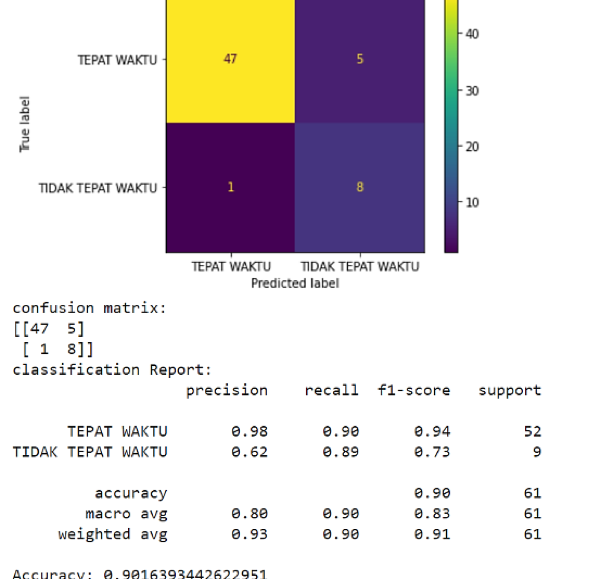
Student graduation is one of the key indicators in a university’s Internal Quality Assurance System (SPMI). Based on data from the Bachelor of Informatics Engineering program, out of 305 students from the 2016 cohort, 227 graduated on time and 78 graduated late. This study aims to predict student graduation using the K-Nearest Neighbors (KNN) algorithm. The research stages include data collection and division for training and testing, parameter determination with K=3, and distance calculation between data points. The results show that the KNN model with parameter K=3 achieved an accuracy rate of 90% in predicting student graduation. This demonstrates that the KNN method is effective in predicting student graduation outcomes.
##plugins.themes.academic_pro.article.details##

This work is licensed under a Creative Commons Attribution-NonCommercial 4.0 International License.
References
[2] A. Wahyudi and F. Wahyu Wibowo, “PREDIKSI KELULUSAN MAHASISWA TEPAT WAKTU MENGGUNAKAN METODE DECISION TREE DAN NAÏVE BAYES PREDICTING ON-TIME GRADUATION OF STUDENTS USING DECISION TREE AND NAÏVE BAYES METHODS,” 2023.
[3] A. Sabathos Mananta and G. Arther Sandag, “Prediksi Kelulusan Mahasiswa Dalam Memilih Program Magister Menggunakan Algoritma K-NN,” vol. 10, no. 2, 2021.
[4] I. Riadi, R. Umar, and R. Anggara, “Prediksi Kelulusan Tepat Waktu Berdasarkan Riwayat Akademik Menggunakan Metode K-Nearest Neighbor,” Jurnal Teknologi Informasi dan Ilmu Komputer, vol. 11, no. 2, pp. 249–256, Apr. 2024, doi: 10.25126/jtiik.20241127330.
[5] A. Fakih, M. A. Hamzami, M. R. Hadianto, and N. I. S. Alifah, “Perbandingan Akurasi Algoritma C4.5 dan K-NN Untuk Prediksi Kelulusan Mahasiswa Penerima Beasiswa,” Jurnal Komputer Antartika, vol. 3, no. 1, pp. 18–25, Jan. 2025, doi: 10.70052/jka.v3i1.623.
[6] I. Ramdhani, “PERBANDINGAN METODE DATA MINING MODEL KLASIFIKASI NAIVE BAYES, DECISSION TREE DAN K-NEAREST NEIGHBOUR DALAM MEMPREDIKSI KETEPATAN KELULUSAN MAHASISWA PRODI TEKNIK INFORMATIKA DI UNIVERSITAS PAMULANG,” |Jurnal Ilmu Komputer JIK, vol. VI, no. 01, 2023.
[7] E. Etriyanti Sistem Informasi, S. Bina Nusantara Jaya Lubuklinggau Jl Yos Sudarso No, K. Lubuklinggau, and S. Selatan, “Perbandingan Tingkat Akurasi Metode KNN Dan Decision Tree Dalam Memprediksi Lama Studi Mahasiswa,” Jurnal Ilmiah Binary STMIK Bina Nusantara Jaya, vol. 03, 2021.
[8] A. Putri, C. Syaficha Hardiana, E. Novfuja, F. Try Puspa Siregar, Y. Fatma, and R. Wahyuni, “Comparison of K-NN, Naive Bayes and SVM Algorithms for Final-Year Student Graduation Prediction Komparasi Algoritma K-NN, Naive Bayes dan SVM untuk Prediksi Kelulusan Mahasiswa Tingkat Akhir,” Institut Riset dan Publikasi Indonesia (IRPI) MALCOM: Indonesian Journal of Machine Learning and Computer Science Journal Homepage, vol. 3, no. 1, pp. 20–26, 2023.
[9] E. Novianto, A. Hermawan, and D. Avianto, “KLASIFIKASI ALGORITMA K-NEAREST NEIGHBOR, NAIVE BAYES, DECISION TREE UNTUK PREDIKSI STATUS KELULUSAN MAHASISWA S1,” Rabit : Jurnal Teknologi dan Sistem Informasi Univrab, vol. 8, no. 2, pp. 146–154, Jul. 2023, doi: 10.36341/rabit.v8i2.3434.
[10] R. H. Hidayatullah, R. Sanjaya, M. J. Alazami, M. Affifudin, R. Samsinar, and T. Elektro, “Perbandingan Algoritma K-Nearest Neighbor dan Random Forest dalam Prediksi Kelulusan Mahasiswa Mahasiswa Universitas Muhammadiyah Jakarta.”