Design and Construction of an RFID and IoT-Based Attendance System to Improve the Efficiency of Employee Attendance Management at the Indonesian Polytechnic of Piksi Ganesha
##plugins.themes.academic_pro.article.sidebar##
Downloads
##plugins.themes.academic_pro.article.main##
Abstract
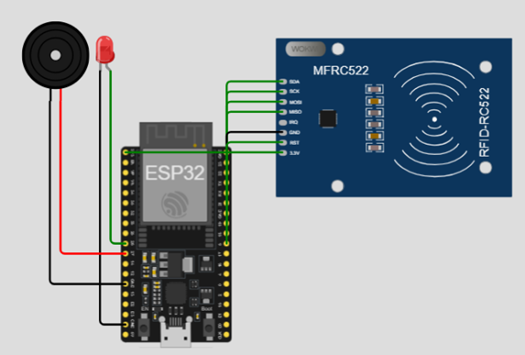
Attendance systems that still rely on manual input require more processing time due to the absence of an automatic identification mechanism, resulting in less efficient attendance recording. This study aims to design and develop an employee attendance system based on Radio Frequency Identification (RFID) and the Internet of Things (IoT) integrated with a web-based application. The research employed the Research and Development (R&D) method using the ADDIE development model. The system was developed using an ESP32 microcontroller, an RFID RC522 Reader, PHP, and MySQL, while IoT technology was utilized to transmit attendance data to the server via the internet. The test results indicate that all system functions operated successfully, including RFID card identification, data transmission, database storage, and attendance information display on the website. Furthermore, the developed system improved attendance processing efficiency by reducing the attendance time from 15–20 seconds to 2–5 seconds. Therefore, the proposed RFID and IoT-based attendance system can serve as an effective and efficient alternative for managing employee attendance.
##plugins.themes.academic_pro.article.details##

This work is licensed under a Creative Commons Attribution-NonCommercial 4.0 International License.
References
[2] Yeni Natalia and Tata Sutabri, “Rancangan Sistem Pemantauan Lingkungan Berbasis IoT untuk Pertanian Padi,” Switch : Jurnal Sains dan Teknologi Informasi, vol. 2, no. 6, pp. 58–67, Nov. 2024, doi: 10.62951/switch.v2i6.282.
[3] I. P. Sari, A. Jannah, A. M. Meuraxa, A. Syahfitri, and R. Omar, “Perancangan Sistem Informasi Penginputan Database Mahasiswa Berbasis Web,” Hello World Jurnal Ilmu Komputer, vol. 1, no. 2, pp. 106–110, Jul. 2022, doi: 10.56211/helloworld.v1i2.57.
[4] N. P. Pardani and B. Yulianti, “Perancangan Sistem Absensi Otomatis Mahasiswa Berbasis RFID Terintegrasi Google Spreadsheet dan Smart Door Lock,” JURNAL TEKNOLOGI INDUSTRI, vol. 15, no. 1, pp. 15–25, Mar. 2026, doi: 10.35968/jti.v15i1.1926.
[5] H. Dhien Chandra, “Sistem Informasi Absensi RFID Berbasis Web Menggunakan ESP32 di PT Dharma Sentosa Marindo,” 2023.
[6] M. A. Hasan, M. Nuzuluddin, and H. M. Putra, “Penerapan RFID (Radio Frequency Identification) pada Sistem Presensi Guru dan Karyawan Berbasis Web,” Jurnal PRINTER: Jurnal Pengembangan Rekayasa Informatika dan Komputer, vol. 1, no. 1, pp. 33–42, Sep. 2023, doi: 10.29408/jprinter.v1i1.6811.
[7] M. Yusuf Widsono and Nuroji, “Perancangan Teknologi Radio Frequency Identification Dalam Sistem Presensi Peserta Didik Berbasis Internet of Things di Sekolah Menegah Pertama Sejahtera 2 Cileungsi,” Arcitech: Journal of Computer Science and Artificial Intelligence, vol. 5, no. 1, pp. 125–147, Jun. 2025, doi: 10.29240/arcitech.v5i1.13968.
[8] M. S. Hossain and G. Muhammad, “Cloud-assisted Industrial Internet of Things (IIoT)–Enabled Framework for Health Monitoring,” Computer Networks, vol. 101, pp. 192–202, 2016, doi: 10.1016/j.comnet.2016.01.009.
[9] Sugiyono, “METODE PENELITIAN KUANTITATIF KUALITATIF DAN R&D,” Edisi Revisi. Bandung: Alfabeta, 2022.
[10] T. S. MI Zuhdi, “Implementasi Sistem Presensi Karyawan Berbasis IoT Dan Website Di PT Tanjung Enim Lestari Dengan Teknologi RFID Dan Kamera,” 2024.
[11] A. A. Yulianto, M. F. Wicaksono, and R. Nugraha, “Design of ESP32-Based Smart Attendance System Using RFID and Web Integration,” International Journal of Electronics and Communication Systems, vol. 4, no. 2, pp. 45–53, 2025.
[12] P. P. Ray, “A Survey on Internet of Things Architectures,” Journal of King Saud University – Computer and Information Sciences, vol. 30, no. 3, pp. 291–319, 2018, doi: 10.1016/j.jksuci.2016.10.003.
[13] A. K. Triwibowo, B. Harjito, and S. Riyadi, “Rancang Bangun Sistem Presensi Mahasiswa Menggunakan RFID dan ESP32 Berbasis Web,” Jurnal RESTI (Rekayasa Sistem dan Teknologi Informasi), vol. 5, no. 4, pp. 755–762, 2021, doi: 10.29207/resti.v5i4.3201.
[14] R. Setiawan and D. Kurniawan, “Implementasi Internet of Things pada Sistem Monitoring dan Presensi Karyawan Berbasis ESP32,” Jurnal Informatika Upgris, vol. 8, no. 2, pp. 101–109, 2022, doi: 10.26877/jiu.v8i2.12045.
[15] S. A. Rizki, M. Iqbal, and A. F. Hidayat, “Design of RFID and IoT-Based Employee Attendance System with Real-Time Web Monitoring,” International Journal of Advanced Computer Science and Applications, vol. 15, no. 1, pp. 233–241, 2024, doi: 10.14569/IJACSA.2024.0150128.