Peningkatan Keterampilan dan Kompetensi Siswa SMK dalam Menghadapi Era Revolusi Industri 4.0 melalui Pelatihan 3D Printing
##plugins.themes.academic_pro.article.sidebar##
Downloads
##plugins.themes.academic_pro.article.main##
Abstract
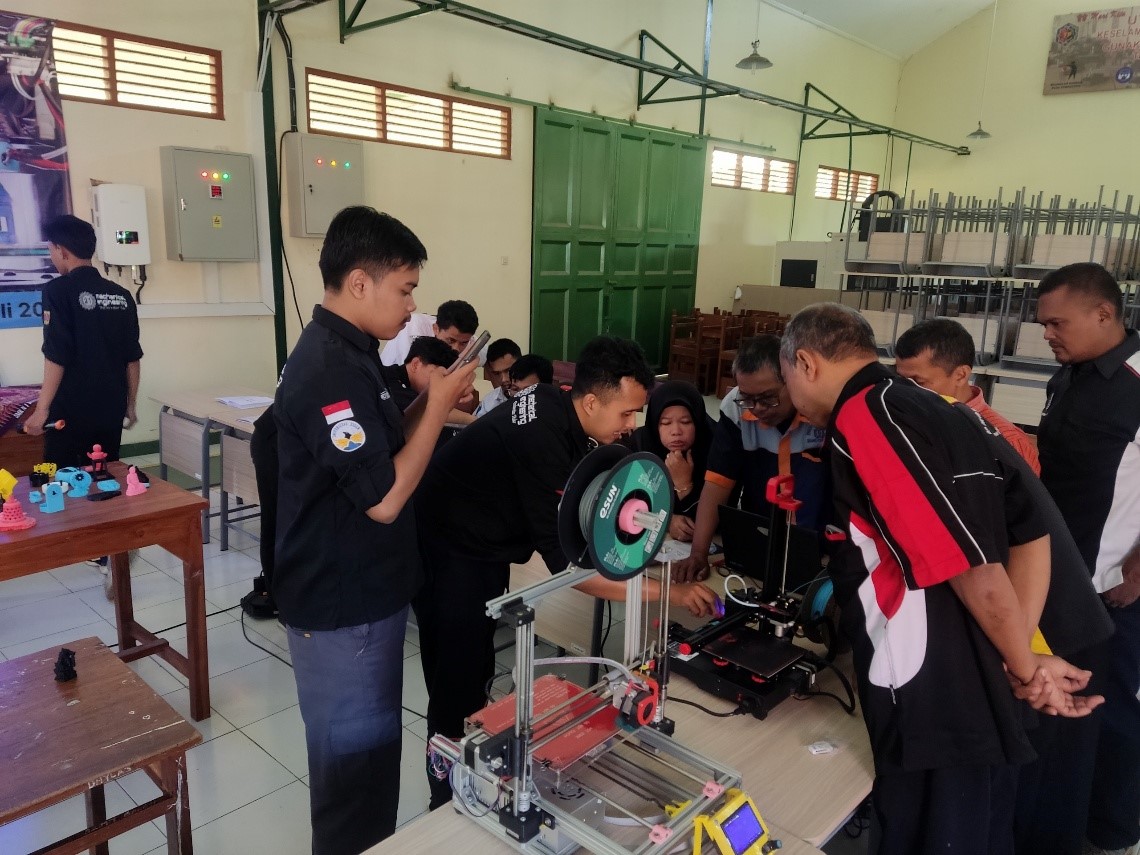
The Industrial Revolution 4.0 requires Vocational High Schools (SMK) to master key technologies such as 3D Printing. SMK Negeri 1 Windusari, the service partner, faces technology gaps, characterized by limited equipment and a lack of practical (hands-on) knowledge regarding FDM 3D Printing. The objective of this service is to enhance the knowledge and understanding of students, teachers, and lab assistants regarding 3D Printing (Additive Manufacturing) as a core pillar of Industry 4.0. The methodology involved integrating knowledge transfer and practical skills (learning by doing) using FDM machines. The service emphasized a participatory and community-driven relevance approach. Evaluation was conducted quantitatively using pre-test and post-test comparisons. Results showed a significant increase in competence, with the participants’ average score rising from 50.67 to 74. This strengthens the competence of the Machining Engineering Department, preparing adaptive graduates in the field of Additive Manufacturing.
##plugins.themes.academic_pro.article.details##

This work is licensed under a Creative Commons Attribution-NonCommercial 4.0 International License.
JURPIKAT (Jurnal Pengabdian Kepada Masyarakat) accepts manuscripts that have not been published elsewhere and are not under consideration for publication by other print or electronic media. Authors retain copyright and grant the journal right of first publication with the work simultaneously licensed under a Creative Commons BY-NC License that allows others to share the work with an acknowledgment of the work's authorship and initial publication in this journal.
Authors are able to enter into separate, additional contractual arrangements for the non-exclusive distribution of the journal's published version of the work (eg, post it to an institutional repository, in a journal or publish it in a book), with an acknowledgment of its initial publication in this journal.
License to Publish
The non-commercial use of the article will be governed by the Attribution-NonCommercial 4.0 International (CC BY-NC 4.0). The author hereby grants JURPIKAT (Jurnal Pengabdian Kepada Masyarakat) an exclusive publishing and distribution license in the manuscript include tables, illustrations or other material submitted for publication as part of the manuscript (the “Articleâ€) in print, electronic and all other media (whether now known or later developed), in any form, in all languages, throughout the world, for the full term of copyright, and the right to license others to do the same, effective when the article is accepted for publication. This license includes the right to enforce the rights granted hereunder against third parties.
References
ASTM International. (2016). Standard Terminology for Additive Manufacturing – General Principles – Terminology.
Butt, J. (2020). Exploring the Interrelationship between Additive Manufacturing and Industry 4.0. Designs, 4(2), 13. https://doi.org/10.3390/designs4020013
Dipta, S. D., Rahman, Md. M., Ansari, Md. J., & Uddin, Md. N. (2025). A Comprehensive Review of Sustainable and Green Additive Manufacturing: Technologies, Practices, and Future Directions. Journal of Manufacturing and Materials Processing, 9(8), 269. https://doi.org/10.3390/jmmp9080269
Fuad Hilmy, Endang Mawarsih, & Firmansyah, R. (2025). Pelatihan Proses Slicing Untuk Menentukan Parameter Optimal Dalam Proses 3D Printing (Additive Manufacturing). JURPIKAT (Jurnal Pengabdian Kepada Masyarakat), 6(2), 1059–1067. https://doi.org/10.37339/jurpikat.v6i2.2271
Godec, D., Gonzalez-Gutierrez, J., Nordin, A., Pei, E., & Ureña Alcázar, J. (Eds). (2022). A Guide to Additive Manufacturing. Springer International Publishing. https://doi.org/10.1007/978-3-031-05863-9
Mahdi Hamad, B., & K. Jawad, M. (2024). The Fourth Industrial Revolution: A Historical and Conceptual Review. Journal of Economics and Administrative Sciences, 30(141), 154–172. https://doi.org/10.33095/gh3a7g38
Mohamed, O. A., Masood, S. H., & Bhowmik, J. L. (2015). Optimization of fused deposition modeling process parameters: A review of current research and future prospects. Advances in Manufacturing, 3(1), 42–53. https://doi.org/10.1007/s40436-014-0097-7
Olivia, S., Anshar, K., Muliana, E., Faliza, N., & Novianti, Y. (2024). Pengenalan Teknologi 3D Print Sebagai Pendukung Wirausaha Bagi Siswa SMK Kota Lhokseumawe.
Ortiz, J. H. (2020). Industry 4.0 Current Status and Future Trends. IntechOpen.
Sandanamsamy, L., Harun, W. S. W., Ishak, I., Romlay, F. R. M., Kadirgama, K., Ramasamy, D., Idris, S. R. A., & Tsumori, F. (2023). A comprehensive review on fused deposition modelling of polylactic acid. Progress in Additive Manufacturing, 8(5), 775–799. https://doi.org/10.1007/s40964-022-00356-w
Suwendi, S., Basir, Abd., & Wahyudi, J. (2022). Metodologi Pengabdian Masyarakat. Direktorat Pendidikan Tinggi Keagamaan Islam, Direktorat Jenderal Pendidikan Islam, Kementerian Agama RI.
Taufik, I., Budiono, H. S., Herianto, H., & Andriyansyah, D. (2020). Pengaruh Printing Speed terhadap Tingkat Kekasaran Permukaan Hasil Additive Manufacturing dengan Polylactic Acid Filament. Journal of Mechanical Engineering, 4(2). https://doi.org/10.31002/jom.v4i2.3412
Taufik, I., Herianto, H., & Herliansyah, M. K. (2017). Monitoring dan Analisis Mesin 3D Printing Berbasis Sensor Getaran untuk Mengoptimalkan Kualitas Hasil. 1, 1–9.
Tientcheu, S. W. T., Djouda, J. M., Bouaziz, M. A., & Lacazedieu, E. (2024). A review on fused deposition modeling materials with analysis of key process parameters influence on mechanical properties. The International Journal of Advanced Manufacturing Technology, 130(5–6), 2119–2158. https://doi.org/10.1007/s00170-023-12823-x
Zhou, L., Miller, J., Vezza, J., Mayster, M., Raffay, M., Justice, Q., Al Tamimi, Z., Hansotte, G., Sunkara, L. D., & Bernat, J. (2024). Additive Manufacturing: A Comprehensive Review. Sensors, 24(9), 2668. https://doi.org/10.3390/s24092668